
Las razones de la presencia de marcas de herramientas de mecanizado CNC
Tabla de Contenido
A menudo encontramos el fenómeno de las marcas de herramientas de mecanizado CNC cuando utilizamos centros de mecanizado para procesar productos. ¿Cuáles son las razones para esto? La siguiente es un resumen de las causas y soluciones comunes para las marcas de herramientas en el mecanizado CNC, combinado con el análisis de múltiples factores como máquinas herramienta, herramientas de corte y materiales:
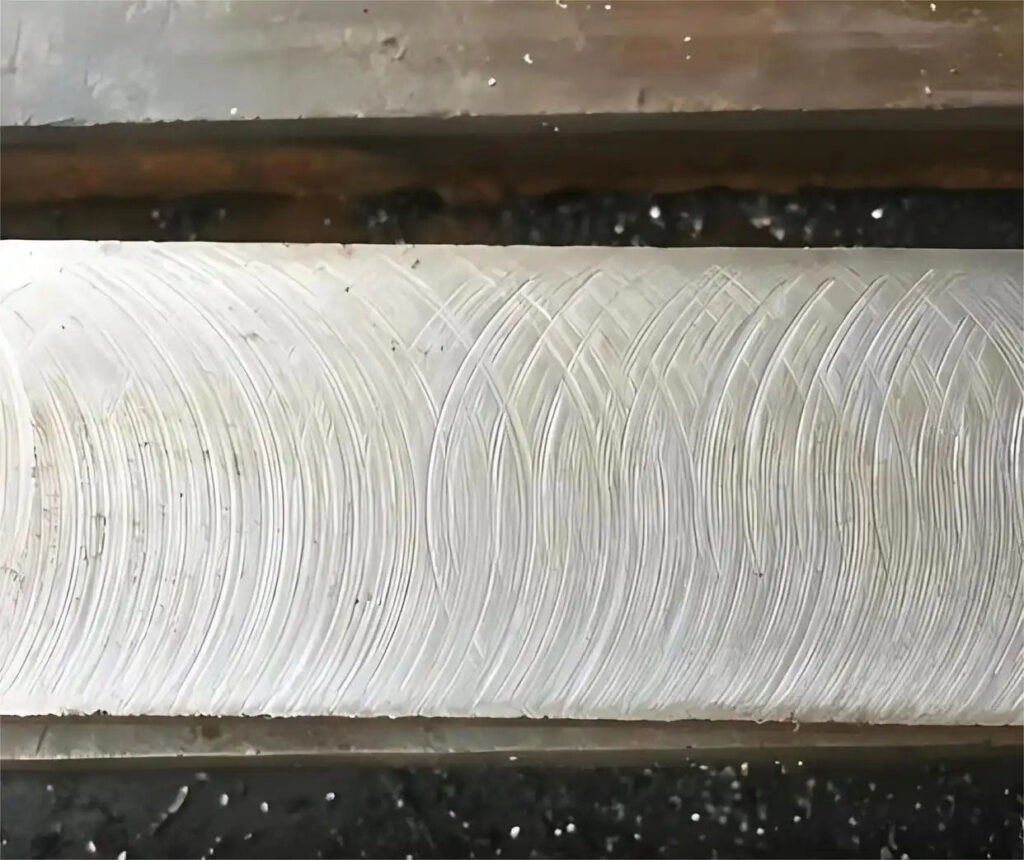
¿Qué son las marcas de herramientas de mecanizado CNC?
Las marcas de herramientas de mecanizado CNC se refieren a la textura en la superficie de corte de la herramienta generada durante el proceso de mecanizado. Según la dirección de corte, la forma de la herramienta y el material de la herramienta, los patrones de la herramienta se pueden dividir en patrones longitudinales, transversales, oblicuos, curvos e intersecantes.
Factores relacionados con la herramienta para las marcas de herramientas de mecanizado CNC
1. Desgaste de la herramienta
La pasivación o el astillado del filo de corte puede provocar un aumento en la fuerza de corte, lo que hace que la superficie de la pieza de trabajo se apriete y forme patrones de corte en espiral u ondulados.
Solución: Compruebe periódicamente el desgaste de las herramientas de corte y reemplace las herramientas pasivadas de manera oportuna; Elija herramientas recubiertas resistentes al desgaste (como el recubrimiento de TiAlN) para mejorar su vida útil.
2. Parámetros geométricos incorrectos de las herramientas de corte
Un ángulo frontal demasiado pequeño (15 °) pueden intensificar la fricción de corte y causar rayones en la superficie.
Sugerencia de optimización: Ajuste los parámetros geométricos según el material (como el ángulo frontal recomendado de 15 ° -25 ° y el ángulo posterior de 8 ° -12 ° para el procesamiento de aluminio).
3. Problemas de instalación de la herramienta
La excentricidad o inclinación de la herramienta puede cambiar el ángulo de corte real, por ejemplo, si la altura de instalación de la herramienta de corte se desvía del centro de la pieza de trabajo en 0,1 mm, puede causar patrones en espiral.
Medidas de control: Utilice un preajustador de herramientas para calibrar la coaxialidad de la herramienta (error ≤ 0,005 mm).
Cutting Parameters And Process Issues For CNC Machining Tool Marks
1. The feed rate does not match the rotational speed
Excessive feed rate (such as>0.15mm/tooth when milling aluminum parts) will form obvious tooth marks; Excessive rotation speed (such as aluminum parts>8000rpm) can easily cause vibration knife marks. ·
Optimization formula: Recommended line speed for aluminum parts is 200-300m/min, with a feed rate of 0.05-0.1mm/tooth.
2. Unreasonable cutting depth
Rough machining with a cutting depth exceeding 50% of the tool diameter will significantly increase cutting force and cause tool vibration. ·
Layered strategy: using small cutting depth and multiple cutting times (such as 0.2mm/layer) combined with high-speed milling.
Machine Tool and Clamping Issues For CNC Machining Tool Marks
1. Influence of material properties
Resilient materials (such as copper alloys) are prone to the formation of chip deposits, leading to surface tearing like knife marks; Uneven hardness materials (such as castings) have large fluctuations in cutting force.
Response measures: When processing copper parts, add extreme pressure cutting fluid to reduce cutting speed by 10% -20%.
2. Insufficient cooling and lubrication
Low cutting fluid concentration (<5%) or insufficient flow rate (<10L/min) will intensify friction and form high-temperature oxidation grooves. ·
Parameter suggestion: For aluminum alloy processing, it is recommended to use emulsion with a concentration of 8% -12% and a pressure of ≥ 1MPa.
Materials and Cooling Factors For CNC Machining Tool Marks
1. Machine tool vibration
Radial runout of the spindle (>0.01mm) or wear of the guide rail can cause periodic ripples. ·
Testing method: Use a micrometer to check the spindle runout. If it exceeds 0.005mm, the bearing needs to be repaired.
2. Unstable workpiece clamping
Uneven clamping force of thin-walled parts (such as a pressure difference of more than 10N between three jaw chucks) can cause deformation, and stress release after processing can result in tool lines. ·
Improvement plan: Adopt hydraulic fixtures or soft claws for uniform clamping, with clamping force controlled at 20% -30% of the material yield strength.
Comprehensive Optimization Suggestions For CNC Machining Tool Marks
1. Process parameter adjustment:
Adopting high-speed (increasing line speed by 20%) and small feed (reducing by 30%) strategies to reduce cutting force fluctuations.
2. Equipment maintenance:
Check the clearance between the spindle bearings every 500 hours, and control the straightness error of the guide rail within 0.01mm/m.
3. Tool optimization:
When machining steel parts with hard alloy tools, increasing the rake angle by 5 ° can reduce cutting force by 15% -20%.
Typical case: A 0.1mm spacing ripple appeared on the machined surface of an aluminum component, which was detected to be caused by tool eccentricity of 0.08mm. After adjusting the installation coaxiality, the surface roughness improved from Ra3.2 μ m to Ra0.8 μ m.
Conclusión
The above are some reasons for the occurrence of tool lines during the machining process of machining centers. The specific reasons need to be systematically investigated through factors such as cutting tools, parameters, equipment, materials, etc., in order to eliminate the problem of tool lines in a targeted manner. Specific measures need to be verified through processing scenario experiments.
Comentarios
Últimas Entradas
Blogs Relacionados
Senyo del blog se centra en compartir nuestro amplio conocimiento de la fabricación de prototipos. A través de nuestros artículos, nuestro objetivo es apoyar a usted en refinar el diseño del producto y navegar por las complejidades de la creación rápida de prototipos de forma más efectiva.


El Poder de la creación Rápida de Prototipos y herramientas de Proceso
diciembre 29, 2025
Leer Más "
Moldeo por inyección de bajo volumen: Guía de piezas en lotes pequeños
15 de noviembre de 2024
Leer Más "