Guss vs. Edelstahl: Definitive Manufacturing Guide
Inhaltsverzeichnis
Im dem weiten Feld der industriellen Fertigung ist die Materialauswahl eine grundlegende technische Entscheidung. Die Wahl des Metalls wirkt sich direkt auf die Festigkeit, Haltbarkeit, Kosten und Leistung eines Produkts aus. Unter den gebräuchlichsten Eisenmetallen sind Gusseisen und Stahl grundlegende Werkstoffe. Hersteller wie Senyorapid verwenden diese Metalle häufig aufgrund ihrer außergewöhnlichen Eigenschaften. Beide bieten eine beeindruckende Festigkeit und die Fähigkeit, über längere Zeiträume zuverlässig zu funktionieren.
Es gibt jedoch einen entscheidenden Unterschied. Obwohl Gusseisen und Stahl optisch ähnlich erscheinen mögen, unterscheiden sich ihre zugrunde liegende Metallurgie und ihre Leistungsmerkmale grundlegend. Die Hauptdebatte von Gusseisen vs. Stahl dreht sich um diese Unterschiede. Jedes Material besitzt einzigartige Eigenschaften, die je nach spezifischer Anwendung unterschiedliche Vor- und Nachteile mit sich bringen. Ist Stahl stärker als Eisen? Was eignet sich besser zum Gießen komplexer Formen? Dieser Leitfaden bietet einen wissenschaftlichen und technologischen Deep Dive, um diese Fragen zu beantworten. Wir werden ihre Eigenschaften analysieren, ihre Leistung vergleichen und Ihnen eine klare Anleitung geben, damit Sie die optimale Materialauswahl für Ihre Fertigungsprojekte treffen können.
Was ist Gusseisen? Eine metallurgische Perspektive
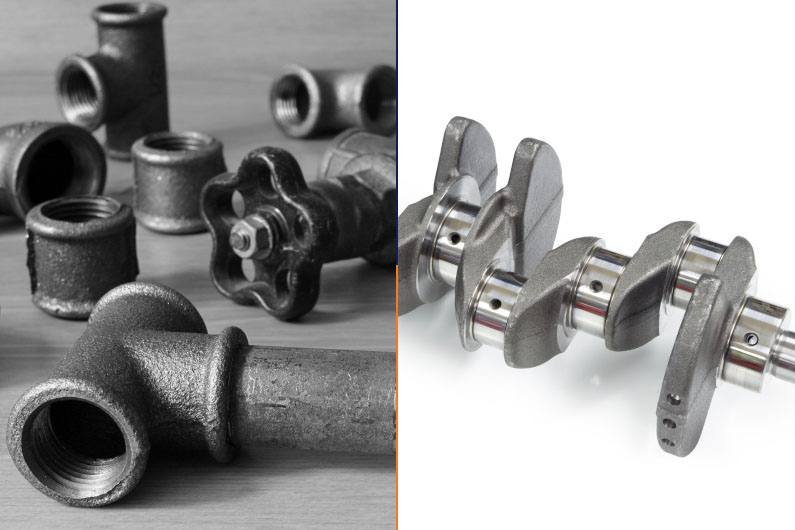
Gusseisen ist eine Eisenlegierung, die sich durch einen hohen Kohlenstoffgehalt auszeichnet. Es wird durch Schmelzen von Eisen-Kohlenstoff-Legierungen in einem Ofen hergestellt. Das definierende Merkmal ist ein Kohlenstoffanteil, der typischerweise zwischen 2% und 4% liegt. Dieser Kohlenstoffgehalt übersteigt die Menge, die sich vollständig in der Eisenmatrix lösen kann. Infolgedessen fällt der überschüssige Kohlenstoff während der Abkühlung aus, üblicherweise in Form von Graphit oder Eisenkarbid (Zementit).
Der Herstellungsprozess ist unkompliziert. Nach dem Schmelzen wird das geschmolzene Metall direkt in eine Form gegossen, um sich in die gewünschte Form zu verfestigen. Dies steht im Gegensatz zu Schmiedeeisen oder Stahl, das oft mit Hämmern bearbeitet oder im heißen Zustand gewalzt wird.
Zusätzlich zu Kohlenstoff enthält Gusseisen 1% bis 3% Silizium. Dieses Element ist entscheidend, da es die Bildung von Graphit anstelle von Eisenkarbid fördert, was die Gießleistung und Bearbeitbarkeit des Materials erheblich verbessert. Spuren von Mangan sind ebenfalls vorhanden, zusammen mit Verunreinigungen wie Schwefel und Phosphor. Das Zusammenspiel dieser Elemente verleiht Gusseisen seine besonderen mechanischen Eigenschaften, darunter hohe Härte, ausgezeichnete Druckfestigkeit und bemerkenswerte Sprödigkeit.
Die spezifischen Eigenschaften von Gusseisen können durch Wärmebehandlung und Legierungszusammensetzung beeinflusst werden, was zu verschiedenen Arten führt:
- Grauguss: Die häufigste Art. Sein Kohlenstoff liegt als Graphitflocken vor. Diese Flocken verleihen ihm eine ausgezeichnete Bearbeitbarkeit und Schwingungsdämpfung, machen ihn aber auch spröde.
- Weißes Gusseisen: Der Kohlenstoff bildet Eisenkarbid (Zementit) anstelle von Graphit. Dadurch ist es extrem hart und abriebfest, aber auch unbearbeitbar und sehr spröde.
- Temperguss: Wird durch Wärmebehandlung von weißem Gusseisen hergestellt. Dieser Prozess wandelt das Eisenkarbid in unregelmäßige Graphitknötchen um, wodurch das Material im Vergleich zu Grauguss eine verbesserte Duktilität und Zähigkeit erhält.
- Ductile Iron: Silicon and other elements (like magnesium) are added to the melt. This forces the graphite to form spherical nodules instead of flakes. These spheres inhibit crack propagation, giving ductile iron superior strength, ductility, and impact resistance, approaching that of steel.
- Compacted Graphite Iron: A hybrid between gray and ductile iron. Its graphite particles are interconnected and worm-like. It offers a combination of good thermal conductivity, strength, and damping properties.
What is Steel? An Engineering Overview
Steel is also an alloy of iron and carbon, but its defining feature is a significantly lower carbon content. Steel contains less than 2% carbon, with most grades having between 0.15% and 1.5%. This lower concentration allows the carbon to be fully dissolved within the iron’s crystalline structure when heated, forming a single, strong solid solution. This fundamental difference in carbon management gives steel its characteristic high tensile strength and ductility, improving its resistance to fracture.
Steel can also incorporate a wide range of other alloying elements. These elements are added to enhance specific properties. For instance, stainless steel contains a minimum of 11% chromium, which forms a passive oxide layer on the surface, providing exceptional resistance to corrosion and oxidation. Other common alloying elements include manganese, silicon, nickel, and molybdenum, each contributing unique qualities.
The high tensile strength of steel makes it an indispensable material across countless industries. We use steel to produce everything from structural beams for infrastructure and high-performance automotive components to precision tools, weapons, and vehicles. Its versatility is a key reason it is a preferred material for processes like CNC-Bearbeitung Und sheet metal fabrication.
Like cast iron, steel is categorized into several main types based on composition:
- Carbon Stahl: The most widely used type, where carbon is the primary alloying element. It is classified into low, medium, and high carbon grades, with strength and ductility varying accordingly.
- Alloy Steel: Contains specific amounts of alloying elements like manganese, nickel, chromium, and molybdenum to improve properties like hardenability, strength, and wear resistance.
- Rostfreier Stahl: Characterized by its high chromium content, which provides superior corrosion resistance. It is essential for medical, food-grade, and marine applications.
- Werkzeugstahl: Contains hard elements like tungsten and vanadium. It is exceptionally hard and heat-resistant, making it ideal for cutting tools, dies, and molds, including those used in rapid injection molding.
Cast Iron vs. Steel: A Head-to-Head Technical Comparison
While both materials originate from iron ore, their distinct compositions lead to a stark contrast in performance. The Gusseisen vs. Stahl debate is best understood by examining their properties side-by-side.
| Eigentum | Cast Iron | Stahl | Technical Explanation |
|---|---|---|---|
| Carbon Content | 2% – 4% | < 2% (typically 0.1% – 1.5%) | This is the fundamental differentiator that governs all other properties. |
| Melting Point | Lower (~1200°C / 2200°F) | Higher (~1370-1540°C / 2500-2800°F) | The higher carbon content in cast iron acts as a flux, lowering its melting temperature. |
| Strength Profile | High Compressive Strength | High Tensile Strength | Cast iron’s graphite structure resists compression well but fails easily under tension. Steel’s crystalline structure resists being pulled apart. |
| Castability | Ausgezeichnete | Fair to Poor | Cast iron’s lower melting point and fluidity make it easy to fill intricate molds with low shrinkage. Steel is viscous and shrinks more upon cooling. |
| Korrosion Widerstand | Gut | Poor (except for Stainless/Weathering) | The high silicon content in cast iron provides a degree of inherent corrosion resistance. Standard steel rusts easily. |
| Impact Resistance | Low to Moderate (Poor for Gray Iron) | Hoch | Cast iron is brittle and will fracture under sudden impact. Steel is tough and will deform or bend before breaking. |
| Vibration Damping | Ausgezeichnete | Arm | The graphite flakes in gray cast iron absorb and dissipate vibrational energy effectively, making it quiet. |
| Schweißeignung | Difficult | Ausgezeichnete | The high carbon content in cast iron makes it prone to cracking during welding. Most steels are easily welded. |
| Kosten | Unter | Höher | Cast iron production requires less energy and labor. Steel refining and alloying are more expensive processes. |
Deep Dive: Key Differentiators
Strength: Compressive vs. Tensile
This is the most critical mechanical difference in the Gusseisen vs. Stahl comparison.
- Cast Iron excels in compressive strength. It can withstand immense crushing forces without deforming. This makes it ideal for machine bases, engine blocks, and support columns.
- Stahl excels in Zugfestigkeit. It resists being pulled apart. This property, combined with its ductility, allows it to bend and stretch under load without failing. This is why steel is used for structural beams, cables, and automotive frames.
Melting Point and Castability
Cast iron is significantly easier to cast than steel. Its lower melting point (around 1200°C) requires less energy to melt. More importantly, molten cast iron is highly fluid, allowing it to flow into and fill complex and detailed molds with precision. It also exhibits less shrinkage as it cools. In contrast, steel’s higher melting point (1370°C+) and greater viscosity make it more challenging to cast. It is also more reactive with molding materials and shrinks considerably, requiring more complex mold designs and feeding systems.
Choosing the Right Material: Application-Driven Decisions
The decision between Gusseisen vs. Stahl is not about which is “better,” but which is “right” for the job. Your choice should be dictated by the specific functional requirements of the component.
When to Choose Cast Iron:
- Komplexe Geometrien: If your part has an intricate shape that is difficult or expensive to machine, cast iron’s superior castability makes it the ideal choice.
- Vibration Damping is Critical: For machine bases, engine blocks, and heavy machinery frames, gray cast iron’s ability to absorb vibrations is a major advantage. It leads to quieter and more stable operation.
- High Compressive Loads: For applications that involve primarily crushing forces, cast iron offers excellent performance at a lower cost than steel.
- Cost is a Primary Driver: Cast iron is generally cheaper than steel due to lower material, energy, and labor costs.
When to Choose Steel:
- High Tensile Strength is Required: For any structural application where parts are under tension, such as beams, bolts, or pressure vessels, steel is the only safe choice.
- Impact Resistance is Necessary: If a component will be subjected to sudden shocks or impacts, steel’s toughness and ability to deform without fracturing are essential. Think of automotive bumpers or construction equipment.
- Welding and Fabrication are Needed: When building complex assemblies that require welding multiple components together, steel’s excellent weldability makes it far superior to cast iron.
- Flexibility and Ductility are Key: For parts that need to bend or flex without breaking, such as springs or car body panels, steel’s ductility is a non-negotiable property.
| Decision Factor | Choose Cast Iron | Choose Steel |
|---|---|---|
| Primary Load Type | Compression | Tension, Bending, Shear |
| Ein Teil Der Komplexität | High (Intricate Castings) | Low to Medium (Machined, Stamped, Welded) |
| Impact Environment | Niedrig | Hoch |
| Need for Vibration Damping | Hoch | Niedrig |
| Joining Method | Bolting / Mechanical Fastening | Welding, Bolting |
| Budget Constraint | High (Cost-sensitive) | Low (Performance is key) |
Fazit
Der Gusseisen vs. Stahl debate is a fundamental topic in materials science and manufacturing. While both are iron-based alloys, their differences, driven primarily by carbon content, are profound. Cast iron offers superb castability, high compressive strength, and excellent vibration damping at a lower cost, making it ideal for complex, rigid structures. Steel provides superior tensile strength, toughness, ductility, and weldability, establishing it as the premier material for structural, high-impact, and fabricated applications.
There is no universal winner. The optimal choice depends entirely on a thorough analysis of your product’s design requirements, operating environment, and budget. For prototyping and production, partnering with an experienced manufacturer like Senyorapid is crucial. With expertise in a wide range of metal fabrication services, from die casting to CNC-Präzisionsbearbeitung, we can provide the guidance and manufacturing capabilities needed to turn your design into a high-performance final part, using the material best suited for the task.
Kommentare
Neueste Beiträge
Verwandte Blogs
Der Blog von Senyo konzentriert sich darauf, unser umfassendes Wissen über die Prototypenfertigung zu teilen. Mit unseren Artikeln möchten wir Sie dabei unterstützen, Ihr Produktdesign zu optimieren und die Komplexität des Rapid Prototyping effektiver zu bewältigen.