CNC Metal Cutting: Revolutioniert Metal Fabrication
Inhaltsverzeichnis
Fazit
CNC-Metallbearbeitung hat sich zu einer bahnbrechenden Technologie in der Welt der Metallherstellung. Dieses fortschrittliche Verfahren nutzt die CNC-Maschinen um hohe Präzision und Effizienz beim Schneiden verschiedener Metallarten zu erreichen. Ganz gleich, ob Sie ein Hobbyist oder ein Profi in der Fertigungsbranche sind, ein Verständnis der CNC-Metallzerspanung kann Ihre Produktionsmöglichkeiten und die Qualität Ihrer Arbeit verbessern. Dieser lesenswerte Artikel befasst sich mit den Feinheiten der CNC-Metallzerspanung und bietet wertvolle Einblicke und praktische Tipps für alle, die sich für die Metallbearbeitung interessieren.
- CNC-Metallbearbeitung revolutioniert die Metallverarbeitungsindustrie mit seiner Präzision und Effizienz.
- Verstehen der Komponenten und Funktionen eines CNC-Maschine ist entscheidend für einen erfolgreichen Betrieb.
- Regelmäßige Wartung und Sicherheitsmaßnahmen sind für eine optimale Leistung und Sicherheit unerlässlich.
- Bei der Auswahl der richtigen CNC-Maschine müssen Materialarten, Zerspanungsleistung und Budget berücksichtigt werden.
Wenn Sie die CNC-Metallzerspanung verstehen, können Sie ihre Fähigkeiten nutzen, um Ihre Metallbearbeitungsprojekte zu verbessern, die Produktion zu rationalisieren und die Gesamtqualität zu steigern.

Was ist CNC-Metallbearbeitung und wie funktioniert sie?
CNC metal cutting is a method that involves the use of a CNC machine to make accurate metal parts. Unlike manual machining, where operators use machines with levers and dials, CNC machines are automated and controlled by computer software. The movements of the machine are dictated by a G-code that specifies the machine’s route, speed, and tool to be used for cutting the metal.
How CNC Metal Cutting Is Done:
- Teil Design: Initially, a digital design of the part is made with the help of CAD (Computer-Aided Design) software.
- Creating G-code: The CAD file is changed into G-code, which tells the machine how to do the cutting.
- Machine Operation: The CNC machine reads the code and makes the design by doing operations like drilling, milling, turning, or routing, as indicated by the design.
Such a method leads to very accurate cuts, which is a reduction of human errors, and also the process can be repeated for large production runs.
Was sind die Vorteile der CNC-Metallzerspanung gegenüber herkömmlichen Verfahren?
CNC metal cutting is a whole new level of metal cutting and brings with it a lot of benefits as compared to the traditional ones by means of manual milling, lathe turning, or laser cutting. The most significant ones are increased precision, shortened production times, and handling complex shapes.
Main Benefits:
- Präzision und Genauigkeit: CNC machines are capable of cutting metal with very close tolerances and hence they are able to produce high-quality, error-free results. This is very important in industries like aerospace, automotive, and medical devices.
- Konsistenz: CNC machines, after being programmed, are able to perform the same cut over and over again with absolute consistency, thus ideal for mass production.
- Less Labor Costs: CNC cutting automatizes the process thus less labor is needed, which in turn gives the chance to manufacturers to lower labor costs and increase productivity.
The Possibility of Cutting Complex Designs: CNC machines are able to generate detailed patterns and cuts which would be very difficult or even impossible for traditional methods.
Such advantages make CNC metal cutting a revolutionary tool in a high-efficiency and precision-demanding industrial sector.
Wie schneidet eine CNC-Maschine Metall?
A CNC metal cutting machine changes its metal parts by means of what it calls cutting tools which may be drills, mills, lasers, or plasma cutters. The cutting action is decided by the kind of machine and the material that is being cut. Usually, the metal is set up in a way that is stable, and the cutting tool is moved along different axes to take off the metal.
Schritte bei der CNC-Metallzerspanung:
- Material Setup: The metal sheet is properly fixed on the machine bed of the CNC machine.
- Tool Selection: One tool is chosen depending on the type of the cut to be made (e.g., milling cutter, laser, or water jet).
- Cutting Process: The device carries out the metal cutting operation precisely by following the G-code, it takes off the metal in layers until the final shape is achieved.
The procedure is what allows the cuts to be very accurate and also fast, thus parts will always be able to meet the design specifications.
Was sind die verschiedenen Arten von CNC-Maschinen für die Metallbearbeitung?
Various CNC machines are there for metal cutting, with each one being suitable for differently. Knowing these machines and their capabilities becomes an essential part of decision-making about which one to use for your project.
Major Kinds of CNC Machines:
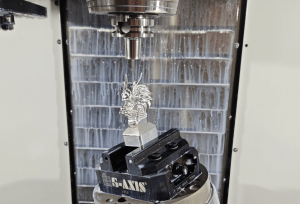
- CNC Milling Machines: These machines are capable of cutting a workpiece by the sheer use of their rotary cutters. They can have multiple operations axes (usually 3 to 5), thus enabling them to do complex 3-dimensional cutting.
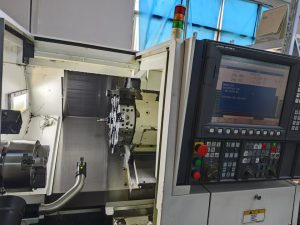
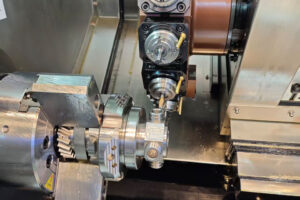
- CNC Lathes: Turning operations, where metal gets the rotation and the cutting tool is applied to its surface, is the core work of these machines. CNC lathes are the ones used for making parts such as shafts and cylinders.
- CNC Plasma Cutters: The precision of the cut made by plasma ions in CNC plasma cutting is highly accurate. The process is used generally for the cutting of steel, aluminum, and other metals with thicknesses up to several inches.
- CNC Water Jet Cutters: The devices are powered by water that is being pressurized and mixed with abrasive materials to cut through metal. Water jet cutting is a method used for application of materials not resistant to the high heat of plasma or laser cutting.
- CNC Laser Cutters: CNC laser cutting utilizes a laser beam that is focused on the workpiece causing it to either melt, burn or vaporize. The process is the most accurate one when dealing with the cutting of thin or medium metal.
One single kind of machine cannot be chosen if the specific area of cutting is a project as different as each machine will have unique advantages depending on the criteria.
Wie wählt man die beste CNC-Metallbearbeitungsmaschine aus?
Bei der Auswahl der richtigen CNC-Metallbearbeitungsmaschine sind mehrere Faktoren zu berücksichtigen:
- Art des Metalls: Vergewissern Sie sich, dass die Maschine in der Lage ist, das spezifische Metall zu schneiden, das Sie bearbeiten wollen.
- Schneidekapazität: Prüfen Sie, ob die Maschine in Bezug auf Schnittgröße und -dicke Ihren Projektanforderungen entspricht.
- Software-Kompatibilität: Prüfen Sie, ob die CNC-Maschine mit Ihrer Konstruktionssoftware kompatibel ist, um einen reibungslosen Betrieb zu gewährleisten.
- Haushalt: Bestimmen Sie Ihr Budget und finden Sie eine Maschine, die Ihren Anforderungen entspricht, ohne dass Sie Kompromisse bei der Qualität eingehen müssen.
Was ist die beste CNC-Metallbearbeitungsmaschine für kleine Unternehmen?
If small businesses are willing to enter metalworking, picking the right CNC metal cutting machine is a must. CNC routers, milling machines, and plasma cutters can all be used, depending on what you require.
Beste Optionen für kleine Unternehmen:
- CNC Routers: Are the best choice for small-scale production and can also be used to manufacture custom parts, mainly for metals that are easy to work with such as aluminum and brass.
- CNC Milling Machines: Are perfect for making precision cuts in small volumes, mostly when dealing with complex parts.
- CNC Plasma Cutters: Are the most efficient in cutting thicker materials quickly and thus are the most widely used in the steel industry.
The one that is best for your company is the machine that fulfills your needs the most. What kinds of materials will you use? How thick are they? How accurate do the cuts need to be? What is your budget?
Wie wählt man die beste CNC-Metallbearbeitungsmaschine aus?
Choosing an appropriate CNC metal cutting machine depends on what kind of metal you are working with. You have to make sure that the machine is capable of cutting that particular metal.
- Cutting capacity: The cutting size and the thickness of the project should be evaluated by the machine to meet your requirements.
- Software compatibility: CNC machines should be checked for compatibility with the software used for designing in order to have a smooth operation.
- Haushalt: Setting a budget will help you to look for a machine that will satisfy your requirements, and at the same time, be of good quality.
Welche Materialien können mit einer CNC-Metallbearbeitungsmaschine bearbeitet werden?
Mit CNC-Maschinen kann eine Vielzahl von Metallen geschnitten werden. Einige der am häufigsten geschnittenen Metalle sind:
Materialien, die geschnitten werden können:
- Stahl: Einschließlich Kohlenstoffstahl, rostfreier Stahl und Werkzeugstahl. Stahl ist aufgrund seiner Festigkeit und Vielseitigkeit eines der am häufigsten verwendeten Materialien für die CNC-Zerspanung.
- Aluminium: Aluminium ist leicht und haltbar und wird häufig in der Luft- und Raumfahrt, in der Automobilindustrie und in der Fertigung eingesetzt.
- Kupfer und Messing: Wird für elektrische Komponenten, Sanitäranlagen und künstlerische Gestaltungen verwendet.
- Titan: Titan ist für sein Verhältnis von Festigkeit zu Gewicht bekannt und wird in der Luft- und Raumfahrt sowie in medizinischen Geräten verwendet.
- Legierungen: Viele Legierungen, wie z.B. Bronze oder Nickelkönnen auch mit CNC-Maschinen bearbeitet werden.
Die Härte und Dicke des Materials beeinflussen die Wahl des Schneidwerkzeugs und des Maschinentyps.
Wie wirkt sich die CNC-Zerspanung auf Effizienz und Präzision in der Metallbearbeitung aus?
Die CNC-Metallzerspanung hat die metallverarbeitende Industrie revolutioniert, da sie mehrere wichtige Vorteile bietet, die sowohl die Effizienz Und Präzision.
Auswirkungen auf die Effizienz:
- Schnellere Produktionszeiten: CNC-Maschinen können Metall schneller schneiden als manuelle Verfahren, was die Produktionsvorlaufzeiten verkürzt und den Durchsatz erhöht.
- Reduzierter Abfall: Das CNC-Schneiden ist hochpräzise, was den Materialabfall minimiert und sicherstellt, dass die Teile genau den Spezifikationen entsprechen.
- Automatisierung: Einmal eingerichtet, können CNC-Maschinen autonom arbeiten, wodurch die Notwendigkeit einer ständigen Überwachung durch den Menschen reduziert wird.
Auswirkungen auf die Präzision:
- Enge Toleranzen: CNC-Maschinen können enge Toleranzen von bis zu ±0,001 Zoll erreichen, was für Branchen, die hochpräzise Teile benötigen, von entscheidender Bedeutung ist.
- Reproduzierbarkeit: CNC-Maschinen können denselben Schnitt viele Male mit identischer Präzision wiederholen, was für die Massenproduktion entscheidend ist.
Was sind die neuesten Trends in der CNC-Zerspanungstechnologie?
The capabilities of CNC metal cutting machines change in tandem with technology. The metal cutting is made faster, more accurate and cost-effective by the new advancements in CNC technology.
Aufkommende Trends:
- Automatisierung und Robotik: More and more robotic arms are being used together with CNC machines for parts handling and processing thus, there is no need for human intervention.
- Advanced Cutting Tools: There are new laser and plasma cutting techniques that can cut even harder materials at a higher speed and with more accuracy.
- Integration with AI: AI-based CNC program optimization for better toolpath generation thereby reducing machining time and improving the quality.
These changes are fundamentally altering the CNC metal cutting environment that is the resounding effect of innovations in the field and they are empowering manufacturers to be able to meet complex demands of the customers.
Häufig gestellte Fragen
Welches ist das am häufigsten verwendete Material in der CNC-Metallbearbeitung?
Aluminium und Stahl gehören aufgrund ihrer Vielseitigkeit und Verfügbarkeit zu den am häufigsten verwendeten Materialien in der CNC-Metallbearbeitung.
Was ist der Unterschied zwischen CNC-Schneiden und Laserschneiden?
Das CNC-Schneiden bietet in der Regel eine größere Auswahl an Materialien und Stärken, während das Laserschneiden oft präziser für komplizierte Designs auf dünneren Materialien ist.
Kann ich eine CNC-Fräse für die Metallbearbeitung verwenden?
Ja, CNC-Oberfräsen können zum Schneiden von Metall verwendet werden. Achten Sie jedoch darauf, dass Sie die richtigen Werkzeuge und Einstellungen für die jeweilige Art von Metall haben.
Welche Art von Software wird für CNC-Maschinen verwendet?
Zu den gängigen Programmen gehören CAD-Programme für die Konstruktion und CAM-Software für die Umsetzung von Entwürfen in Maschinencode.
Wie kann ich sicherstellen, dass meine CNC-Metallbearbeitungsmaschine sicher ist?
Regelmäßige Wartung, die Einhaltung von Sicherheitsprotokollen und eine angemessene Schulung sind für einen sicheren Betrieb unerlässlich.
Kommentare
Neueste Beiträge
Verwandte Blogs
Der Blog von Senyo konzentriert sich darauf, unser umfassendes Wissen über die Prototypenfertigung zu teilen. Mit unseren Artikeln möchten wir Sie dabei unterstützen, Ihr Produktdesign zu optimieren und die Komplexität des Rapid Prototyping effektiver zu bewältigen.