Umfassender Leitfaden zum Blechpressen und -formen
Inhaltsverzeichnis
Blech spielt eine entscheidende Rolle in der modernen Fertigung. Es ist das bevorzugte Material für die Herstellung von Strukturbauteilen in Fahrzeugen, Haushaltsgeräten und Gebrauchsgegenständen. Türgriffe und andere komplexe Industrieteile sind nur einige Beispiele für die Anwendungsmöglichkeiten von Blech durch Designer. Spricht man von Blech, denkt man zuerst an … sheet metal fabricationEs handelt sich um einen sehr umfassenden Prozess, der unter anderem das Schneiden, Verbinden, Montieren und Veredeln von Metallen beinhaltet.
Bei der Aufteilung der Blechbearbeitung in einzelne Arbeitsschritte ist das Umformen wahrscheinlich der wichtigste. Es geht darum, das Metall zu formen, ohne das Materialgewicht durch Hinzufügen oder Abziehen zu verändern – ein Prozess, der von großer Bedeutung sein kann. Dieser Artikel bietet einen wissenschaftlichen Überblick über das Umformen in Verbindung mit dem Blechpressen. Wir untersuchen detailliert die Prozesse, die Materialeigenschaften sowie die Konstruktionskriterien. Mit einem fundierten Verständnis dieser Konzepte können Hersteller auch für anspruchsvolle Aufgaben präzise Ergebnisse erzielen. industrielle prototyping und Großproduktionen.
Was ist Blechpressen und -umformen?
Das Blechpressen nutzt Enzyme zur mechanischen Bearbeitung von Metallen. Es kann durch Biegen mittels Zug- oder Druckeinwirkung erreicht werden. Dieser Prozess führt zu Formänderungen des Metalls ohne Schneiden oder Bohren. Dies ist einer der Hauptunterschiede zwischen der Metallumformung und den subtraktiven Bearbeitungsverfahren.CNC-Bearbeitung).
Die Metallbearbeitung hängt von der Duktilität (Plastizität) des Werkstoffs ab. Die Plastizität beschreibt die bleibende Verformung eines Werkstoffs, solange dieser seine strukturelle Integrität behält. Bauteile werden hergestellt durch Metall biegenMetallstreckung und Blechpressen.
Hersteller verschiedenster Branchen entscheiden sich aufgrund der Materialeinsparung für das Umformen. Metalle wie Stahl, Aluminium, Messing und Kupfer vereinen hohe Festigkeit mit guter Formbarkeit. Diese Eigenschaften ermöglichen die Herstellung leichter und verschleißfester Bauteile. Die Wirtschaftlichkeit des Blechpressens ist auch bei sehr hohen Stückzahlen ein wichtiger Faktor. Skaleneffekte gleichen die hohen Werkzeugkosten zu Beginn aus.
Gängige Werkstoffe beim Blechpressen
Die Materialauswahl bestimmt die Haltbarkeit und Funktionalität des Endprodukts. Ingenieure müssen die mechanischen Eigenschaften an die Umgebungsbedingungen anpassen. Die folgende Tabelle fasst gängige Materialien zusammen.
| Material | Key Properties | Typische Anwendungen |
|---|---|---|
| Rostfreier Stahl | Korrosionsbeständig, hohe Festigkeit | medical device prototypingKüchenutensilien |
| Aluminium | Leichtgewicht, hohes Festigkeits-Gewichts-Verhältnis | Roboter-Prototyping, Luft- und Raumfahrt-Ausstattung |
| Warmgewalzter Stahl | Kostengünstig, flexibel | Konstruktionsrahmen, Eisenbahnkomponenten |
| Kaltgewalzter Stahl | Präzise Abmessungen, glatte Oberfläche | Haushaltsgeräte, Konstruktionshalterungen |
| Verzinkter Stahl | Zinkbeschichtet, rostbeständig | Lüftungskanäle, Dachplatten |
| Kupfer & Messing | Wärme-/Elektrische Leitfähigkeit | Verkabelung, Stromschienen, dekorative Elemente |
| HSLA-Stahl | Hohe Festigkeit, reduziertes Gewicht | automotive prototypingschwere Maschinen |
Kernprozesse der Blechumformung
Präzisionsbiegen
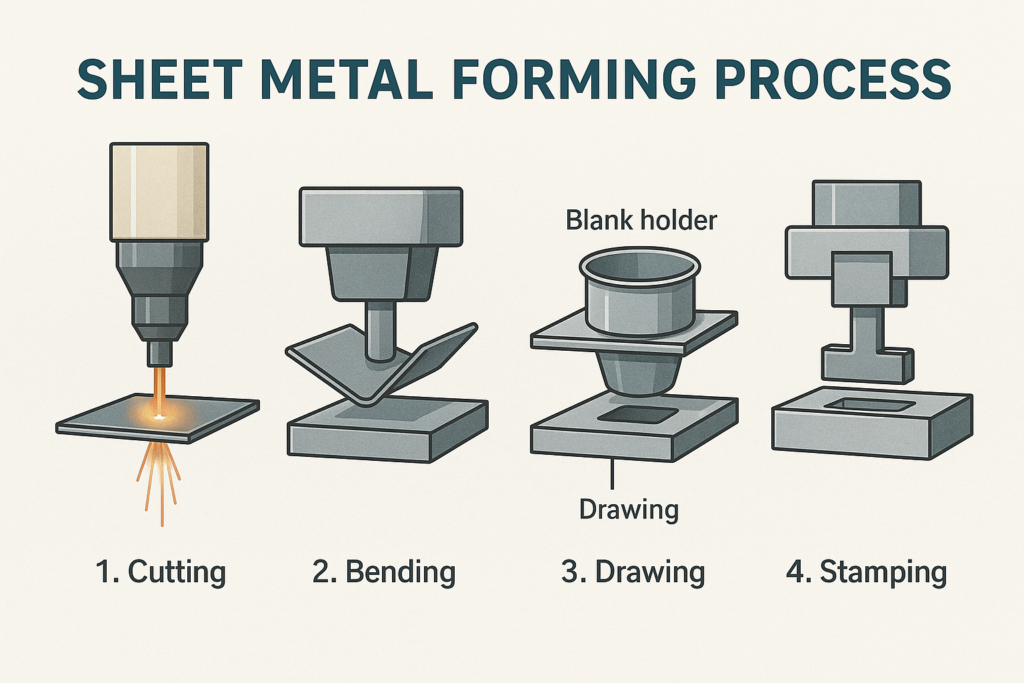
Biegen ist eines der gängigsten Verfahren zur Blechumformung. Die Maschine übt eine Kraft entlang der geraden Achse des Blechs aus, wodurch dieses in einem Winkel verformt wird. Wichtig ist, dass sich Volumen und Dicke des Materials dabei nicht verändern. Eine Abkantpresse ist das am häufigsten verwendete Werkzeug für diese Bearbeitung. Sie besteht aus einem Stempel und einer Matrize. Der Stempel drückt das Blech in die Matrize. Der Biegewinkel hängt direkt von der Hubtiefe ab. Biegen ist das bevorzugte Verfahren zur Herstellung von Halterungen, Gehäusen und architektonischen Bauteilen.
Verschiedene Biegemethoden sind:
- V-Biegen: Entspricht dem Freibiegen und dem Grundbiegen. Das Freibiegen ermöglicht verschiedene Biegewinkel. Das Grundbiegen hingegen erzielt die höchste Wiederholgenauigkeit, indem das Metall in die Werkzeugbasis gepresst wird.
- Prägen: Es handelt sich um ein Verfahren mit hohem Kraftaufwand, das extrem präzise Biegungen ermöglicht. Durch den Aufprall auf die Metalloberfläche wird zudem die Rückfederung minimiert.
- Walzenbiegen: Dies ist das Verfahren zur Herstellung zylindrischer oder gebogener Formen. Das Blech wird in einer Reihe von Walzen gebogen.
- Wischbiegen: Das Material wird an den Kanten fest zwischen Stempel und Matrize gehalten und dann sehr präzise gefaltet.
Progressive Rolling
Beim progressiven Walzen durchlaufen Flachbleche mehrere Walzstationen. Jede Station ist mit zwei Walzwerkzeugen ausgestattet. Das Metall wird so Schritt für Schritt in ein bestimmtes Profil geformt. Dieses Verfahren ermöglicht die präzise Herstellung komplexer Querschnitte. Unternehmen nutzen es zur Fertigung von Dachpaneelen und I-Trägern.
Zu den Walzarten gehören:
- Beim Flachwalzen wird Metall zwischen Walzen verdichtet, um gleichmäßige Bleche zu erzeugen.
- Durch das Formwalzen entstehen Formen wie T-Profile oder U-Profile.
- Beim Gewinderollen werden Gewinde auf runden Teilen erzeugt, ohne Material abzuschneiden.
Kantencurling
Durch das Kantenbiegen werden die Blechkanten glatt und abgerundet. Dadurch werden scharfe Ecken vermieden und die Sicherheit erhöht. Maschinen führen diesen Vorgang langsam aus und formen das Metall zu einer gleichmäßigen Kurve. Man sieht abgerundete Kanten an Türrahmen und Zierleisten. Die dadurch verbesserte Stabilität und Optik sind unübersehbar.
Industrielle Extrusion
Extrusion ist ein Verfahren, bei dem Metall durch eine Düse gepresst wird, um lange, gleichmäßige Profile herzustellen. Hersteller verwenden dazu Warm- oder Kaltextrusion. Extrusion eignet sich zur Fertigung komplexer Profile wie Fensterrahmen und leichter Bauteile.
Blechpressen in großen Stückzahlen
BlechpressenDas Pressverfahren, oft in Verbindung mit dem Stanzen, produziert große Mengen identischer Teile. Es ist ein schnelles und kostengünstiges Verfahren. Arbeiter legen Metallrohlinge in eine Pressmaschine ein. Werkzeug und Matrize üben immense Kraft aus, um das Material umzuformen.
Pressmaschinen bewältigen große Kapazitäten. Hochleistungspressen fertigen Bauteile mit einer Dicke von nur 0,127 mm. Dieses Verfahren dient der Massenproduktion in vielen Branchen. Es stellt Autotüren, Maschinenteile und komplexe Bauteile her. Verbraucher-Produkt-prototyping Komponenten. kundenspezifische Metallstanzdienstleistungen bieten die Effizienz und Konsistenz, die für enge Toleranzen erforderlich sind.
Präzisionsbügeln
Präzisionsbügeln erzeugt eine gleichmäßige Wandstärke. Das Metall wird durch einen schmalen Spalt zwischen Stempel und Matrize gepresst. Dieses Verfahren verstärkt das Material und reduziert sein Gewicht. Getränkedosen und tiefe Behälter werden damit hergestellt, um mit weniger Metall eine stabile Struktur zu erzielen.
Hydroforming
Beim Hydroforming wird Metall mithilfe von Hochdruckflüssigkeit über eine Matrize gestreckt. So entstehen gebogene oder hohle Formen. Aluminium eignet sich besonders gut, da es formbar ist. Die so hergestellten Teile sind robust und werden in der Luft- und Raumfahrt sowie in der Medizintechnik eingesetzt.
Die Flüssigkeit verteilt sich gleichmäßig über die Oberfläche. Die Schichtdicke bleibt konstant. Der Ausschuss ist minimal. Die Maschinen sind zwar teuer, aber für komplexe Anwendungen geeignet. Roboter-Prototyping Teilweise zahlt sich die Methode aus.
Spinformung
Beim Drückformen entstehen rotationssymmetrische Formen. Ein Metallrohling rotiert schnell in einer Maschine. Anschließend wird er von einer Walze gegen einen Dorn gepresst. Kochgeschirr, Satellitenschüsseln und Instrumente werden mit diesem Verfahren hergestellt.
Zwei Spinnmethoden dominieren:
- Konventionelles Spinnen Die Walze formt den Rohling gegen den Dorn. Das Teil verringert seinen Durchmesser, die Dicke bleibt gleich.
- Scherspinnen Das Metall wird über den Dorn gedehnt. Der Durchmesser ändert sich nicht, die Wandstärke nimmt stark ab.
Tiefziehen
Tiefziehen Metallprägen Tiefziehen ist das Verfahren, bei dem Metall zu becherförmigen Bauteilen verformt wird. Es eignet sich ideal für Teile, deren Tiefe mehr als die Hälfte des Durchmessers beträgt. Dabei wird das Metall mithilfe eines Niederhalters über einer Matrize fixiert. Ein hydraulischer Stempel presst das Material anschließend in die Form. Tiefziehen ermöglicht die Herstellung von Küchenspülen, Karosserieteilen und Getränkebehältern.
Streckformen
Beim Streckziehen entstehen große, konturierte Bauteile. Spannbacken fixieren die Metallkanten. Ein hydraulischer Schlitten dehnt das Blech über eine Konturmatrize. Diese Matrize dient als Form. Luft- und Raumfahrtunternehmen nutzen das Streckziehen für Flugzeughaut. Die Automobilindustrie verwendet es für Dach- und Türverkleidungen.
Fortschritte bei Werkzeugen zum Blechpressen
Die Entwicklung neuer Werkzeugwerkstoffe hat die Blechbearbeitung grundlegend verändert. Heutzutage werden Werkzeuge meist aus hochkohlenstoffhaltigem Werkzeugstahl und Wolframkarbid gefertigt. Diese Werkstoffe sind verschleißfest und halten auch langen Produktionszyklen problemlos stand. Um die Reibung zu reduzieren, wird häufig eine Schicht aus Titannitrid (TiN) oder eine andere Spezialbeschichtung aufgebracht.
Durch die geringe Reibung wird eine Erwärmung unter der Oberfläche verhindert, wodurch die Lebensdauer der Pressmaschine erhöht wird. Spritzgusswerkzeuge Experten sehen heutzutage im Vorteil eher die Werkzeughersteller. Mehrstufige Folgeverbundwerkzeuge werden üblicherweise von Konstrukteuren gefertigt. Solche Werkzeuge ermöglichen mehrere Blechumformvorgänge mit einem einzigen Presshub. Sie steigern nicht nur die Produktionsrate, sondern minimieren auch die Teilehandhabung.
Simulation des Materialflusses beim komplexen Pressen
Computergestützte Konstruktion (CAE) spielt heute eine entscheidende Rolle. Die Software simuliert den Metallfluss während des Herstellungsprozesses. BlechpressenDiese Simulationen sagen potenzielle Defekte wie Faltenbildung oder Risse voraus. Sie ermöglichen es Ingenieuren, die Geometrie der Werkzeuge zu optimieren, bevor die eigentliche Fertigung beginnt.
Simulationswerkzeuge berechnen auch die erforderliche Presskraft. Dies verhindert eine Überbeanspruchung der Maschine. Durch die Analyse des Umformgrenzdiagramms (FLD) stellen Konstrukteure sicher, dass das Material innerhalb sicherer Verformungsgrenzen bleibt. Dieser wissenschaftliche Ansatz reduziert Materialverschwendung und beschleunigt die Entwicklung. rapid injection molding und dringende Projekte.
Kritische technische Parameter
Eine erfolgreiche Umformung hängt von mehreren Variablen ab. Ingenieure müssen diese Faktoren kontrollieren, um Präzision zu gewährleisten.
Berechnung des K-Faktors
Der K-Faktor misst die Materialverformung bei Biegung. Hohe Werte deuten auf eine erhebliche Dehnung hin. Die neutrale Achse erfährt keine Spannung. Formel: $K = t/T$ (t = Abstand von der Innenfläche zur neutralen Achse; T = Blechdicke) Weiche Werkstoffe haben üblicherweise einen K-Faktor um 0,33. Härtere Legierungen wie Edelstahl erfordern Werte zwischen 0,40 und 0,50.
Springback verwalten
Die Rückfederung entsteht durch die Elastizität aller Metalle. Nach dem Pressvorgang versucht das Bauteil, in seine ursprüngliche Form zurückzukehren. Faktoren wie eine höhere Streckgrenze verstärken die Rückfederung. Verarbeiter kompensieren dies, indem sie das Material über den Zielwinkel hinaus überbiegen.
| Parameter | Definition | Bedeutung |
|---|---|---|
| K-Faktor | Verhältnis der Position der neutralen Achse | Bestimmt die Schnittmusterlänge für Metall biegen. |
| Biegeradius | Innenradius der Falte | Wirkt sich auf die Spannungsverhältnisse aus und verhindert Rissbildung in harten Legierungen. |
| Rückfederung | Elastische Rückstellung nach Krafteinwirkung | Beeinflusst die endgültigen Bauteilabmessungen; erfordert Überbiegung. |
| Die Clearance | Spalt zwischen Stempel und Matrize | Beeinflusst die Kantenqualität und den Werkzeugverschleiß beim Pressen. |
| Haltezeit | Dauer der Druckanwendung | Verbessert die Oberflächengüte und die Maßgenauigkeit. |
Konstruktionsüberlegungen für das Blechpressen
Erfolgreich Blechpressen Beginnt mit einem optimierten Design. Ingenieure müssen verschiedene Faktoren berücksichtigen, um Fehler zu minimieren.
1. Materialeigenschaften Duktilität ist entscheidend. Metalle wie Kupfer und kohlenstoffarmer Stahl verformen sich leicht. Spröde Werkstoffe können brechen. Auch die Faserrichtung spielt eine Rolle. Biegen quer zur Faserrichtung verhindert Brüche. Eine Wärmebehandlung kann die Duktilität verbessern, aber die benötigte Kraft erhöhen.
2. Geometrie und Größe Dickere Bleche erfordern mehr Presskraft. Dies kann die Komplexität des Bauteils einschränken. Dünnere Bleche lassen sich leichter formen, neigen aber zu Faltenbildung. Bauteile mit hohem Aspektverhältnis weisen ungleichmäßige Verformung auf. cnc-Präzisionsbearbeitung helfen, Werkzeuge zu entwickeln, die diese Probleme mindern.
3. Personalmanagement Eine gleichmäßige Lastverteilung verhindert lokale Materialausdünnungen. Hochfeste Werkstoffe beschleunigen den Werkzeugverschleiß. Konstrukteure müssen sicherstellen, dass die Pressmaschine die erforderlichen Zugkräfte aufnehmen kann, ohne das Bauteil zu beschädigen.
4. Optimiertes Layout
- Lochanordnung: Die Bohrungen sollten so platziert werden, dass sie nicht in der Nähe von Biegelinien liegen. Dadurch werden Verformungen während des Pressvorgangs vermieden. Laserschneiden können bei Bedarf nach dem Formen Löcher erzeugt werden.
- Hilfskürzungen: In Bereichen mit hoher Verformung sollten Kerben angebracht werden. Diese Einschnitte reduzieren die Spannung und verhindern ein Einreißen.
- Mindestbiegeradius: Der Radius muss größer sein als die Materialstärke. Scharfe Biegungen führen zu Strukturversagen.
- Materialfluss: Konstruktionsmerkmale wie Wülste oder Rippen dienen der Führung des Materialflusses und verstärken die endgültige Struktur.
Qualitätskontrolle und Inspektion
Die Präzisionsfertigung erfordert strenge Prüfungen. Prüfer verwenden Koordinatenmessmaschinen (KMM), um die Bauteilabmessungen zu überprüfen. BlechpressenSie prüfen auf gleichmäßige Wandstärke und Oberflächenfehler.
Die Sichtprüfung deckt Grate oder Risse auf. Ultraschallprüfungen erkennen innere Fehler in dicken Platten. Die Einhaltung hoher Standards gewährleistet, dass die Teile die Anforderungen erfüllen. Mehrkavitäten-Spritzgießen und andere integrierte Baugruppen.
Wirtschaftliche Auswirkungen des Blechpressens
Das Pressen bietet erhebliche finanzielle Vorteile bei Großaufträgen. Zwar ist die Herstellung der Werkzeuge zunächst teuer, die Stückkosten sinken jedoch rapide. Automatisierte Presslinien reduzieren die Lohnkosten und minimieren menschliche Fehler.
Durch die effiziente Anordnung von Teilen auf einem Blech wird der Materialverschnitt reduziert. Die verbleibenden Teilegerüste können von den Herstellern recycelt werden. Diese Nachhaltigkeit verbessert die Gesamtrentabilität. Vakuumguss-Service In der Blechverarbeitung sind Geschwindigkeit und Materialeinsparung entscheidende Wettbewerbsvorteile.
Fazit
Die Blechumformung ist ein vielseitiges und unverzichtbares Fertigungsverfahren. Sie produziert präzise und langlebige Bauteile für unterschiedlichste Branchen. Die Wahl des richtigen Materials und Verfahrens gewährleistet optimale Ergebnisse. Parameter wie der K-Faktor und die Rückfederung bestimmen die endgültige Genauigkeit.
Blechpressen Die Umformtechnik bildet die Grundlage für eine schnelle Produktion. Durch die Bewertung der Materialduktilität und der Konstruktionsvorgaben minimieren Hersteller den Materialverbrauch. Ein wissenschaftlich optimierter Prozess garantiert die strukturelle Integrität. Ob einfache Halterungen oder komplexe Außenhautkonstruktionen für die Luft- und Raumfahrt – die Umformtechnik bietet die Zuverlässigkeit, die moderne Ingenieurskunst fordert. Nutzen Sie diese Strategien, um Effizienz und Qualität in Ihrem nächsten Projekt zu steigern.
Häufig gestellte Fragen
1. Worin unterscheidet sich das Blechpressen vom traditionellen Stanzen?
Blechpressen Stanzen ist ein Oberbegriff für die Umformung von Metall durch Druck. Es handelt sich dabei um eine spezielle Hochgeschwindigkeits-Presstechnik. Beim Stanzen werden oft mehrere Arbeitsschritte wie Schneiden und Umformen gleichzeitig ausgeführt – oft in einem einzigen Hub.
2. Warum ist die Rückfederung bei der Metallumformung wichtig?
Die Rückfederung tritt auf, wenn das Metall nach dem Wegfall der Kraft teilweise in seine ursprüngliche Form zurückkehrt. Wird dies nicht berücksichtigt, entspricht das Bauteil nicht den geforderten Abmessungen. Konstrukteure müssen das Bauteil daher überbiegen, um den korrekten Endwinkel zu erreichen.
3. Welchen Vorteil bietet die Hydroformung?
Beim Hydroforming wird mit Druckflüssigkeit eine gleichmäßige Kraft ausgeübt. Dadurch wird eine lokale Materialausdünnung verhindert und die Herstellung komplexer, organischer Formen ermöglicht. Das Verfahren eignet sich ideal für Bauteile, die hohe Festigkeit und geringes Gewicht erfordern.
4. Können mit diesen Methoden auch dicke Metallbleche geformt werden?
Ja, aber sie erfordern eine deutlich höhere Presskraft. Dickere Bleche haben einen größeren Mindestbiegeradius, um Risse zu vermeiden. Bei sehr dicken Platten setzen Hersteller unter Umständen Warmumformung ein, um die Duktilität zu erhöhen.
5. Wie wirken sich Entlastungsschnitte beim Blechpressen aus?
Entlastungsschnitte oder -kerben werden in Bereichen mit starker Verformung angebracht. Sie reduzieren die Spannung im Material. Dadurch wird verhindert, dass das Metall beim Einbringen in den Formhohlraum reißt oder Falten wirft.
Kommentare
Neueste Beiträge
Verwandte Blogs
Der Blog von Senyo konzentriert sich darauf, unser umfassendes Wissen über die Prototypenfertigung zu teilen. Mit unseren Artikeln möchten wir Sie dabei unterstützen, Ihr Produktdesign zu optimieren und die Komplexität des Rapid Prototyping effektiver zu bewältigen.