Unilateral Tolerance: A Guide for Precision Engineering
Tabla de Contenido
En el mundo de CNC de mecanizado, precision is paramount. Engineers design parts with exact nominal dimensions, but manufacturing processes inherently involve variability. No two machined parts are ever truly identical down to the atomic level. Tool wear, temperature fluctuations, and material inconsistencies create microscopic deviations. Engineering tolerance is the language that defines the acceptable limits of this variation. It is the critical bridge between design intent and manufacturing reality. Without tolerance, quality control would be impossible.
This guide provides a detailed exploration of unilateral tolerance, a specific and powerful method for controlling dimensional variation. We will define what it is, contrast it with the more common bilateral tolerance, and demonstrate its indispensable role in creating functional, reliable assemblies. Understanding how and when to apply unilateral tolerance is a key skill for any designer or engineer involved in creating high-precision components.
What is Bilateral Tolerance? The Two-Way Street
Before diving into unilateral tolerance, we must first understand its counterpart: bilateral tolerance. Most engineers are familiar with this form. Bilateral tolerance specifies that a dimension’s acceptable variation can occur in both the positive and negative directions from a nominal, or target, value.
We can further divide bilateral tolerances into two categories:
Equal Bilateral Tolerance: This is the most common tolerance callout on engineering drawings. The acceptable deviation is the same in both directions. For example, a dimension shown as
25.0 mm ±0.1 mmmeans the part is acceptable if its final measurement falls between 24.9 mm and 25.1 mm. The tolerance zone is centered perfectly around the nominal dimension.Unequal Bilateral Tolerance: In some cases, a designer may need to allow for more variation in one direction than the other. This is an unequal bilateral tolerance. A dimension might be specified as
25.0 mm +0.1/-0.2. Here, the acceptable range is from 24.8 mm to 25.1 mm. The tolerance zone is still on both sides of the nominal value but is no longer symmetrical.
Bilateral tolerances are excellent for general features where the exact location of the tolerance zone is not critical to the part’s function.
Unilateral Tolerance: Defining a Critical Boundary
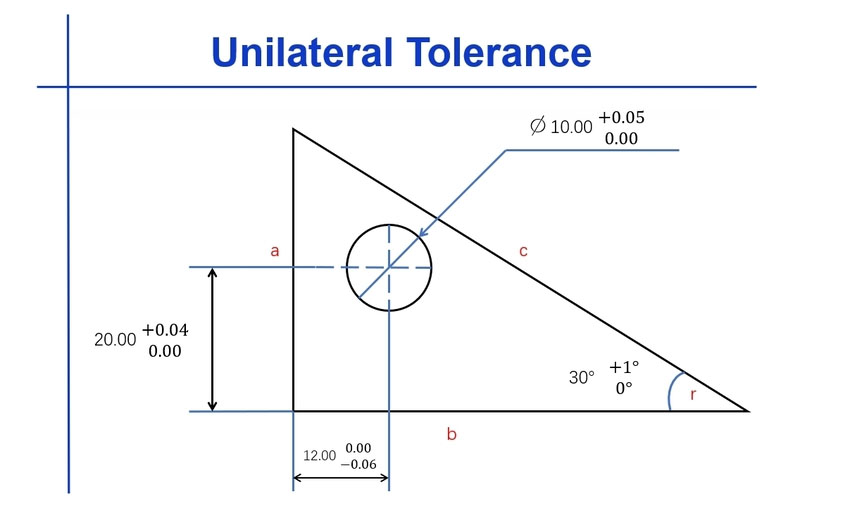
A unilateral tolerance is fundamentally different. It dictates that the acceptable dimensional variation extends in only one direction from the nominal value. One of the tolerance limits is always zero. This effectively transforms the nominal dimension from a target into a firm, non-negotiable boundary.
There are two forms of unilateral tolerance:
Positive Unilateral Tolerance: The dimension can only be larger than the nominal value, never smaller.
- Notation:
25.0 mm +0.1/-0.0 - Acceptable Range: 25.0 mm to 25.1 mm.
- Meaning: 25.0 mm is the absolute minimum acceptable size.
- Notation:
Negative Unilateral Tolerance: The dimension can only be smaller than the nominal value, never larger.
- Notation:
25.0 mm +0.0/-0.1 - Acceptable Range: 24.9 mm to 25.0 mm.
- Meaning: 25.0 mm is the absolute maximum acceptable size.
- Notation:
Designers use unilateral tolerance when a feature must never violate a specific size or location boundary to ensure proper function, especially when parts must fit together.
Why Choose Unilateral Tolerance? The Design Intent
The selection between bilateral and unilateral tolerance is not arbitrary; it connects a particular layout intent. A bilateral resistance suggests “go for the nominal measurement, with some wiggle area.” In contrast, an unilateral tolerance sends a clear message to the maker and quality inspector: “this nominal dimension is an essential limit.”
Consider the traditional example of a shaft suitable right into a hole. If the shaft has a small diameter of 10.0 mm and the opening has a small diameter of 10.0 mm, they will certainly not fit. The developer needs to build in clearance. Making use of unilateral resistances is the most accurate means to assure this clearance.
- Hole Dimension: Ø10.0 mm +0.05/ -0.0 (The opening has to be 10.0 mm or a little bigger).
- Shaft Dimension: Ø10.0 mm +0.0/ -0.05 (The shaft should be 10.0 mm or a little smaller sized).
This system assures that the tiniest possible hole (10.0 mm) is still larger than the largest feasible shaft (9.95 mm), ensuring the components will certainly always assemble. This degree of functional control is the main factor for making use of unilateral tolerance.
Unilateral vs. Bilateral: A Direct Comparison
The following table breaks down the key differences between these two fundamental tolerancing methods.
| Característica | Unilateral Tolerance | Bilateral Tolerance |
|---|---|---|
| Definition | Variation is permitted in only one direction (positive or negative) from the nominal size. | Variation is permitted in both directions (positive and negative) from the nominal size. |
| Tolerance Zone | Begins at the nominal dimension and extends in one direction. | Is centered on (equal) or distributed around (unequal) the nominal dimension. |
| Role of Nominal | The nominal dimension acts as a critical boundary (e.g., a minimum or maximum size). | The nominal dimension acts as an ideal target for the manufacturing process. |
| Uso Principal | Specifying clearance, interference, or transition fits between mating parts. | General dimensioning of non-critical features, such as overall length or pocket depth. |
| Design Intent | To control the function and fit of an assembly with high precision. | To control the size of a feature within reasonable manufacturing limits. |
| Example Notation | 10.0 +0.1/-0.0 | 10.0 ±0.1 o 10.0 +0.1/-0.2 |
Practical Applications in Precision Manufacturing
Unilateral tolerance is not just a theoretical concept; it is a practical tool used every day in high-stakes industries like dispositivo médico de prototipos y automotriz de prototipos. Its applications are centered around controlling the fit between components.
Clearance Fits
This is the most common application. A clearance fit ensures there is always a gap between mating parts, allowing for free movement. Unilateral tolerances define the minimum clearance.
- Por ejemplo: A bearing must slide easily onto a shaft. The hole (bearing inner diameter) is given a positive unilateral tolerance, while the shaft is given a negative unilateral tolerance. This guarantees the shaft is never larger than the hole.
Interference Fits (Press Fits)
An interference fit requires that the internal part (e.g., a pin) is larger than the external part (e.g., a hole) before assembly. The parts are joined using force, creating a strong, locked connection.
- Por ejemplo: A dowel pin must be pressed into a plate for precise alignment. The pin is given a positive unilateral tolerance (
Ø5.0 +0.01/+0.0), and the hole is given a negative unilateral tolerance (Ø5.0 +0.0/-0.01). This ensures the pin is always larger than the hole, creating the required interference.
Location Control
Unilateral tolerances are also used to control the position of features. For instance, the location of a mounting hole relative to an edge might be critical. A unilateral tolerance can ensure the hole is never drilled too close to the edge, which could compromise structural integrity.
Unilateral Tolerance and GD&T
While simple +/- tolerances are useful, modern engineering often relies on Geometric Dimensioning and Tolerancing (GD&T). GD&T is a symbolic language that provides much more specific control over a part’s geometry. Unilateral tolerance is a foundational concept within the GD&T framework, particularly when using material condition modifiers.
- Maximum Material Condition (MMC): This modifier refers to the state where a feature contains the most material (e.g., the smallest hole or the largest shaft). When a positional tolerance is applied at MMC, it effectively creates a unilateral boundary. As the feature deviates from its MMC size, the machinist gains bonus tolerance.
- Least Material Condition (LMC): This is the opposite of MMC, where a feature contains the least material (e.g., the largest hole or the smallest shaft). It’s used to control things like minimum wall thickness, ensuring a part remains strong enough.
Understanding GD&T reveals how the simple idea of a one-sided tolerance zone is expanded to control complex geometric properties like position, profile, and runout, which are essential for advanced applications like prototipos de robots.
Conclusión
Unilateral tolerance is an essential tool in the engineer’s toolkit for designing functional and reliable products. While bilateral tolerance is suitable for defining general sizes, unilateral tolerance provides the robust control needed for critical fits and component interfaces. It clearly communicates to the machinist that a nominal dimension is not just a target but a hard limit that must be respected. By mastering the application of unilateral tolerance, designers can prevent assembly issues, improve product performance, and ensure that parts produced through CNC de mecanizado de precisión perform exactly as intended. This precise control is the cornerstone of modern, high-quality manufacturing.
Comentarios
Últimas Entradas
Blogs Relacionados
Senyo del blog se centra en compartir nuestro amplio conocimiento de la fabricación de prototipos. A través de nuestros artículos, nuestro objetivo es apoyar a usted en refinar el diseño del producto y navegar por las complejidades de la creación rápida de prototipos de forma más efectiva.


Comprender las texturas de la superficie del molde en el moldeo por inyección
6 de diciembre de 2024
Leer Más "