
¿Qué es el código G?: Introducción a la programación de máquinas CNC
Tabla de Contenido
¿Qué es el código G? En el mundo de la fabricación moderna, la precisión es primordial. Sectores desde el aeroespacial hasta dispositivo médico de prototipos depend on the flawless execution of complex designs. This execution is carried out by automated workhorses like Computer Numerical Control (CNC) machines and 3D printers. However, these powerful machines do not understand visual designs or abstract concepts. They require a precise, instruction-based language to function. That language is G-code. Understanding “what is G-code” is essential for anyone involved in manufacturing, engineering, or design. This article provides a definitive explanation of G-code, detailing its purpose, structure, workflow, and critical commands that transform digital blueprints into physical objects.Metal rapid prototyping has transformed the way products are developed, enabling designers and engineers to create high-precision metal prototypes at unprecedented speed. Whether for automotive, aerospace, or consumer products, this advanced methodology offers significant advantages, from cost savings to shorter production timelines. In this article, we’ll explore the tools, techniques, and benefits of metal rapid prototyping, making it a valuable resource for anyone involved in manufacturing or product development.

What Is G-Code? A Fundamental Definition
G-code is the main shows language that people make use of to instruct CNC makers and 3D printers. The “G” in G-code represent “Geometric,” since the language largely describes the geometry of the toolpath. Consider it as a collection of direct, detailed directions. These instructions tell the machine’s device head specifically where to move, exactly how swiftly to travel, and what course to adhere to.
This language runs within a Cartesian coordinate system, using X, Y, and Z axes to define placements in three-dimensional space. G-code commands, likewise known as preparatory codes, determine every motion. Past simple positioning, G-code also controls important variables. These consist of feed rate (the speed of the cutting tool’s breakthrough), pin rate (the rotation speed of the tool), and the selection of particular tools needed for a task.
G-code rarely works alone. It functions in tandem with M-code, or “miscellaneous code.” While G-code commands manage the equipment’s motions, M-code commands control supporting equipment features. These include transforming the coolant on or off, beginning or quiting the program, and starting a device change. Together, G-code and M-code type a full program that guides a machine from its starting point to a finished component.
The Historical Roots of G-Code
The story of G-code starts in the 1950s at the Massachusetts Institute of Technology (MIT) Servomechanisms Laboratory. At the time, early numerical control (NC) equipments relied upon physical punched tape for instructions, a difficult and inflexible system. The development of G-code was an innovative action, developing a standardized text-based language for controlling machine movement.
Its prevalent adoption, however, was available in the 1960s. The Electronic Industries Alliance (EIA) standardized the language under the classification RS-274. This standardization was an important landmark. It developed a global foundation that equipment tool makers can build on. This permitted greater interoperability between various devices and software program systems. This crucial development led the way for the CNC revolution, changing manufacturing from a manual craft right into a very automated, precise science.
Why G-Code Is Crucial in Modern Manufacturing
Makers, by their nature, are not intelligent. A CNC de mecanizado facility possesses powerful servomotors and precise actuators, however it requires explicit guidelines to execute any task. G-code serves as the essential bridge between an electronic design produced in software program and the physical activities of the maker. It converts the abstract intent of an engineer or designer right into a concrete, actionable collection of commands that the equipment’s controller can recognize and implement.
The importance of G-code depends on three crucial areas:
- Automation: G-code permits complicated machining processes to run from begin to completed with marginal human intervention. This is fundamental to mass production and performance in sectors like automotriz de prototipos.
- Precision: The language permits movements specified to thousandths of an inch (or micrometers). This level of accuracy is difficult to accomplish regularly by hand and is essential for high-tolerance parts.
- Repeatability: Once a G-code program is improved, an equipment can execute it thousands of times, producing identical parts every time. This consistency is the bedrock of contemporary quality control.
Without G-code, the production of intricate elements for whatever from customer electronic devices to commercial equipment would be slower, more pricey, and much less trusted.
The G-Code Workflow: From Digital Design to Physical Part
Producing a finished part with a CNC device involves a structured, multi-stage procedure. The G-code script is the last outcome of the pre-production process. Right here is just how it functions.
1. Computer-Aided Design (CAD) The process starts with a concept. An engineer or designer develops a 2D drawing or 3D strong model of the preferred component utilizing CAD software program. This electronic plan specifies all the geometric attributes, measurements, and tolerances of the end product.
2. Computer-Aided Manufacturing (CAM) Next, the CAD data is imported into CAM software program. This is where the manufacturing strategy is established. The CAM software driver specifies the sort of basic material, picks the proper cutting tools, and sets machining specifications like reducing speed and depth. The software application then uses this info to determine one of the most effective toolpaths to develop the part. Its main outcome is a G-code program that translates these toolpaths right into machine-readable guidelines.
3. Post-Processing The G-code created by a CAM program is frequently common. Different brands of CNC machines (like Haas, Fanuc, or Siemens) talk slightly different “languages” of G-code. A post-processor is a tiny software program energy that functions as a translator. It converts the common CAM outcome into a particular G-code file formatted completely for the target equipment’s controller. This step is vital to stop errors and guarantee compatibility.
4. Device Execution The finalized G-code documents is moved to the CNC device’s controller, usually by means of USB or an ethernet connection. The maker operator sets up the work surface and tools. Once the program starts, the maker’s controller reviews the G-code one line, or “block,” each time. It analyzes each command and sends out electrical signals to the maker’s motors and systems, driving the device along the programmed course to reduce, drill, or shape the part.
Deconstructing G-Code: Understanding Its Structure
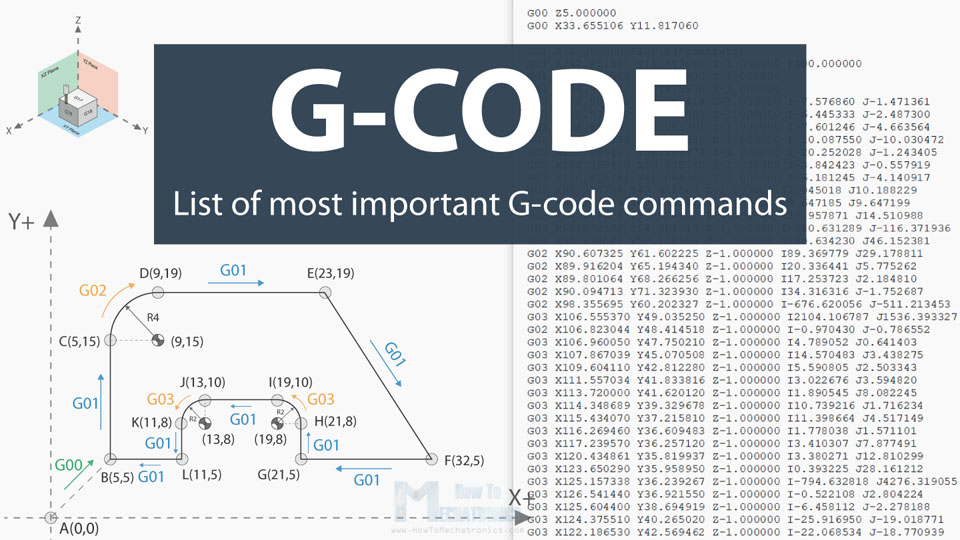
At first glance, a G-code file may look like a confusing assortment of letters and numbers. Nonetheless, it follows a rational and consistent framework. The program includes a series of lines, called blocks. Each block has several commands, known as words. A word is just a letter followed by a number. The maker executes the blocks sequentially from top to bottom.
Let’s evaluate an example block of G-code: N100 G01 X50.0 Y25.5 Z-5.0 F150 S1200 M03
- N100: The block number (N). This aids arrange the program and makes it easier to find specific lines.
- G01: A G command. This is a preparatory command telling the maker to carry out a details sort of movement– in this instance, a linear feed move.
- X50.0 Y25.5 Z-5.0: The coordinate data. These words tell the equipment the endpoint for the action along the X, Y, and Z axes.
- F150: The feed price (F). This instructs the maker to move at a price of 150 units (e.g., mm/minute) throughout the cut.
- S1200: The pin speed (S). This establishes the rotational speed of the reducing device to 1200 transformations per min (RPM).
- M03: An M command. This is a miscellaneous command that tells the spindle to start kipping down a clockwise instructions.
The following table summarizes the most typical address characters located in G-code.
Table 1: Common G-Code Address Characters
| Character | Nombre | Propósito |
|---|---|---|
| G | Preparatory Command | Defines the type of motion or operation (e.g., rapid move, linear cut, drilling cycle). |
| M | Miscellaneous Function | Controls auxiliary machine functions (e.g., coolant on/off, program stop, tool change). |
| X, Y, Z | Linear Axes | Specifies the target coordinates for motion along the primary three axes. |
| A, B, C | Rotational Axes | Specifies the target coordinates for rotational axes around X, Y, and Z, respectively. |
| F | Feed Rate | Sets the speed at which the cutting tool moves through the material. |
| S | Spindle Speed | Sets the rotational speed of the machine’s spindle in RPM. |
| T | Selección de herramientas | Instructs the machine to select a specific tool from its turret or magazine. |
| N | Block/Line Number | Provides a sequence number for a line of code, used for organization and reference. |
| I, J, K | Arc Center Data | Defines the center point of an arc when using G02 or G03 commands. |
Common G-Code Commands You Must Know
While there are hundreds of G-code commands, a handful form the foundation of nearly every CNC program. An operator or programmer who understands these core commands can read and interpret most G-code scripts.
Table 2: Essential G-Code Commands and Their Functions
| Command | Nombre | Descripción |
|---|---|---|
| G00 | Rapid Positioning | Moves the tool at the machine’s maximum travel speed to a specified coordinate. This is used for non-cutting movements to save time. |
| G01 | Linear Interpolation | Moves the tool in a straight line to a specified coordinate at a defined feed rate (F). This is the primary command for cutting material. |
| G02 | Clockwise Circular Interpolation | Moves the tool along a clockwise arc. Requires specifying the endpoint and the arc’s center or radius. |
| G03 | Counter-Clockwise Circular Interpolation | Moves the tool along a counter-clockwise arc. Similar to G02 but in the opposite direction. |
| G21 | Millimeter Units | Sets the machine’s interpretation of all dimensional values to millimeters. |
| G90 | Absolute Positioning | Interprets all coordinate values as positions relative to a fixed program zero point (the origin). This is the most common mode. |
| G91 | Incremental Positioning | Interprets all coordinate values as distances relative to the tool’s current position. |
| G81 | Drilling Cycle | A “canned cycle” that automates the standard process of drilling a hole to a specified depth and retracting. |
| G41/G42 | Cutter Radius Compensation | Automatically adjusts the toolpath to the left (G41) or right (G42) to compensate for the radius of the cutting tool. This ensures the final part dimensions are accurate. |
Understanding these commands is the first step to G-code literacy. For example, G00 X100 Y100 quickly repositions the tool, while G01 X100 Y100 F200 moves it to the same spot slowly and carefully, performing a cut.
G-Code vs. M-Code: Clarifying the Difference
A common point of confusion for newcomers is the distinction between G-codes and M-codes. While they work together in the same program, they have fundamentally different roles.
G-Codes (Geometric Codes): These are action commands that control the movement and operation of the tool. They answer the questions “Where is the tool going?” and “How should it get there?”. They manage the geometry of the part being created, controlling everything from straight lines and arcs to complex canned cycles for estampación metálica profunda.
M-Codes (Miscellaneous Codes): These are switching commands that control the non-geometric functions of the machine itself. They act like on/off switches for hardware. They answer questions like “Is the coolant on?” or “Is the spindle spinning?”.
In short: G-code moves the tool; M-code runs the machine. A program needs both to function. For example, a line might use G01 to start a cut while simultaneously using M08 to turn on the flood coolant to keep the tool and workpiece from overheating.
A Practical G-Code Example: Machining a Simple Square
To see how these commands work together, let’s examine a simple G-code program designed to mill a 20mm x 20mm square, cutting 1mm deep into a workpiece.
G21 ; Set all units a millimeters. A crucial first step para clarity.
G90 ; Set positioning mode a absolute. All coordinates will be relative a el origin (X0 Y0).
G00 Z5 ; Rapid move el herramienta a a safe height de 5mm above el workpiece.
G00 X0 Y0 ; Rapid move el herramienta a el starting corner de el square.
G01 Z-1 F100 ; Lower el herramienta into el material a a depth de 1mm en a feed rate de 100 mm/minute.
G01 X20 F200 ; Cut el first side de el square by moving a X=20 en a feed rate de 200 mm/minute.
G01 Y20 ; Cut el second side by moving a Y=20. The feed rate remains 200.
G01 X0 ; Cut el third side by moving back a X=0.
G01 Y0 ; Cut el final side, returning a el start point.
G00 Z5 ; Rapid move el tool back up a el safe height.
M30 ; Program end y reset. Este M-code signals el máquina that el job es complete.
This simple example demonstrates how a sequence of G-code and M-code commands can produce a precise geometric shape.
Troubleshooting Common G-Code Errors
While web cam software program produces extremely trusted G-code, mistakes can still happen. Understanding just how to fix them is a valuable ability for any machine driver.
- Syntax Errors: These are straightforward typos, like creating G1 as opposed to G01 or neglecting a needed value like the feed price. A lot of contemporary CNC controllers will detect syntax errors and stop the program with an alarm system, showing the troublesome line.
- Sensible Errors: The code is syntactically appropriate however commands the device to do something harmful or incorrect. An usual example is commanding a rapid move (G00) with the product rather than a feed step (G01), which can damage the device or damage the part.
- Post-Processor Errors: The code contains commands that the particular device controller does not acknowledge. This takes place when the wrong post-processor is made use of and is a suggestion of why that action is so crucial.
The very best way to stop these mistakes is to use a G-code simulation software. These programs, like NC Viewer, develop a digital rendering of the toolpath, allowing you to enjoy the whole program run on a screen prior to you cut any type of steel. This aids capture collisions, ineffective paths, and sensible errors before they create expensive damage.
The Broad Spectrum of Machines Using G-Code
G-code’s influence extends far beyond a single type of machine. It is the de facto standard for a vast range of computer-controlled equipment across multiple manufacturing disciplines.
- Subtractive Manufacturing: This is G-code’s traditional domain. It includes CNC milling machines that use rotating tools, CNC turning lathes that rotate the workpiece, and grinders for finishing surfaces.
- Fabrication and Cutting: Machines that cut shapes from flat stock heavily rely on G-code. This includes cortadoras láser, plasma cutters, and high-pressure waterjet cutters.
- Additive Manufacturing: Impresoras 3D, which build parts layer by layer, also run on G-code. When you “slice” a 3D model, the slicer software generates a G-code file that controls the print head’s movement (X, Y), the layer height (Z), and the material extrusion rate.
This universality makes G-code a transferable skill across many areas of la creación de prototipos industriales and production.
Conclusión
G-code is more than just a programming language; it is the fundamental link between digital innovation and physical reality. It provides the precise, unambiguous instructions that allow automated machines to build our world with unparalleled speed and accuracy. While modern CAM software handles the heavy lifting of generating complex G-code programs, a solid understanding of “what is G-code” remains an invaluable asset. For engineers, machine operators, and hobbyists alike, literacy in G-code empowers them to optimize processes, troubleshoot problems, and unlock the full potential of CNC technology. In the ongoing evolution of manufacturing, G-code stands as an enduring and essential tool.
Suggested External Links for Insertion
- For General Reference: Autodesk’s Guide to G-Code – An excellent, authoritative overview from a leading software provider.
- For Technical Details: LinuxCNC G-Code Documentation – A highly detailed technical reference for a wide range of G- and M-codes.
- For Practical Visualization: NC Viewer – A free, web-based G-code simulator that allows users to paste their code and see a visual representation of the toolpath.
- For Manufacturer-Specific Info: Haas Automation’s Resource Center – Provides practical tips and information specific to one of the most popular CNC machine brands.
Comentarios
Últimas Entradas
Blogs Relacionados
Senyo del blog se centra en compartir nuestro amplio conocimiento de la fabricación de prototipos. A través de nuestros artículos, nuestro objetivo es apoyar a usted en refinar el diseño del producto y navegar por las complejidades de la creación rápida de prototipos de forma más efectiva.
EDM de alambre de Corte de Revelado:el Papel de la Manufactura Moderna
septiembre 4, 2024
Leer Más "