Besi Cor vs. Baja: Panduan Manufaktur Definitif
Daftar Isi
Dalam bidang manufaktur industri yang luas, pemilihan material adalah keputusan rekayasa mendasar. Pilihan logam secara langsung memengaruhi kekuatan, daya tahan, biaya, dan kinerja suatu produk. Di antara logam besi yang paling umum, besi cor dan baja adalah bahan dasar. Produsen seperti Senyorapid sering menggunakan logam ini karena sifatnya yang luar biasa. Keduanya menawarkan kekuatan yang mengesankan dan kemampuan untuk bekerja dengan andal dalam jangka waktu yang lama.
Namun, ada perbedaan penting. Meskipun besi cor dan baja mungkin tampak serupa secara visual, metalurgi dan karakteristik kinerja yang mendasarinya sangat berbeda. Perdebatan utama tentang besi cor vs baja berkisar pada perbedaan ini. Setiap material memiliki fitur unik yang menghadirkan keunggulan dan kerugian yang berbeda tergantung pada aplikasi spesifik. Apakah baja lebih kuat dari besi? Mana yang lebih baik untuk mengecor bentuk yang kompleks? Panduan ini memberikan penyelaman mendalam secara ilmiah dan teknologi untuk menjawab pertanyaan-pertanyaan ini. Kami akan membedah sifat-sifatnya, membandingkan kinerjanya, dan memberikan panduan yang jelas untuk membantu Anda membuat pilihan material yang optimal untuk proyek manufaktur Anda.
Apa itu Besi Cor? Perspektif Metalurgi
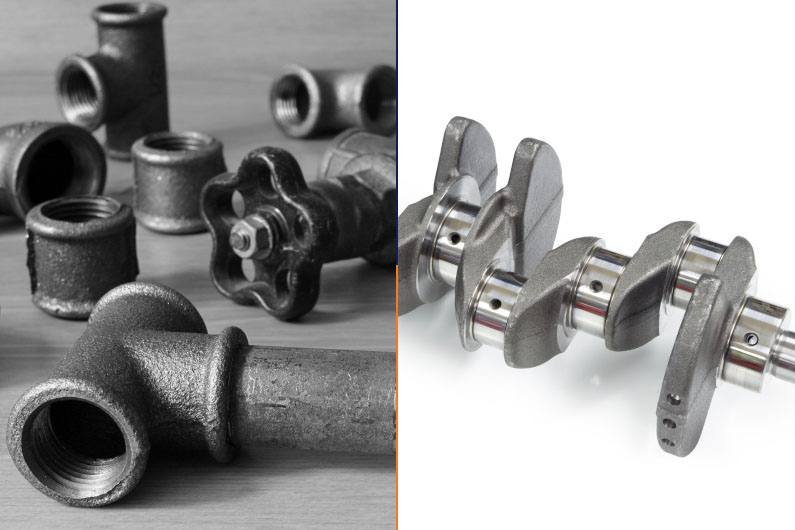
Besi cor adalah paduan besi yang ditentukan oleh kandungan karbon yang tinggi. Itu diproduksi dengan melebur paduan besi-karbon dalam tungku. Karakteristik yang menentukan adalah persentase karbon yang biasanya berkisar dari 2% hingga 4%. Tingkat karbon ini melebihi jumlah yang dapat sepenuhnya larut dalam matriks besi. Akibatnya, kelebihan karbon mengendap selama pendinginan, biasanya dalam bentuk grafit atau besi karbida (sementit).
Proses pembuatannya sangat mudah. Setelah peleburan, logam cair langsung dituangkan ke dalam cetakan untuk memadat menjadi bentuk yang diinginkan. Ini berbeda dengan besi tempa atau baja, yang sering dikerjakan dengan palu atau digulung saat panas.
Selain karbon, besi cor mengandung 1% hingga 3% silikon. Elemen ini sangat penting karena mendorong pembentukan grafit alih-alih besi karbida, yang secara signifikan meningkatkan kinerja pengecoran dan kemampuan mesin material. Sejumlah kecil mangan juga hadir, bersama dengan kotoran seperti sulfur dan fosfor. Interaksi elemen-elemen ini memberikan sifat mekanik yang berbeda pada besi cor, termasuk kekerasan tinggi, kekuatan tekan yang sangat baik, dan kerapuhan yang menonjol.
Sifat spesifik besi cor dapat dimanipulasi melalui perlakuan panas dan komposisi paduan, yang mengarah ke beberapa jenis yang berbeda:
- Besi Kelabu: Jenis yang paling umum. Karbonnya ada sebagai serpihan grafit. Serpihan ini memberikan kemampuan mesin dan peredaman getaran yang sangat baik tetapi juga membuatnya rapuh.
- Besi Putih: Karbon membentuk besi karbida (sementit) alih-alih grafit. Ini membuatnya sangat keras dan tahan abrasi tetapi juga tidak dapat dikerjakan dengan mesin dan sangat rapuh.
- Besi Lunak: Diproduksi dengan perlakuan panas pada besi putih. Proses ini mengubah besi karbida menjadi nodul grafit yang tidak beraturan, memberikan material peningkatan daktilitas dan ketangguhan dibandingkan dengan besi kelabu.
- Ductile Iron: Silicon and other elements (like magnesium) are added to the melt. This forces the graphite to form spherical nodules instead of flakes. These spheres inhibit crack propagation, giving ductile iron superior strength, ductility, and impact resistance, approaching that of steel.
- Compacted Graphite Iron: A hybrid between gray and ductile iron. Its graphite particles are interconnected and worm-like. It offers a combination of good thermal conductivity, strength, and damping properties.
What is Steel? An Engineering Overview
Steel is also an alloy of iron and carbon, but its defining feature is a significantly lower carbon content. Steel contains less than 2% carbon, with most grades having between 0.15% and 1.5%. This lower concentration allows the carbon to be fully dissolved within the iron’s crystalline structure when heated, forming a single, strong solid solution. This fundamental difference in carbon management gives steel its characteristic high tensile strength and ductility, improving its resistance to fracture.
Steel can also incorporate a wide range of other alloying elements. These elements are added to enhance specific properties. For instance, stainless steel contains a minimum of 11% chromium, which forms a passive oxide layer on the surface, providing exceptional resistance to corrosion and oxidation. Other common alloying elements include manganese, silicon, nickel, and molybdenum, each contributing unique qualities.
The high tensile strength of steel makes it an indispensable material across countless industries. We use steel to produce everything from structural beams for infrastructure and high-performance automotive components to precision tools, weapons, and vehicles. Its versatility is a key reason it is a preferred material for processes like Mesin CNC dan fabrikasi lembaran logam.
Like cast iron, steel is categorized into several main types based on composition:
- Baja Karbon: The most widely used type, where carbon is the primary alloying element. It is classified into low, medium, and high carbon grades, with strength and ductility varying accordingly.
- Alloy Steel: Contains specific amounts of alloying elements like manganese, nickel, chromium, and molybdenum to improve properties like hardenability, strength, and wear resistance.
- Stainless Steel: Characterized by its high chromium content, which provides superior corrosion resistance. It is essential for medical, food-grade, and marine applications.
- Tool Steel: Contains hard elements like tungsten and vanadium. It is exceptionally hard and heat-resistant, making it ideal for cutting tools, dies, and molds, including those used in cetakan injeksi cepat.
Cast Iron vs. Steel: A Head-to-Head Technical Comparison
While both materials originate from iron ore, their distinct compositions lead to a stark contrast in performance. The besi cor vs baja debate is best understood by examining their properties side-by-side.
| Properti | Besi Cor | Baja | Technical Explanation |
|---|---|---|---|
| Carbon Content | 2% – 4% | < 2% (typically 0.1% – 1.5%) | This is the fundamental differentiator that governs all other properties. |
| Titik Leleh | Lower (~1200°C / 2200°F) | Higher (~1370-1540°C / 2500-2800°F) | The higher carbon content in cast iron acts as a flux, lowering its melting temperature. |
| Strength Profile | High Compressive Strength | High Tensile Strength | Cast iron’s graphite structure resists compression well but fails easily under tension. Steel’s crystalline structure resists being pulled apart. |
| Castability | Sangat baik | Fair to Poor | Cast iron’s lower melting point and fluidity make it easy to fill intricate molds with low shrinkage. Steel is viscous and shrinks more upon cooling. |
| Ketahanan Korosi | Bagus | Poor (except for Stainless/Weathering) | The high silicon content in cast iron provides a degree of inherent corrosion resistance. Standard steel rusts easily. |
| Impact Resistance | Low to Moderate (Poor for Gray Iron) | Tinggi | Cast iron is brittle and will fracture under sudden impact. Steel is tough and will deform or bend before breaking. |
| Vibration Damping | Sangat baik | Miskin | The graphite flakes in gray cast iron absorb and dissipate vibrational energy effectively, making it quiet. |
| Kemampuan las | Difficult | Sangat baik | The high carbon content in cast iron makes it prone to cracking during welding. Most steels are easily welded. |
| Biaya | Lebih rendah | Lebih tinggi | Cast iron production requires less energy and labor. Steel refining and alloying are more expensive processes. |
Deep Dive: Key Differentiators
Strength: Compressive vs. Tensile
This is the most critical mechanical difference in the besi cor vs baja comparison.
- Besi Cor excels in compressive strength. It can withstand immense crushing forces without deforming. This makes it ideal for machine bases, engine blocks, and support columns.
- Baja excels in kekuatan tarik. It resists being pulled apart. This property, combined with its ductility, allows it to bend and stretch under load without failing. This is why steel is used for structural beams, cables, and automotive frames.
Melting Point and Castability
Cast iron is significantly easier to cast than steel. Its lower melting point (around 1200°C) requires less energy to melt. More importantly, molten cast iron is highly fluid, allowing it to flow into and fill complex and detailed molds with precision. It also exhibits less shrinkage as it cools. In contrast, steel’s higher melting point (1370°C+) and greater viscosity make it more challenging to cast. It is also more reactive with molding materials and shrinks considerably, requiring more complex mold designs and feeding systems.
Choosing the Right Material: Application-Driven Decisions
Keputusan antara besi cor vs baja is not about which is “better,” but which is “right” for the job. Your choice should be dictated by the specific functional requirements of the component.
When to Choose Cast Iron:
- Geometri Kompleks: If your part has an intricate shape that is difficult or expensive to machine, cast iron’s superior castability makes it the ideal choice.
- Vibration Damping is Critical: For machine bases, engine blocks, and heavy machinery frames, gray cast iron’s ability to absorb vibrations is a major advantage. It leads to quieter and more stable operation.
- High Compressive Loads: For applications that involve primarily crushing forces, cast iron offers excellent performance at a lower cost than steel.
- Cost is a Primary Driver: Cast iron is generally cheaper than steel due to lower material, energy, and labor costs.
When to Choose Steel:
- High Tensile Strength is Required: For any structural application where parts are under tension, such as beams, bolts, or pressure vessels, steel is the only safe choice.
- Impact Resistance is Necessary: If a component will be subjected to sudden shocks or impacts, steel’s toughness and ability to deform without fracturing are essential. Think of automotive bumpers or construction equipment.
- Welding and Fabrication are Needed: When building complex assemblies that require welding multiple components together, steel’s excellent weldability makes it far superior to cast iron.
- Flexibility and Ductility are Key: For parts that need to bend or flex without breaking, such as springs or car body panels, steel’s ductility is a non-negotiable property.
| Decision Factor | Choose Cast Iron | Choose Steel |
|---|---|---|
| Primary Load Type | Compression | Tension, Bending, Shear |
| Kompleksitas Bagian | High (Intricate Castings) | Low to Medium (Machined, Stamped, Welded) |
| Impact Environment | Rendah | Tinggi |
| Need for Vibration Damping | Tinggi | Rendah |
| Joining Method | Bolting / Mechanical Fastening | Welding, Bolting |
| Budget Constraint | High (Cost-sensitive) | Low (Performance is key) |
Kesimpulan
The besi cor vs baja debate is a fundamental topic in materials science and manufacturing. While both are iron-based alloys, their differences, driven primarily by carbon content, are profound. Cast iron offers superb castability, high compressive strength, and excellent vibration damping at a lower cost, making it ideal for complex, rigid structures. Steel provides superior tensile strength, toughness, ductility, and weldability, establishing it as the premier material for structural, high-impact, and fabricated applications.
There is no universal winner. The optimal choice depends entirely on a thorough analysis of your product’s design requirements, operating environment, and budget. For prototyping and production, partnering with an experienced manufacturer like Senyorapid is crucial. With expertise in a wide range of metal fabrication services, from die casting to Mesin presisi CNC, we can provide the guidance and manufacturing capabilities needed to turn your design into a high-performance final part, using the material best suited for the task.
Komentar
Postingan Terbaru
Blog Terkait
Blog Senyo berfokus pada berbagi pengetahuan kami yang luas tentang pembuatan prototipe. Melalui artikel kami, kami bertujuan untuk mendukung Anda dalam menyempurnakan desain produk Anda dan menavigasi kompleksitas pembuatan prototipe cepat dengan lebih efektif.