How to Improve Internal Stress with Mold Temperature
Innehållsförteckning
Let’s first clarify a concept: what is internal stress?
Internal stress refers to the self-equilibrating residual stress frozen within the polymer (plastic molecules) inside the molded product after formsprutning. Its root cause lies in the fact that the cooling process of the polymer from the molten state to the solid state is a non-equilibrium process, where the relaxation time of molecular chains does not match the cooling timescale, preventing the system from reaching thermodynamic equilibrium.
Simply put: After the injection molding of molten plastic, due to rapid cooling and solidification, the internal plastic molecules, which tend to contract and rebound, are constrained by the mold cavity and unable to release this tendency. It is a stalemate of “wanting to release but unable to.”
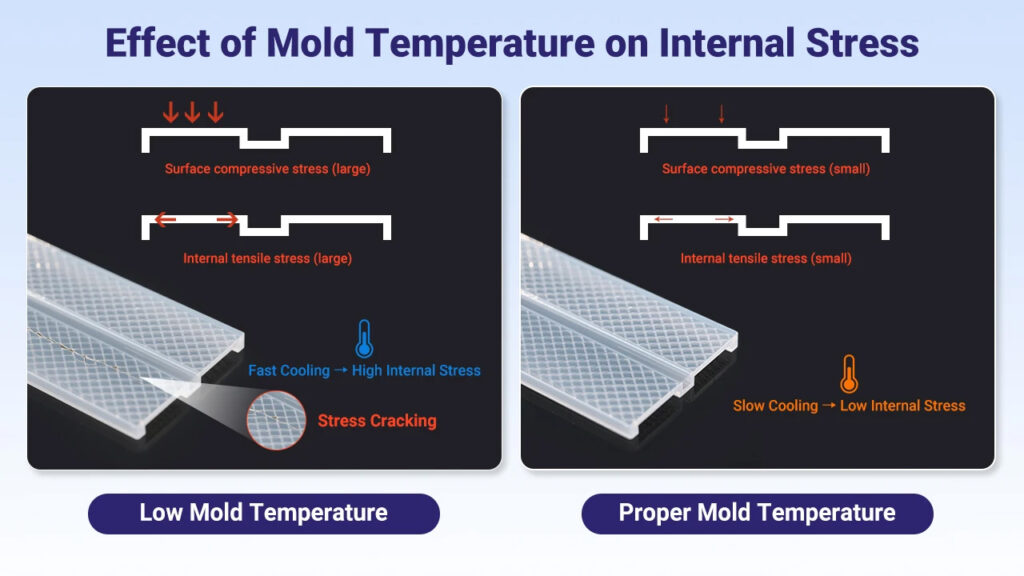
The Main Source Of Internal Stress
The internal stress of plastics mainly comes from two aspects:
Orientation Internal Stress Generated By Flow Orientation
- Stretching: Under formsprutning, the molten plastic molecular chains are disordered. When passing through narrow gates and channels, they are forcibly stretched and straightened by strong shear forces, arranged in the direction of flow (forming an orientation).
- Freeze: Ideally, if cooled slowly, these stretched molecular chains have enough time to relax and retract back to their natural curled state (driven by entropy increase). But in reality, the mold is cold and the cooling speed is extremely fast.
- Stress generation: The molecular chain is instantly “frozen” in this stretched and unnatural extended state before it can retract.
Thermal Stress Caused By Uneven Temperature Field
- Temperature difference: Molten plastic (e.g. above 200 ° C) is injected into a cold mold (e.g. 60 ° C). When it comes into contact with the cold mold wall, the surface will instantly cool and solidify, forming a hard “shell”.
- Asynchronous shrinkage: At this time, the core part inside the product is still in a high-temperature molten state. As the interior began to slowly cool and attempt to contract, it found its actions tightly constrained by the already solidified “hard shell” outside.
Stress generation: - Internal: wants to contract, but is pulled by the external shell, resulting in tensile stress (stretched stress) inside. Surface: is pulled by the tendency of internal contraction, resulting in compressive stress (compressed stress) on the surface.
Problems Caused By Internal Stress
The internal stress mentioned above is a contradictory state of “wanting to release but not being able to release” due to the limitations of the mold cavity. What if we break free from the limitations of the cavity? The following problems will occur.
- Warping and deformation: This is the most common consequence. When the internal stress distribution is uneven, it will attempt to bend the material in the direction of lower stress in order to seek balance, resulting in unstable product dimensions and inability to assemble.
- Stress cracking: This is the most fatal consequence. When storing, using, or coming into contact with chemical solvents, a slight external stimulus may combine with the enormous internal stress, causing the product to crack without warning.
- Decreased dimensional accuracy: The release of internal stress can cause the product to slowly deform over time, making it unable to meet the dimensional requirements of precision parts.
Product whitening and decreased optical performance: In stress concentration areas, changes in material density may cause light scattering, resulting in “silver lines” or stress whitening.
The Effect Of Mold Temperature On Improving Internal Stress
Whether it’s directional stress or thermal stress. In the process of injection molding, in order to cope with the adverse phenomena caused by stress, we need to fundamentally adjust by controlling the freezing time and shrinkage time.
Hur justerar man det?
There are two directions in terms of craftsmanship.
One is to adjust the cooling time of the frozen layer of the product and adjust the density shrinkage of each part through multiple stages of pressure holding. If you can’t understand, you can go back to my previous article to explain examples of pressure holding.
The second is to use our mold temperature. Reduce stress by controlling the freezing time through mold temperature, and compensate for uneven shrinkage in various parts of the product through mold temperature adjustment.
Setting Criteria For Material Mold Temperature
The glass transition temperature (Tg) and crystallinity of different materials vary significantly, and there are significant differences in mold temperature settings. Crystalline materials require “crystallization temperature matching”, while non crystalline materials require “cooling rate slowing down”.
The following are the general optimization ranges (which need to be adjusted in conjunction with plastic part wall thickness: if the wall thickness is ≥ 3mm, the mold temperature should be appropriately increased by 5-10 ℃):
Material Type | Representative Materials | Recommended Mold Temp Range | Key Points for Reducing Internal Stress |
|---|---|---|---|
Low Crystallinity | PP/PE | 20~50℃ | Cavity/core temperature difference ≤5℃ to avoid uneven shrinkage caused by rapid cooling at low temperatures |
High Crystallinity | POM/PA6/PA66 | 40~80℃ (60~90℃ recommended for glass fiber reinforced PA) | Insufficient crystallization and internal micro-stress occur at excessively low mold temperature; mold sticking is likely at excessively high mold temperature, requiring fine-tuning of holding pressure |
Amorphous (Low Tg) | ABS/HIPS | 40~70℃ | Increasing mold temperature to 50~60℃ significantly reduces molecular orientation stress and improves part brittleness (e.g., crack-prone issue of ABS) |
Amorphous (High Tg) | PC/PMMA/PSU | 80~120℃ (100~130℃ recommended for thick-walled PC parts) | Excessively low mold temperature is the main cause of overproof internal stress; high mold temperature is required to realize slow melt cooling and sufficient molecular relaxation; mold temperature ≥90℃ for PMMA can greatly reduce crazing/cracking |
Alloy Materials | PC/ABS/PBT/PEEK | 60~100℃ (120~180℃ recommended for high-temperature PEEK) | Set mold temperature based on the high Tg component (e.g., PC as the benchmark for PC/ABS with mold temperature ≥80℃) to balance the shrinkage difference of the two materials |
The Principle Of Controlling Deformation By Temperature Difference In The Mold
Här kommer jag att ta deformation som ett exempel för att förklara i detalj varför formtemperaturskillnad kan styra deformation?
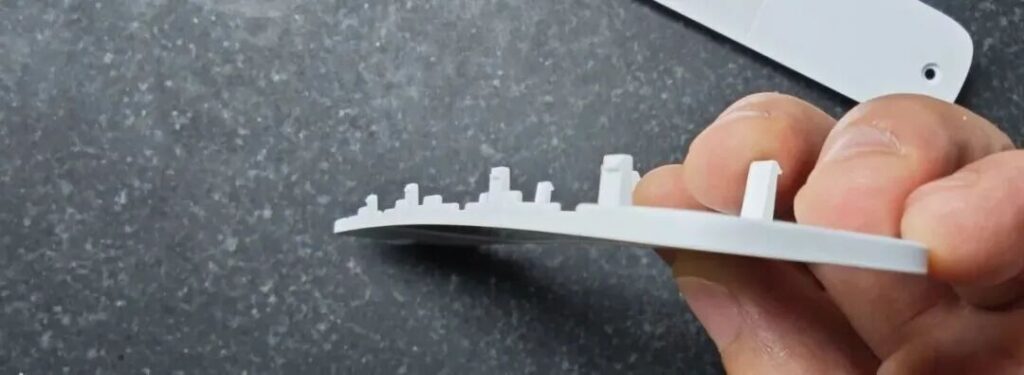
Let’s take the product that warped and deformed in the direction of the front mold as an example. Next, let’s focus on the key points!
Let’s forget about the previous theories here, such as the concept of time dilation, thermal stress orientation, and entropy increase and decrease.
Let me give you an interesting example to help you understand:
- Scenario: A narrow corridor with left and right walls representing the cavities of the front and rear molds.
- Protagonist: Two plastic molecule figures stand in the middle of the hallway. They have just finished warming up (melting and filling) and are now preparing to do a “static shape” (cooling and shaping).

Act 2: Inevitable Pulling (Deformation)
Now, the little person on the left is desperately pulling to the left, while the little person on the right has no resistance. The result is obvious: the entire small person on the right is uncontrollably pulled to the left (low-temperature side). This is the warping deformation we see.
So, how to maintain stability (eliminate deformation)?
Plan A: Thaw the little person who is holding onto the wall (corresponding to increasing the low-temperature side mold temperature)
- Description: The referee quickly blows warm air to the small person on the left and says, “Don’t be so tight, release your hands and relax a bit
- Effect: The muscles of the small person on the left thaw, gradually releasing the hand that was gripping the wall (releasing internal stress relaxation). The balance of left and right forces was restored, and the team stood straight.
- Professional correspondence: By increasing the low-temperature side mold temperature, slowing down the cooling rate, and providing relaxation time for molecular chains, orientation stress and thermal stress can be reduced.

Option B: Let the person on the other side also “grab onto the armrest” (corresponding to reducing the mold temperature on the high-temperature side)
- Description: The referee turned and ordered the person on the right: “Don’t be idle, freeze immediately and grab the handrail on the right
- Effect: The little person on the right also froze instantly, grabbing onto the right wall. Now, both sides are desperately pulling towards their own side, with opposing forces, reaching a new and tense balance. Although the team has stabilized, each member is very ‘tired’ (due to high internal stress).
- Professional correspondence: By reducing the mold temperature on the high temperature side, the cooling rate is synchronized and accelerated with the low temperature side. This achieves “synchronous freezing”, although the overall level of internal stress in the product is high, the distribution is symmetrical and not easy to cause warping. This is a balanced strategy of ‘fighting poison with poison’.

Slutsats
By now, you should understand!
The reason for deformation is not the internal stress itself, but the uneven magnitude of internal stress on the left and right sides.
We can change this state by adjusting the temperature difference of the mold, either promoting stress relaxation through “joint relaxation” or achieving symmetrical freezing through “joint tension”!
Vanliga frågor
What is the main cause of internal stress in injection-molded parts?
Uneven shrinkage of the melt during the filling and cooling stages is the primary reason. It essentially involves fast cooling, which freezes molecular chains, uneven temperature difference between cavity and core, over molecular orientation due to wrong injection speed, and lack of crystallization (for crystalline materials).
Can changing the temperature of the mold get rid of internal stress completely?
Nej, det gör jag inte. Adjusting the formtemperatur is certainly the most straightforward and effective way to lower the internal stress, but it should be combined with injection process parameters (injection speed, holding pressure) and mold structure optimization (uniform waterway). For parts that carry a great risk of deformation (such as thick, walled PC parts), post, treatment (tempering) är also necessary till further remove residual stress.
Why does the mold temperature have different effects on the internal stress of crystalline and amorphous materials?
I fallet med kristallina material (såsom PP/POM/PA), en lämplig formtemperatur setting can lead till Uniform och complete crystallization, thus eliminating micro, stresses caused by uneven crystallization; whereas in the case of amorphous materials (such as PC/ABS/PMMA), form temperature is mainly a regulator for molecular orientation and, by increasing the mold temperature, the cooling process can be slowed down till allow for sufficient molecular relaxation, thus lowering orientation stress.
What simple ways can be used to detect internal stress of injection, molded parts during mold trial?
Flera simple detection methods most commonly used locally are: acetone immersion test (for PC/PMMA, check if crazing or cracking occurs after soaking); bending test (for ABS/HIPS, check the ease of cracking when bent); visual inspection (examine the part surface for obvious silver streaks, warpage or cracks).
How to vary mold temperature for thick, walled and thin, walled parts respectively to reduce internal stress?
In the case of thick, walled parts (wall thickness 3mm), the form temperature should be raised by 5~10 compared with the standard range, thus slowing down the cooling rate to prevent internal shrinkage stress; On the other hand, for thin, walled parts (wall thickness 1. 5mm), the mold temperature should be set at the medium till high level av the recommended range and used in conjunction with medium and low injection speed in order to reduce molecular orientation stress due to rapid filling.
Kommentarer
Senaste Inlägg
Relaterade Bloggar
Senyo blogg är fokuserad på att dela med oss av vår omfattande kunskap av prototyp-tillverkning. Genom våra artiklar, har vi som mål att stödja dig i att förfina din produkt design och navigering i komplicerade rapid prototyping mer effektivt.