Modern Plastik Üretim Süreçlerine Giriş
içindekiler tablosu
Plastics are foundational materials in contemporary production. They develop the basis for numerous end-use products, from life-saving medical gadgets to day-to-day durable goods. The globe of plastics supplies thousands of polymer alternatives, each offering special mechanical and aesthetic homes. This flexibility, however, increases an essential inquiry for designers and engineers: what is the best means to transform a plastic material into a completed component?
A broad variety of plastics making procedures exists to fit diverse applications, part geometries, and material kinds. Understanding these options is essential for anybody involved in item growth. An educated option can drastically lower costs, shorten preparations, and boost end product quality. This comprehensive overview explores the most prevalent plastics making innovations today. We will give clear guidelines to help you select the excellent procedure for your particular application, guaranteeing your task moves from idea to truth with performance and precision.
How to Choose the Right Plastics Manufacturing Process
Choosing the optimal production process requires a calculated evaluation of your project’s specific needs. Prior to committing to a technology, an engineer should consider a number of crucial elements. We suggest you assess the adhering to aspects to make a notified choice.
- Component Geometry and Form: Does your component layout consist of complex inner functions? Does it require extremely tight resistances? The geometry of your design heavily affects your manufacturing alternatives. Some processes excel at developing detailed forms, while others are restricted to easier types. Complex layouts may also need substantial Design for Manufacturing (DFM) adjustments to be created economically.
- Production Volume and Cost: How several parts do you intend to make, both originally and annually? Particular plastics making techniques, like shot molding, have high in advance expenses for tooling yet produce parts at a really reduced per-unit cost. This makes them optimal for automation. In contrast, procedures like 3D printing have very little arrangement expenses, however the price per part stays relatively high, making them ideal for low-volume manufacturing and prototyping.
- Teslim Süresi: How swiftly do you need the finished parts? Some processes can deliver a first prototype within 24 hours. Others, particularly those calling for facility tool manufacture, might take weeks or perhaps months before the first component is produced. Your job timeline will certainly be a definitive variable.
- Malzeme Gereksinimleri: What functional and environmental stress and anxieties must your item sustain? The perfect material depends on a balance of factors, including toughness, flexibility, temperature level resistance, chemical resistance, and appearance. You need to evaluate the desired features against the materials offered for a provided manufacturing process.
Understanding the Two Main Types of Plastics
Plastics are broadly categorized into two main families: thermoplastics and thermosets. Their fundamental difference lies in how they respond to heat, which dictates which plastics manufacturing processes are suitable for them.
Termoplastikler
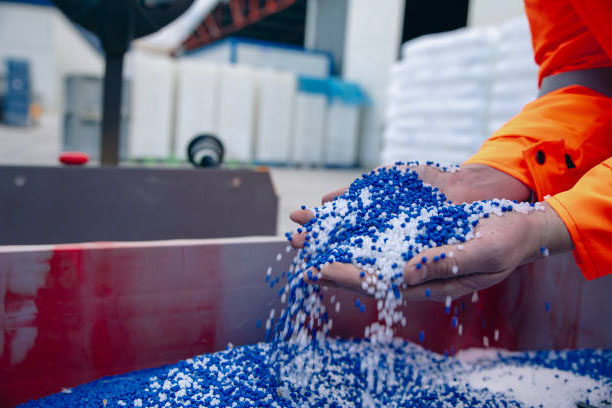
Termoplastikler, üretimde kullanılan en yaygın plastik türüdür. Onların tanımlayıcı özelliği, önemli kimyasal bozulma olmadan eritilme, katılaştırılma ve ardından tekrar eritilme yeteneğidir. Bu özellik onları son derece geri dönüştürülebilir ve tekrar kullanılabilir hale getirir. Üreticiler tipik olarak termoplastikleri küçük granüller veya levhalar halinde tedarik ederler. Malzemeyi esnek bir duruma ısıtırlar ve daha sonra istenen şekle sokarlar. Bu işlem tamamen fiziksel ve tersine çevrilebilir.
Yaygın Termoplastik Malzemeler:
- Akrilonitril Bütadien Stiren (ABS)
- Polikarbonat (PC)
- Polipropilen (PP)
- Polietilen (PE)
- Poliamid (PA / Naylon)
- Polilaktik Asit (PLA)
- Polivinil Klorür (PVC)
- Polieter Eter Keton (PEEK)
Termoset Plastikler
Termoset plastikler veya termosetler farklı davranır. Kürlendikten sonra kalıcı bir katı halde kalırlar. Kürleme işlemi sırasında - ısı, ışık veya kimyasal reaksiyonla indüklenen - polimerler çapraz bağlanarak geri dönüşü olmayan bir kimyasal bağ oluşturur. Bir termoset plastiği yeniden ısıtırsanız, erimek yerine ayrışır ve yanar. Bu, termosetleri termoplastiklerle aynı şekilde yeniden kalıplayamayacağınız veya geri dönüştüremeyeceğiniz anlamına gelir.
Yaygın Termoset Malzemeler:
- Epoksi
- Silikon
- Polyurethane
- Polyester
- Vulcanized Rubber
- Cyanate Ester
| Özellik | Termoplastikler | Thermosetting Plastics (Thermosets) |
|---|---|---|
| Response to Heat | Softens when heated, hardens when cooled. Reversible. | Cures and hardens permanently with heat. Irreversible. |
| Molecular Structure | Long-chain polymers with weak intermolecular forces. | Polymers form a rigid, cross-linked 3D network. |
| Geri Dönüştürülebilirlik | Highly recyclable. Can be melted and reformed. | Generally not recyclable through melting. |
| Mechanical Properties | Often more flexible and impact-resistant. | Typically more rigid, stable, and heat-resistant. |
| Common Processes | Injection Molding, 3D Printing (FDM), Extrusion. | Polymer Casting, Reaction Injection Molding. |
| Tipik Uygulamalar | Consumer goods, packaging, pipes, containers. | Adhesives, coatings, electrical components, high-heat parts. |
Key Plastics Manufacturing Processes Explained
Here, we detail eight of the most significant plastics manufacturing technologies used in industry today.
1. 3D Baskı (Additive Manufacturing)
3D printers build three-dimensional parts directly from CAD files. The process works by adding material layer by layer until the final object is complete. This additive approach contrasts sharply with traditional subtractive methods.
The Process:
- Print Setup: An operator uses specialized software to orient the digital model in a virtual build space. The software then slices the model into thin horizontal layers and generates a toolpath for the printer. If needed, the software adds support structures.
- Baskı: The printer executes the toolpath layer by layer. The specific technology determines how it adds material. Fused Deposition Modeling (FDM) extrudes molten plastic filament. Stereolithography (SLA) uses a laser to cure liquid photopolymer resin. Selective Laser Sintering (SLS) uses a laser to fuse powdered plastic.
- İşlem sonrası: After printing, the operator removes the part from the printer. Depending on the technology, the part may require cleaning, washing, and post-curing to achieve its final properties. The operator then removes any support structures.
3D printing eliminates the need for tooling, which drastically reduces setup times and costs for custom parts. However, it is generally slower and more labor-intensive per part than mass-production methods. As the technology advances, its cost-effectiveness is improving, making it viable for low-to-mid-volume production runs.
| 3D Baskı | |
|---|---|
| Form Freedom | Yüksek |
| Teslim Süresi | < 24 hours |
| Setup Cost | $ |
| Cost Per Part | $$$ |
| Ideal Volume | ~1 – 1.000 parça |
| Yaygın Malzemeler | Termoplastikler (Naylon, ABS, PLA), Termoset Reçineler |
2. CNC işleme
CNC (Bilgisayarlı Sayısal Kontrol) işleme, bir çıkarma üretim sürecidir. Bir iş parçası olarak bilinen katı bir plastik veya metal bloktan malzemeyi seçici olarak çıkarmak için frezeler, torna tezgahları ve taşlama makineleri gibi bilgisayar kontrollü araçlar kullanır.
The Process:
- İş Kurulumu: Bir programcı önce bir CAD modelini bir CAM (Bilgisayar Destekli Üretim) dosyasına dönüştürür. Bu dosya, kesme aletlerinin hareketlerini ve hızlarını yönlendiren takım yollarını içerir.
- İşleme: Operatör, takım yollarını CNC makinesine gönderir. Frezeleme için, dönen bir alet sabit bir iş parçasından malzeme çıkarır. Bir torna tezgahında tornalama için, iş parçası sabit bir kesme aletine karşı döner.
- İşlem sonrası: İşleme tamamlandıktan sonra, operatör parçayı temizler, keskin kenarları çapaklardan arındırır ve fazla malzemeyi keser.
CNC işleme, çok sıkı toleranslara ve kalıplanması zor geometrilere sahip düşük hacimli plastik parçalar üretmek için idealdir. Dişliler ve fikstürler gibi prototipler ve fonksiyonel son kullanım parçaları oluşturmada mükemmeldir. Kurulum maliyetleri orta düzeyde olsa da, parça karmaşıklığı işleme süresini ve maliyetini önemli ölçüde artırabilir.
| CNC işleme | |
|---|---|
| Form Freedom | Orta |
| Teslim Süresi | < 24 hours |
| Setup Cost | $$ |
| Cost Per Part | $$$$ |
| Ideal Volume | ~1 – 5.000 parça |
| Yaygın Malzemeler | Çoğu sert plastik (PC, POM, PEEK, Naylon, ABS) |
3. Polimer Dökümü
Polimer dökümü, sıvı reaktif reçine veya kauçuğun bir kalıba dökülmesini içerir. Malzeme daha sonra kimyasal bir reaksiyona girer ve nihai parça halinde katılaşır.
The Process:
- Kalıp Hazırlığı: Bir operatör, parçanın yapışmasını önlemek için kalıbın iç yüzeylerine bir ayırıcı madde uygular. Bazen kalıbı belirli bir sıcaklığa önceden ısıtırlar.
- Döküm: Operatör, sentetik bir reçineyi bir kürleme maddesiyle karıştırır ve kalıp boşluğuna döker veya enjekte eder.
- Kürleme: Malzeme, katılaşana kadar kalıbın içinde kürlenir. Isı uygulamak, belirli polimerler için bu süreci hızlandırabilir.
- Kalıptan Çıkarma: Operatör kalıbı açar ve kürlenmiş parçayı dikkatlice çıkarır.
- Kırpma: Son olarak, operatör çapak veya yolluk gibi artefaktları keser veya zımparalar.
Molds for polymer casting, often made from RTV silicone rubber, are inexpensive compared to the hard steel tools used in injection molding. This makes the process excellent for prototyping and short production runs. However, thermoset casting resins are often more expensive than thermoplastics, and the process is labor-intensive, resulting in a higher cost per part.
| Polymer Casting | |
|---|---|
| Form Freedom | Yüksek |
| Teslim Süresi | 1 – 3 days |
| Setup Cost | $ |
| Cost Per Part | $$ |
| Ideal Volume | ~1 – 1.000 parça |
| Yaygın Malzemeler | Polyurethane, Epoxy, Silicone, Acrylic |
4. Rotational Molding
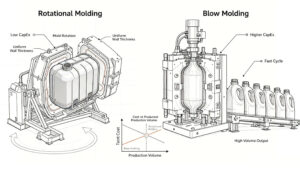
Rotational molding, or rotomolding, is a unique process for creating large, hollow plastic objects. It involves heating a hollow mold filled with powdered plastic while rotating it on two axes.
The Process:
- Charging: An operator loads a measured amount of plastic powder into the mold cavity and closes it securely.
- Isıtma: The mold is placed in an oven and rotated along two perpendicular axes. The heat melts the powder, which tumbles and coats the mold’s interior walls.
- Soğutma: The mold continues to rotate as it cools slowly. This ensures the plastic skin solidifies evenly without sagging.
- Parça çıkarma: Once cool, the operator opens the mold and removes the finished hollow part.
Rotomolding uses centrifugal force, not pressure, so its tooling can be made from less expensive materials like aluminum. This keeps setup costs relatively low. The process is perfect for producing items like tanks, kayaks, and large containers. Its main limitations are long cycle times and looser tolerances compared to other molding methods.
| Rotasyonel Kalıplama | |
|---|---|
| Form Freedom | Medium (ideal for large hollow parts) |
| Teslim Süresi | Days to weeks |
| Setup Cost | $$$ |
| Cost Per Part | $$ |
| Ideal Volume | ~200 – 5,000 parts |
| Yaygın Malzemeler | Polyethylene (PE), Polypropylene (PP), PVC, Nylon |
Vacuum forming is a type of thermoforming where a sheet of heated plastic is draped over a mold and a vacuum pulls it into shape.
The Process:
- Sıkıştırma: A machine clamps a sheet of plastic into a frame.
- Isıtma: Heating elements warm the sheet until it becomes soft and pliable.
- Vacuum: The frame lowers the softened sheet over a mold. A vacuum pump then activates, sucking out the air between the sheet and the mold, forcing the plastic to conform to the mold’s shape.
- Cooling and Release: The formed part cools and solidifies. Fans or a fine water mist can speed up this stage.
- Kırpma: Operatör parçayı kalıptan çıkarır ve fazla malzemeyi keser.
Vakumla şekillendirme için kullanılan takımlar çok uygun maliyetlidir, çünkü işlem düşük basınçlar içerir. Bu, tek seferlik prototiplerden seri üretime kadar her şey için uygun hale getirir. Ancak, ambalaj, tepsiler ve otomotiv astarları gibi nispeten basit geometrilere ve ince duvarlara sahip parçalar oluşturmakla sınırlıdır.
| Vacuum Forming | |
|---|---|
| Form Freedom | Sınırlı (basit, ince duvarlı parçalar) |
| Teslim Süresi | Saatlerden haftalara |
| Setup Cost | $-$$$$ |
| Cost Per Part | $-$$$ |
| Ideal Volume | Herhangi bir hacim |
| Yaygın Malzemeler | ABS, PETG, Polistiren (PS), PC, PP, PVC |
Enjeksiyon kalıplama, plastik parçaların seri üretimi için baskın işlemdir. Erimiş termoplastik malzemenin yüksek basınçta hassas bir şekilde işlenmiş bir kalıba enjekte edilmesiyle çalışır.
The Process:
- Kalıp Kurulumu: Bir çelik kalıbın iki yarısı güçlü bir hidrolik pres ile kapatılır.
- Enjeksiyon: Büyük bir vida, plastik granülleri eritir ve erimiş malzemeyi ileri doğru iter. Makine daha sonra bu malzemeyi yüksek basınçta kalıp boşluğuna enjekte eder.
- Cooling and Release: Plastik soğur ve kalıp içinde katılaşır. Katılaştıktan sonra kalıp açılır ve ejektör pimleri parçayı dışarı iter.
- İşlem sonrası: Sistem, kalıp açıldığında genellikle yollukları ve kanalları (plastik yönlendiren kanallar) otomatik olarak temizler.
Injection molding can produce highly complex parts with excellent repeatability. However, the molds themselves are extremely expensive and can take months to create. This high initial investment is only justified by very high production volumes, where the per-part cost becomes incredibly low.
| Enjeksiyon Kalıplama | |
|---|---|
| Form Freedom | Yüksek |
| Teslim Süresi | 2 – 4 months (for tooling) |
| Setup Cost | $$$$$ |
| Cost Per Part | $ |
| Ideal Volume | 5,000+ parts |
| Yaygın Malzemeler | Almost any thermoplastic (ABS, PP, PC, PA, etc.) |
7. Extrusion
Extrusion creates objects with a fixed cross-sectional profile. The process works by pushing molten plastic through a shaped die.
The Process:
- Plasticating: A screw melts and conveys plastic pellets through a heated barrel.
- Kalıplama: The screw forces the molten plastic through a die. The shape of the die opening determines the profile of the final part.
- Soğutma: The extruded plastic profile emerges from the die and is cooled, often in a water bath.
- Kesiyorum: The continuous shape is then cut into desired lengths or coiled onto a spool.
Extrusion is a highly efficient, continuous process with relatively low tooling costs compared to injection molding. It is limited to producing linear, two-dimensional shapes. Common applications include pipes, tubing, window frames, and weather stripping.
| Ekstrüzyon | |
|---|---|
| Form Freedom | Limited (continuous linear profiles) |
| Teslim Süresi | Weeks |
| Setup Cost | $$$ |
| Cost Per Part | $ |
| Ideal Volume | 1,000+ parts |
| Yaygın Malzemeler | PVC, PP, PE, ABS, Polystyrene |
8. Blow Molding
Blow molding is a technique for creating hollow plastic parts, most notably bottles and containers. It works by inflating a heated plastic tube inside a mold cavity.
The Process:
- Parison Creation: A machine melts plastic pellets and extrudes them into a hollow tube called a parison.
- Kalıplama: A mold closes around the parison, pinching one end shut. Pressurized air is then blown into the parison, inflating it like a balloon until it presses against the cold mold walls.
- Cooling and Release: The part cools and solidifies. The mold then opens and ejects the finished product.
Blow molding uses lower pressures than injection molding, which helps keep tooling costs moderate. As a continuous, automated process, it can achieve very high production rates and an extremely low cost per unit. It is the go-to method for manufacturing bottles, fuel tanks, and other hollow items at scale.
| Şişirme Kalıplama | |
|---|---|
| Form Freedom | Limited (hollow, thin-walled parts) |
| Teslim Süresi | Weeks |
| Setup Cost | $$$$ |
| Cost Per Part | $ |
| Ideal Volume | 5,000+ parts |
| Yaygın Malzemeler | Polyethylene Terephthalate (PET), PP, PVC, PE |
Critical Quality Control Considerations
Achieving success in plastics producing depends not only on selecting the best procedure however likewise on applying strenuous quality assurance. Regardless of the method, you have to verify that the ended up parts satisfy the required requirements. Secret locations of emphasis include dimensional accuracy, product properties, and aesthetic coating. Makers make use of precision devices like electronic calipers, micrometers, and Coordinate Measuring Machines (CMMs) to validate that part dimensions are within the specified tolerances.
Additionally, it is frequently needed to perform functional examinations. Product screening can validate properties like tensile stamina, solidity, and impact resistance to make sure the part will certainly do correctly under tension. Aesthetic inspection is additionally important, especially for consumer-facing products. This includes monitoring for surface flaws like sink marks or flash, verifying color uniformity versus a criterion, and ensuring the surface coating satisfies the layout needs. A durable quality control strategy makes certain consistency and integrity from the initial component to the last.
Sonuç
The field of plastics manufacturing is dynamic and diverse, offering a solution for nearly any design challenge. Each process, from the rapid versatility of 3D printing to the high-volume efficiency of injection molding, has a unique profile of strengths and weaknesses. The best choice always depends on a careful analysis of your project’s specific requirements for geometry, volume, speed, and material performance.
By understanding the fundamental principles of these core technologies, designers and engineers can make smarter decisions early in the development cycle. This knowledge empowers you to optimize your designs for manufacturing, reduce costs, and accelerate your time to market. As technology continues to evolve, the boundaries between these processes will shift, opening up new possibilities for innovation in how we create the plastic parts that shape our world.
For Reference
- Society of Plastics Engineers (SPE):
https://www.4spe.org/– A leading technical society for plastics professionals, providing valuable resources and industry information. - Plastics Industry Association (PLASTICS):
https://www.plasticsindustry.org/– An organization that supports the entire plastics supply chain, offering market data and advocacy. - UL Prospector (formerly IDES):
https://www.ulprospector.com/en/na/plastic– A comprehensive database for searching and comparing technical data sheets for thousands of plastic materials. - Autodesk’s Design for Manufacturing (DFM) Guide:
https://www.autodesk.com/products/fusion-360/blog/what-is-design-for-manufacturing-dfm/– An excellent resource for understanding DFM principles, which are critical for processes like injection molding.
Yorumlar
Son Yazılar
İlgili Bloglar
Senyo'nun blogu, prototip üretimi konusundaki kapsamlı bilgimizi paylaşmaya odaklanmıştır. Makalelerimiz aracılığıyla, ürün tasarımınızı geliştirmenize ve hızlı prototiplemenin karmaşıklıklarını daha etkin bir şekilde yönlendirmenize yardımcı olmayı hedefliyoruz.