
Pirinç ve Bronz: Teknik Malzeme Analizi
içindekiler tablosu
In products scientific research and engineering, accuracy is extremely important. Developers and fabricators should make informed choices to guarantee a task’s success. 3 of one of the most common red metals– brass vs bronze vs copper– present a constant point of confusion. Their similar appearances and common parent component, copper, commonly lead to wrong material choice. Nonetheless, the refined variants between them create substantial differences in mechanical efficiency, deterioration resistance, and cost. Misidentifying them is not an insignificant error; it can endanger the integrity and life-span of an end product.
This write-up offers a definitive, scientific comparison of brass vs bronze, with pure copper acting as a foundational benchmark. We will explore their elemental make-ups, assess their unique physical and mechanical properties, and discover their excellent applications. By utilizing clear information and direct comparisons, this guide removes uncertainty. It furnishes you with the technical knowledge to confidently select the appropriate material for your particular engineering and production demands.
Elemental Composition: The Foundational Difference
The identification of each metal starts at the atomic degree. Their distinct buildings are a straight outcome of their constituent aspects.
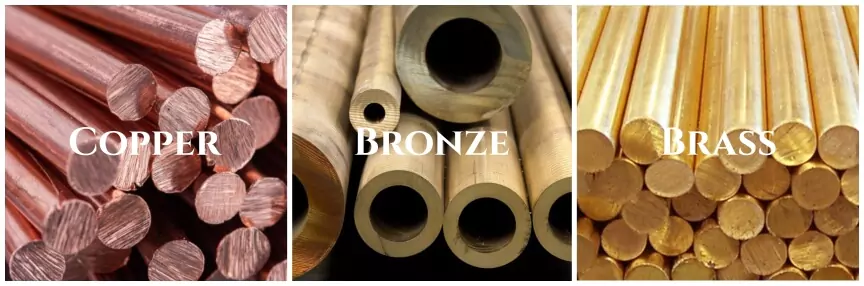
Copper (Cu): Copper is a pure chemical element with the atomic number 29. Unlike its alloys, copper exists naturally in a straight usable metallic type. We consider it the base steel where we create brass and bronze. Its purity is an essential consider its outstanding electrical and thermal conductivity.
Brass (Copper-Zinc Alloy): We produce brass by alloying copper mostly with zinc (Zn). The zinc content can vary from a couple of percent to around 45%. Suppliers usually add various other components in smaller amounts to improve particular buildings. As an example, lead (Pb) boosts machinability, while aluminum (Al) enhances rust resistance. The brass vs bronze distinction essentially begins here, with zinc as the main alloying representative in brass.
Bronze (Copper-Tin Alloy): Bronze is an alloy of copper where tin (Sn) is the primary alloying component. Similar to brass, other aspects like phosphorus (P), manganese (Mn), light weight aluminum (Al), and also zinc can be included to produce details bronze grades. The visibility of tin generally makes bronze harder and a lot more immune to steel fatigue than brass.
Comparative Properties Overview
To provide a clear, at-a-glance reference, the table below summarizes the key distinctions between these three materials. This data offers a high-level view before we delve into a more detailed analysis of each property.
| Mülkiyet | Pirinç | Bronz | Bakır |
|---|---|---|---|
| Primary Composition | Copper (Cu) + Zinc (Zn) | Copper (Cu) + Tin (Sn) | Pure Copper (Cu) |
| Renk | Subdued, yellowish gold | Reddish-brown, often with a dull gold hue | Reddish-brown, bright and lustrous when new |
| Density | ~8,720 kg/m³ | ~7,400 – 8,900 kg/m³ | ~8,930 kg/m³ |
| Melting Point | ~927°C (1700°F) | ~913°C (1675°F) | ~1085°C (1984°F) |
| Tensile Strength | 338 – 469 MPa | 350 – 635 MPa | ~210 MPa |
| Akma Dayanımı | 95 – 124 MPa | 125 – 800 MPa | ~33.3 MPa |
| Brinell Hardness | 55 – 73 | 40 – 420 | ~35 |
| Korozyon Direnci | İyi | Mükemmel | Mükemmel |
| Electrical Conductivity | ~28% IACS | ~15% IACS | 100% IACS (by definition) |
| Thermal Conductivity | ~64 BTU/hr-ft²-°F | ~229 – 1440 BTU/hr-ft²-°F | ~223 BTU/hr-ft²-°F |
(Note: IACS stands for International Annealed Copper Standard. Values are approximate and vary by specific alloy.)
Physical and Mechanical Properties: A Head-to-Head Analysis
Recognizing the data from the table calls for a much deeper explore what each building suggests for real-world efficiency.
Rust Resistance: The Battle Against the Elements
The capacity to resist ecological deterioration is a crucial consider the brass vs bronze dispute.
Bronze shows remarkable corrosion resistance, particularly in saltwater settings. When exposed to air, bronze forms an oxidative layer, or aging. This layer is a copper sulfate/carbonate movie that sticks securely to the surface area and secures the underlying steel from more rust. This particular makes bronze the premier choice for aquatic applications, such as ship props, submerged bearings, and seaside architectural functions.
Pure copper also creates a protective aging. This is the familiar green layer seen on old copper roofing systems and sculptures. This aging effectively shields the metal from climatic rust, providing it a very lengthy life expectancy in outdoor applications.
Brass shows good rust resistance, however it is usually substandard to bronze and copper. Brass is susceptible to a details sort of corrosion called dezincification, where the zinc is precisely seeped from the alloy in the presence of certain corrosive agents. This procedure deteriorates the material. However, some brass alloys, such as marine brass (Alloy 464), include a percentage of tin to hinder this procedure, dramatically boosting their longevity in marine contexts.
Strength and Durability: A Measure of Toughness
Toughness identifies a product’s capability to hold up against applied pressures without deforming or fracturing.
Bronze is the clear champion in terms of stamina. It has a dramatically higher tensile strength (the pressure needed to pull it apart) and return stamina (the pressure called for to create long-term deformation) than both brass and pure copper. Its composition offers it superb wear resistance and a high load-bearing capability, making it optimal for bushings, bearings, and heavy-duty architectural parts.
Brass offers a great balance of strength and formability. While not as strong as many bronze alloys, it is considerably more powerful and much more resilient than pure copper. This makes it ideal for a vast array of applications, from plumbing installations to ammo casings.
Copper is a relatively soft and pliable steel. It has the lowest tensile and return strength of the 3. Its worth lies not in its raw toughness but in its ductility and conductivity. It flexes and stretches conveniently without damaging, but it is not suitable for high-stress architectural applications.
Hardness and Malleability: The Push and Pull of Forming
Firmness measures a material’s resistance to surface impression and scraping, while malleability is the capability to be shaped without damaging.
Bronze is the hardest of the 3 materials. Its Brinell solidity can reach up to 420 for sure high-strength alloys. This solidity contributes to its outstanding wear resistance however also makes it much more brittle than brass and copper. Under severe stress and anxiety, it is more likely to crack than bend.
Brass has a moderate firmness, striking a balance in between the strength of bronze and the softness of copper. This residential property, incorporated with its good strength, makes it a highly flexible material.
Copper is the softest and most flexible. Its low firmness score implies it damages easily. Nonetheless, this exact same gentleness allows it to be attracted into extremely slim cords or inculcated complicated shapes effortlessly, a property central to its use in circuitry and detailed pipework.
The Critical Role of Conductivity
For numerous applications, especially in the electrical and electronic devices markets, thermal and electrical conductivity are one of the most essential homes. Right here, the differences in between the steels are plain.
Electrical Conductivity
We use pure copper as the worldwide criterion for electrical conductivity. Its atomic framework allows electrons to stream with marginal resistance. We designate it a ranking of 100% IACS (International Annealed Copper Standard). This makes copper the undeniable selection for electrical wiring, busbars, electric motor windings, and any type of application where reliable power transfer is important.
When we develop brass and bronze, the addition of alloying elements like zinc and tin interferes with copper’s attire crystal latticework. These international atoms scatter the flow of electrons, dramatically boosting electric resistance. Brass, being a copper-zinc alloy, maintains about 28% of copper’s conductivity. Bronze, with its tin web content, is also much less conductive, usually around 15% IACS. For that reason, in the brass vs bronze face-off for electric applications, neither is a suitable replacement for pure copper.
Thermal Conductivity
Thermal conductivity gauges a product’s capability to transfer warm. This building is essential for applications like warm sinks, warmth exchangers, and premium cookware.
Interestingly, while bronze is a poor electric conductor, certain alloys have very high thermal conductivity, occasionally even surpassing copper under particular problems. Nevertheless, pure copper is much more constantly and famously a superb thermal conductor, with a rating of 223 BTU/hr-ft ² -° F. This is why it is the preferred product for computer warmth sinks and high-performance radiators.
Brass is the least thermally conductive of the 3. With a thermal conductivity of simply 64 BTU/hr-ft TWO- ° F, it acts much more as an insulator than a conductor about copper. This home can be valuable in applications where warm transfer needs to be lessened, such as in particular sorts of shutoff and pipeline fittings.

Machinability and Weldability: Manufacture Considerations
The ease with which a product can be cut, shaped, and joined is a vital consideration for manufacturing performance and price.
- Machinability: Machinability describes the convenience of cutting, drilling, milling, or turning a material. Pure copper can be “gummy” to machine, meaning the soft material can obstruct reducing devices. Bronze, being more challenging, can be much more testing to machine than brass. Brass is typically thought about to have excellent machinability. Particularly, Alloy C360, additionally known as “Free-Machining Brass,” contains a percentage of lead. The lead works as an interior lube and chip breaker, permitting very high cutting rates and a smooth surface finish. This makes C360 a leading selection for creating high volumes of complex components like shutoffs and fittings.
- Kaynaklanabilirlik: All 3 metals can be bonded, but methods and simplicity vary. Deoxidized and oxygen-free copper grades are easily weldable using TIG or MIG processes. Bronze alloys can be more difficult to bond, as they can be vulnerable to cracking under the anxiety of heating and cooling. Brass weldability is greatly dependent on its zinc content. Alloys with lower zinc are less complicated to weld. High-zinc brasses can launch zinc fumes throughout welding, which is a health hazard and can cause a permeable, weak weld.
Alloy Designations and Common Grades
The terms “brass” and “bronze” each represent a large family of alloys. Understanding some common grades helps in practical material specification.
| Alloy Family | Common Alloy (UNS No.) | Ortak Ad | Key Characteristics & Applications |
|---|---|---|---|
| Pirinç | Model numarası.: C26000 | Kartuş Pirinç | Excellent cold workability. Used for ammunition casings, fasteners. |
| Pirinç | Model Numarası.: C36000 | Free-Machining Brass | The benchmark for machinability. Used for fittings, valves, gears. |
| Pirinç | Model numarası.: C46400 | Deniz Pirinci | Excellent corrosion resistance in seawater. Used for marine hardware. |
| Bronz | C51000 | Phosphor Bronze | Good strength, fatigue resistance, and formability. Used for springs, bellows. |
| Bronz | C63000 | Aluminum Bronze | High strength and corrosion resistance. Used for heavy-duty gears, wear plates. |
| Bronz | C93200 | Leaded Bearing Bronze | Excellent lubricity and wear properties. Used for bearings and bushings. |
| Bakır | C10100 | Oxygen-Free Copper | Highest purity (99.99% Cu). Used for high-end electronics and vacuum seals. |
| Bakır | C11000 | ETP Copper | Standard for electrical conductivity. Used for wiring, busbars, roofing. |
Economic Factors: Cost and Availability
For any project, the budget is a practical restraint. The price of these metals is straight connected to their composition and the market worth of their constituent elements.
Copper is commonly one of the most pricey of the three. Its rate is established by worldwide product markets (LME, COMEX). As a pure aspect, its handling needs substantial energy.
Bronze is normally the 2nd most pricey. While it contains much less copper than pure copper, its primary alloying component, tin, is typically extra costly than zinc.
Brass is one of the most affordable of the three. Its primary alloying aspect, zinc, is significantly less expensive than copper. This reduced expense, integrated with its superb machinability, makes brass an economically eye-catching choice for high-volume production of durables.
Sonuç
The debate of pirinç vs bronz vs copper is not a matter of which metal is “better,” but which is “correct” for a specific purpose. The choice is a deliberate engineering decision based on a trade-off of properties.
Seçin Bakır when your primary requirement is maximum electrical or thermal conductivity. Its unparalleled performance in these areas makes it indispensable for electrical and electronic applications.
Seçin Bronz when you need superior strength, hardness, and corrosion resistance, especially in marine environments. Its durability makes it the ideal material for bearings, bushings, ship propellers, and long-lasting sculptures.
Seçin Pirinç when you need a versatile, cost-effective, and highly machinable material with good corrosion resistance and aesthetic appeal. Its balanced properties make it perfect for plumbing fixtures, musical instruments, decorative hardware, and high-volume manufactured parts.
By understanding the fundamental differences in their composition, you can accurately predict their performance and confidently select the precise alloy to ensure the function, longevity, and success of your project.
Son Yazılar
İlgili Bloglar
Senyo'nun blogu, prototip üretimi konusundaki kapsamlı bilgimizi paylaşmaya odaklanmıştır. Makalelerimiz aracılığıyla, ürün tasarımınızı geliştirmenize ve hızlı prototiplemenin karmaşıklıklarını daha etkin bir şekilde yönlendirmenize yardımcı olmayı hedefliyoruz.