Pontos-chave do processo de moldação por injeção de ABS
Tabela de Conteúdo
O ABS é um plástico de engenharia multicomponente não cristalino (mas com uma estrutura bifásica microscópica). As suas propriedades são uma expressão sinérgica dos seus três componentes:
- Acrilonitrilo (A): Proporciona dureza, resistência, resistência ao calor e resistência química.
- Butadieno (B): Proporciona tenacidade, resistência ao impacto (especialmente tenacidade a baixas temperaturas) e elasticidade.
- Estireno (S): Proporciona brilho, fluidez e facilidade de processamento.
Com base nisto, as características relacionadas com o processamento de moldagem por injeção de ABS são as seguintes:
- Fluidez média: A fluidez é melhor que a do PC, mas pior que a do PS, PP, etc. A sua fluidez é relativamente sensível à temperatura.
- Higroscopicidade: Apresenta higroscopicidade moderada e deve ser pré-aquecido e seco; caso contrário, surgirão bolhas, estrias prateadas ou turvação na superfície do produto.
- Encolhimento: A contração de moldagem é baixa, aproximadamente entre 0,4% e 0,7%, e a estabilidade dimensional é boa.
- A estabilidade térmica é geralmente boa: Apresenta uma boa estabilidade de processamento a temperaturas adequadas, mas o aquecimento prolongado ou excessivo pode facilmente levar à degradação, particularmente à decomposição do componente butadieno, fazendo com que o material amarele, se torne quebradiço e produza gases e manchas negras.
- Estrutura bifásica: A fase de borracha (butadieno) está dispersa na fase de resina (AS). As altas temperaturas e as elevadas taxas de cisalhamento podem perturbar esta estrutura, afetando a tenacidade final.
Pontos-chave do processo de moldação por injeção de ABS
1. Pré-tratamento: Secagem
Necessidade: Embora não seja tão rigoroso como o PC, a absorção de humidade no ABS pode causar defeitos superficiais no produto final.
Condições de secagem:
- Equipamento: Um secador de ar quente padrão é suficiente; para ABS de alto brilho ou transparente, recomenda-se um secador com desumidificador.
- Temperatura: 80-85°C. Não ultrapasse os 90°C para evitar a aglomeração e adesão das partículas.
- Tempo: 2 a 4 horas.
- Requisito de teor de humidade: Secar até atingir um teor de humidade < 0,1%.
- Julgamento simples: Uma faixa lisa e brilhante de material fundido ejetada do ar, isenta de bolhas, ou a ausência de bolhas quando a faixa é pressionada contra duas placas de vidro, indica que o produto está qualificado.
2. Temperatura de moldação para injeção de ABS
Temperatura do barril:
- Princípio: Utilize uma distribuição "média-alta-alta-média". O ABS tem uma ampla gama de temperatura de processamento, mas o limite superior deve ser rigorosamente controlado.
- Zona traseira (Secção de alimentação): 160-180℃. Impede o derretimento prematuro e a aderência da matéria-prima, garantindo uma alimentação estável.
- Zona intermédia (Secção de compressão): 180-220℃. Zona principal de plastificação; a temperatura de fixação é crítica.
- Zona frontal (Secção de medição): 200-230 °C. Garante a homogeneização da massa fundida. Para o ABS retardador de chama, deve ser utilizado o limite inferior.
- Alcance geral: Recomenda-se que a temperatura de fusão da maioria dos materiais ABS seja controlada entre 210-240°C.
- Aviso importante: Evite a todo o custo ultrapassar os 250 °C. A altas temperaturas, a fase de borracha decompõe-se facilmente, produzindo uma grande quantidade de gás (odor forte) e manchas pretas, o que leva ao amarelecimento e à degradação grave do desempenho do material.
- Temperatura do bico: Um pouco abaixo da zona frontal, aproximadamente 200-220°C. Podem ser usados bicos abertos.
3. Temperatura do molde para moldagem por injeção de ABS
Intervalo de temperatura: 40-80℃. Esta é uma das variáveis-chave no processo de fabrico do ABS, impactando significativamente a aparência e o desempenho do produto final.
Efeitos específicos:
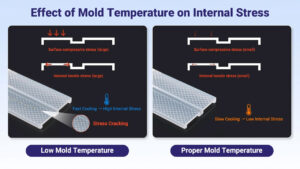
Temperatura baixa do molde (40-50℃):
- Vantagens: Reduz o tempo de ciclo, facilitando uma produção rápida; produz um acabamento superficial mate ou texturizado.
- Desvantagens: Linhas de soldadura visíveis com baixa resistência; maior tensão interna; em peças de paredes espessas, pode ocorrer contração superficial irregular (marcas de contração) devido ao arrefecimento excessivamente rápido.
Temperatura de moldagem elevada (60-80℃):
- Vantagens: Melhora a fluidez do material fundido, facilitando o enchimento de cavidades complexas; produz um brilho superficial extremamente elevado (efeito espelhado); reduz a resistência da linha de soldadura; diminui a tensão interna.
- Desvantagens: Prolonga o tempo do ciclo de moldação, aumentando potencialmente o risco de aderência do molde.
Recomendação: Para produtos de uso geral, é comummente utilizada uma temperatura de 50-60°C; para ABS de alto brilho, deve ser utilizada uma temperatura do molde de 70-80°C ou até superior, combinada com um polimento de alto nível da cavidade do molde.
4. Pressão e velocidade de injeção
Velocidade de injeção:
Recomenda-se a injeção em velocidade média ou baixa a média. A viscosidade do ABS fundido não é sensível à taxa de cisalhamento; a injeção a alta velocidade pode facilmente levar a:
- Ventilação inadequada, resultando em queimaduras (gás aprisionado).
- O calor excessivo gerado pelo cisalhamento provoca picos de temperatura localizados, levando à degradação.
- Marcas de jato (especialmente ao passar por portões pequenos).
Para produtos com requisitos de acabamento superficial elevados, é normalmente utilizado um controlo multi-estágio "lento-rápido-lento": fluxo lento através da entrada → enchimento rápido do corpo da cavidade → alimentação final lenta e ventilação.
Pressão de injeção/Pressão de retenção:
- Pressão de injecção: Média, geralmente entre 60 e 100 MPa.
- Pressão e tempo de retenção: A pressão de retenção é crucial. Como o ABS ainda encolhe um pouco ao arrefecer, é necessária uma pressão de retenção suficiente para compensar o encolhimento e evitar marcas de retração na superfície e bolhas de vácuo internas. A pressão de retenção corresponde normalmente a 60-80% da pressão de injeção. O tempo de retenção necessita de ser determinado com base na espessura da parede para garantir a reposição contínua de material antes de o ponto de injeção congelar.
5. Contrapressão e velocidade da rosca
Contrapressão: Utilize uma contrapressão média de 5 a 15 bar. Este auxilia a plastificação uniforme, a compactação e a ventilação da massa fundida. A contrapressão excessiva também gera calor de cisalhamento excessivo.
Velocidade do parafuso: Recomenda-se uma velocidade baixa a média, de 30 a 60 rpm. Velocidades excessivas geram calor por cisalhamento e submetem a fase de borracha a um cisalhamento excessivo, o que pode afetar a sua resistência.
Pontos-chave do processo de moldagem por injeção de ABS transparente
O ABS transparente consegue normalmente uma elevada transparência reduzindo ou refinando as partículas de borracha (fase butadieno) e ajustando os componentes do copolímero. Isto torna as suas características significativamente diferentes do ABS comum.
Principais funcionalidades e lógica do processo:
- Menor fluidez: A remoção de algumas fases da borracha que desempenham um papel de "plastificante interno" resulta numa maior viscosidade da massa fundida e numa menor fluidez.
- Mais suscetível a tensões internas: As tensões internas podem causar distorção ótica (semelhante ao "padrão de tensão" do vidro), que é ampliada em partes transparentes e se torna muito evidente.
- Sensível à temperatura e ao cisalhamento: Temperaturas excessivas ou forças de cisalhamento podem fazer com que o material amarele ou produza névoa (névoa branca), prejudicando a transparência.
- Os requisitos de qualidade da superfície são extremamente elevados: quaisquer marcas de fluxo, marcas de pulverização ou defeitos são visíveis nas peças transparentes.
Principais ajustes e pontos-chave do processo
Principais ajustes e pontos do processo:
- Secagem: Requisitos mais rigorosos: Recomenda-se a utilização de uma máquina de secar com desumidificador, uma vez que mesmo quantidades mínimas de humidade podem formar bolhas visíveis ou embaciamento em partes transparentes.
- Condições: Secar a 80-85°C durante pelo menos 3-4 horas para garantir uma secagem completa.
Temperatura de moldação:
Temperatura do cilindro: Utilize uma temperatura mais elevada para compensar a baixa fluidez. No entanto, é necessário encontrar um equilíbrio entre melhorar a fluidez e evitar a perda de calor.
- Intervalo recomendado: A temperatura do cilindro pode ser ajustada entre 220 e 250 °C, e a temperatura de fusão é recomendada entre 230 e 250 °C. É fundamental manter uma estabilidade de temperatura rigorosa em cada etapa; flutuações podem resultar numa transparência irregular.
- Atenção: Evite o sobreaquecimento a todo o custo; 250 °C é, normalmente, o limite máximo. Ultrapassar esta temperatura provocará um rápido amarelecimento.
- Temperatura do bico: Ligeiramente inferior à da zona frontal, aproximadamente 200-220℃. Podem ser utilizados bicos abertos.
Temperatura do molde (um dos parâmetros mais críticos):
Requisitos extremamente elevados: A temperatura elevada do molde é essencial.
Intervalo de temperatura recomendado: 70-90℃; para produtos de elevada exigência, é necessário atingir até 90-100℃.
Benefícios da temperatura elevada do molde:
- Reduzir a tensão interna: Esta é a condição primordial para se conseguir uma elevada uniformidade óptica.
- Melhorar a fluidez: Compensar a baixa fluidez inerente ao material.
- Reprodução perfeita do acabamento da cavidade: Obtenção de um efeito de superfície "espelhada" no produto, isento de marcas de fluxo e ondulações.
- Arrefecimento uniforme e lento: Previne a nebulosidade ou o "nevoeiro branco" causados por um arrefecimento excessivamente rápido.
Molde: A cavidade deve ser altamente polida (com acabamento espelhado), podendo mesmo ser necessário o revestimento cromado. O projeto do canal de refrigeração a água deve ser extremamente uniforme.
Velocidade e pressão de injeção:
- Velocidade de injeção: Deve ser utilizada uma velocidade de enchimento média a baixa. A injeção a alta velocidade é estritamente proibida, pois gera facilmente jatos e calor excessivo por cisalhamento, levando a um embaciamento localizado ou à degradação. Um padrão "lento-rápido-lento" é normalmente utilizado para um enchimento uniforme do molde.
- Pressão de Injeção/Retenção: Utilize uma pressão mais baixa, garantindo o enchimento completo. A pressão elevada gera maior tensão de cisalhamento e compressão, o que pode levar a tensões internas após o congelamento e afetar a transparência. A pressão e o tempo de retenção precisam de ser controlados com precisão, idealmente apenas o suficiente para eliminar as marcas de retração, evitando a retenção excessiva.
Velocidade da rosca e contrapressão:
- Velocidade da rosca: Recomenda-se uma velocidade baixa, entre 20 e 50 rpm. Minimize o calor gerado pelo cisalhamento.
- Contrapressão: Utilize uma contrapressão mais baixa (aproximadamente 5-10 bar), garantindo uma plastificação uniforme. Uma contrapressão elevada aumenta também o calor de cisalhamento e a temperatura de fusão.
Outros pontos:
- Canais e entradas: Devem ser concebidos para serem maiores e mais largos de forma a reduzir a resistência ao fluxo. Entradas em forma de leque, entradas tipo lug e outros designs que guiam o material fundido suavemente são os preferidos.
- Limpeza ambiental: O ambiente de produção deve ser extremamente limpo para evitar a contaminação por partículas de pó ou pelo molde, o que pode provocar defeitos no produto.
- Desligar: Antes de desligar, o tambor deve ser completamente limpo com ABS, PS ou PP de uso geral para evitar a acumulação e decomposição do ABS transparente.
Pontos-chave do processo de moldagem por injeção de ABS retardante de chamas
O ABS retardante de chama (normalmente de grau UL94 V-0) é fabricado através da adição de retardantes de chama (frequentemente um sistema sinérgico de bromo-antimónio) a um material base de ABS. Estes aditivos alteram significativamente as características de processamento do material.
Características principais e lógica do processo:
- Baixa estabilidade térmica: Os retardantes de chama à base de bromo são propensos à decomposição a altas temperaturas, tipicamente cerca de 240-260 °C. Este é um desafio fundamental no controlo de processos.
- Corrosividade: O gás brometo de hidrogénio (HBr) produzido durante a decomposição é corrosivo para os moldes, roscas e cilindros.
- Alterações na fluidez: Os retardadores de chama afetam frequentemente a fluidez, e os gases produzidos durante a decomposição podem interferir com o fluxo da massa fundida.
- Maior sensibilidade ao cisalhamento: O calor gerado pelo elevado cisalhamento pode facilmente desencadear o sobreaquecimento localizado e a decomposição do retardante de chama.
Principais ajustes e pontos do processo:
Secagem:
A secagem completa é essencial para evitar reações complexas entre a humidade e o material, além de reduzir as emissões de gases induzidas pela humidade. As condições são semelhantes às do ABS comum (80-85 °C, 2-4 horas).
Temperatura de moldação (o controlo essencial):
- Princípio: “Baixa temperatura, tempo de permanência mínimo”.
- Temperatura do tambor: Devem ser utilizadas temperaturas de processamento mais baixas.
- Gama recomendada: A temperatura do cilindro deve ser rigorosamente controlada entre 190-220°C, e a temperatura de fusão não deve idealmente exceder os 230°C. A temperatura da mochila pode ser de até 170-180°C.
- Aviso importante: Nunca exceda a temperatura máxima recomendada pelo fornecedor (geralmente 240 °C). O sobreaquecimento provocará a decomposição rápida do retardante de chamas, produzindo grandes quantidades de gases corrosivos (com odor irritante), manchas pretas, estrias prateadas e tornando o produto quebradiço e fazendo com que perca as suas propriedades retardantes de chamas.
Temperatura do molde:
Intervalo de temperatura: 50-70℃.
Não é adequado para temperaturas excessivas: Temperaturas excessivamente elevadas no molde atrasam o arrefecimento do produto, aumentando o tempo de aquecimento, o que pode fazer com que o retardador de chama continue a decompor-se lentamente dentro da cavidade do molde, além de aumentar o risco de deformação após a desmoldagem.
Velocidade e pressão de injeção:
- Velocidade de injeção: Utilize uma velocidade de injeção média-baixa ou baixa. O objetivo é reduzir o calor gerado pelo cisalhamento e permitir tempo suficiente para que o ar escape da cavidade (o ABS retardador de chamas é mais propenso a queimar).
- Pressão de injeção: Utilize a pressão mínima necessária para o enchimento da cavidade. A pressão de retenção também deve ser moderada.
- Ventilação: A ventilação do molde deve ser extremamente eficiente. Como o próprio material gera gás com facilidade, o gás aprisionado representa um risco muito elevado de queimaduras. A profundidade do canal de ventilação pode ser ligeiramente superior à do ABS comum (por exemplo, 0,03 mm) e deve ser limpo com frequência.
Velocidade da rosca e contrapressão:
- Velocidade da rosca: Recomenda-se uma velocidade baixa, de 20 a 50 rpm, para uma plastificação suave.
- Contrapressão: Utilize a menor contrapressão possível (por exemplo, 3-8 bar), apenas o suficiente para manter a retração estável da rosca. A contrapressão elevada é uma causa comum de aumento da temperatura do material e de decomposição do retardador de chama.
Pontos relacionados com equipamentos e manutenção:
- Limpeza do cano: Nunca mude diretamente de ABS retardante de chamas para materiais de alta temperatura, como PC ou nylon, uma vez que o ABS retardante de chamas residual decompõe-se violentamente. Antes da troca, limpe completamente o cano com PS, HIPS ou ABS de uso geral.
- Proteção contra a corrosão dos equipamentos: Para a produção contínua de ABS retardador de chamas, a rosca e o cilindro devem ser tratados com medidas anticorrosivas (por exemplo, revestimento). Esvazie sempre o cilindro ao desligar a produção.
- Projeto da comporta: Evite utilizar comportas excessivamente pequenas para prevenir a decomposição devido ao elevado cisalhamento. Aumente o tamanho da comporta adequadamente.
Perguntas frequentes
1. Quais são as condições de secagem necessárias para o material ABS antes da moldagem por injeção?
Como O ABS é Moderadamente higroscópicos, os grânulos precisam de ser secos primeiro. antes de ABS moldagem por injeção. Pode ser utilizado um secador de ar quente simples (um secador desumidificador). é recomendado para ABS de alto brilho ou transparente) a 80, 85 (uma temperatura de 90 deve não ser excedido para evitar a aglomeração de partículas) para 2, 4 horas, até o teor de humidade é inferior a 0. 1%. Uma forma fácil de avaliar isso é que a tira de material fundido lançada no O ar é lisa e brilhante, sem bolhas. ou Não aparecem bolhas quando a tira de material é pressionada com duas placas de vidro.
2. Qual é a gama de temperatura razoável do cilindro para a moldagem por injeção de ABS e que precauções devem ser tomadas?
A temperatura do cano para injeção de abs moldagem é configurado para um padrão 'médio, alto, alto, médio': a parte traseira (secção de alimentação) é 160, 180, a parte intermédia (secção de compressão) é 180, 220 e a parte frontal (secção de dosagem) é 200, 230. A temperatura de fusão habitual para os abdominais. injeção moldagem é Recomenda-se manter a temperatura entre os 210 e os 240 graus, e em caso algum ultrapassá-la (250 graus). As altas temperaturas provocam a degradação do butadieno, resultando em amarelecimento, fragilidade, formação de gases e manchas negras no material. No caso do ABS retardador de chamas em injeção de abs Na moldação, deve ser utilizado o limite inferior de temperatura.
3.De que forma a temperatura do molde influencia as características das peças moldadas por injeção de ABS, e qual o intervalo recomendado?
O temperatura alcance do molde para injeção de abs moldagem é 40, 80, que é um fator muito significativo que influencia a aparência e o desempenho do produto em injeção de abs moldagem.
- Baixa temperatura do molde (40, 50): Reduz o ciclo de moldagem Na moldação por injeção de ABS, é bom para produzindo rapidamente e deixando a superfície do produto com a Acabamento mate ou com textura fina, no entanto, a linha de soldadura é claramente visível, baixa resistência, alta tensão interna e pode provocar retração superficial (marcas de afundamento). para A embalagem pode ser irregular para peças com paredes espessas.
- Alta temperatura do molde (60, 80): Aumenta a fluidez da fusão Na moldação por injeção de ABS, é bom para O enchimento de cavidades complexas confere à superfície do produto um brilho extremamente elevado (efeito espelhado), diminuindo a resistência da linha de soldadura. e A tensão interna, no entanto, prolonga o ciclo de moldagem e pode até aumentar a probabilidade de o molde se agarrar.
Para o padrão produtos em moldagem por injeção de ABS, 50, 60 é Ajuste normalmente; para ABS de alto brilho em injeção de abs moldagem, 70, 80 ou até mais é necessário, juntamente com o elevado polimento da cavidade do molde.
4.º Pode especificar os principais pontos relacionados com a velocidade de injeção, pressão e contrapressão na moldagem por injeção de ABS?
Os detalhes sobre a velocidade de injeção, pressão, e contrapressão são:
- Velocidade de injeção: Para abdominais injeção moldagem, um médio ou médio, baixo injeção A velocidade é preferível. Alta velocidade injeção Na moldagem por injeção de ABS, geralmente resulta em má exaustão (ar preso que causa combustão), sobreaquecimento localizado e degradação devido ao calor excessivo de cisalhamento. e jato (especialmente através de pequenos portões). Se um acabamento superficial de alta qualidade a O produto é necessário. injeção abdominal A moldagem, o controlo de múltiplos estágios ("lento, rápido, lento") devem ser explorados.
- Pressão de injeção/compactação: O pressão de injeção Na moldação por injeção de ABS é geralmente utilizada uma resistência média, que varia entre os 60 e os 100 MPa. Embalagem em ABS injeção A moldagem é muito importante para a embalagem. pressão é geralmente de 60 a 80% de injeção A pressão e o tempo de compactação são calculados com base a espessura da peça para garantir a alimentação contínua do material antes de o ponto de injeção ser congelado.
- Contrapressão: Costas médias pressão de 5, 15 Bar está definido injeção abdominal moldação permitindo uma plastificação, compactação e exaustão mais uniformes de a derreter; porém em excesso contrapressão Produzirá calor excessivo por cisalhamento na moldação por injeção de ABS.
5. Quais são as principais diferenças no processo de injeção entre o ABS transparente, o ABS retardador de chamas e o ABS comum?
Na moldação por injeção de ABS, há são apenas alguns processo principal diferenças entre Os três tipos de materiais são: ABS transparente, ABS retardador de chamas e ABS comum:
- ABS transparente em Moldagem por injeção de ABS: É necessária uma secagem mais rigorosa (secador desumidificador, 80-85 °C durante 3-4 horas ou mais); uma temperatura mais elevada no cilindro (220-250 °C) para compensar. a baixa fluidez; temperatura do molde mais elevada (70, 100) para reduzir a tensão interna e garantir a transparência; um menor injeção Velocidade, velocidade da rosca (20, 50 rpm) e contrapressão (5, 10 bar); canais de alimentação/entradas maiores e mais largos, e cavidades do molde polidas como um espelho.
- ABS retardante de chamas em Moldagem por injeção de ABS: Temperatura mais baixa do cilindro (190, 220, temperatura de fusão não superior a 230) e temperatura do molde (50, 70); inferior injeção velocidade, velocidade da rosca (20, 50 rpm) e Contrapressão (3,8 bar); exaustão do molde mais desimpedida; limpeza completa do cilindro antes da troca de material (evitar a troca direta para materiais de alta temperatura, como o PC) na moldação por injeção de ABS, e tratamento anticorrosivo da rosca e do cilindro para maior durabilidade do ABS. injeção produção de moldes.
Comentários
Posts Mais Recentes
Blogs Relacionados
Senyo o blog é focado em compartilhar o nosso conhecimento extensivo de protótipo de fabricação. Através de nossos artigos, temos o objetivo de apoiar a refinar seu design de produto e navegação do complexidades de prototipagem rápida, mais eficaz.