Chanfro vs. Filete: Refinando Bordas no Design de Produto
Tabela de Conteúdo
Item designers frequently encounter a vital choice: how to finish the sides of a component. This decision ends up being particularly vital when manufacturing methods entail CNC machining or 3D printing. Many people understand fillets as rounded edges and chamfers as sloped corners. Nonetheless, understanding the practical differences in between these features is important. Developers must acknowledge the particular situations where each function provides ideal advantages. This write-up checks out the essential differences in between fillets and chamfers, outlining their influence on component functionality, stress distribution, and manufacturing factors to consider. We will certainly lead you with the style procedure, highlighting practical facets and best techniques for applying these essential side treatments.
Distinguishing Fillets and Chamfers
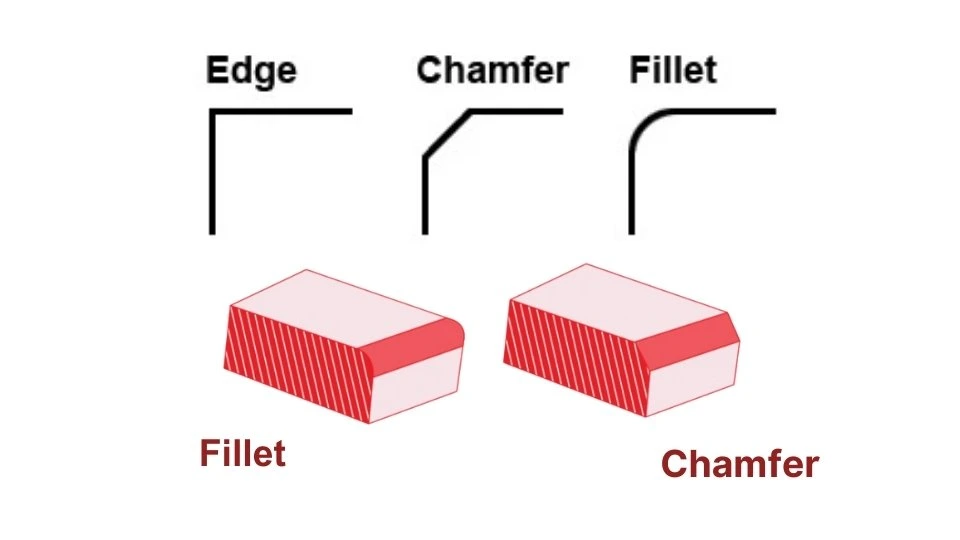
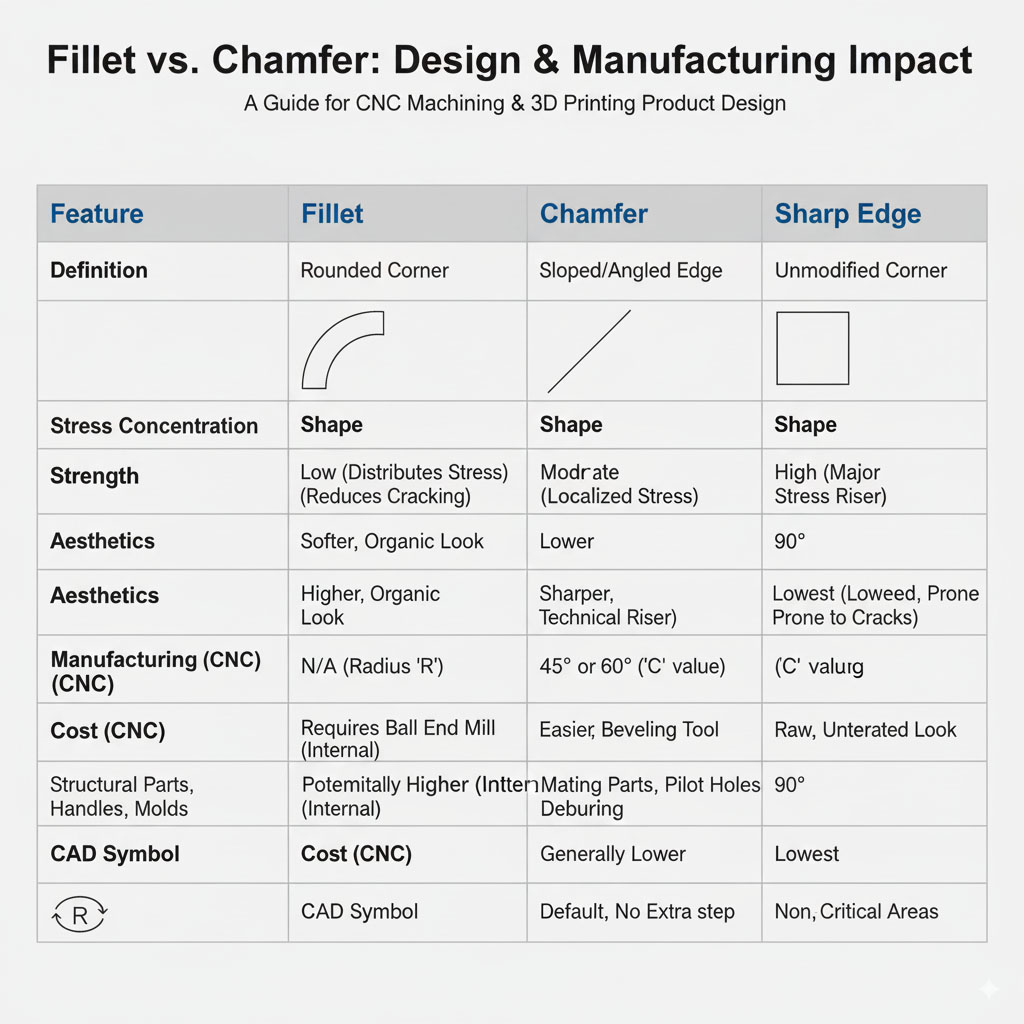
Fillets specify rounded inner or outside edges on a layout. They play an important duty in mitigating stress focus and preventing quick contortion at these corners. In contrast, chamfers represent sloped or angled edges, generally at 45 ° or 60 °, on a component. Both features offer to eliminate sharp edges, decrease stress focus, and enhance a machined part’s load-bearing ability.
Regardless of their shared objectives, fillets and chamfers act differently under stress. Fillets disperse stress and anxiety over a more comprehensive surface because of their gradual contour, leading to exceptional stress resistance. Chamfers, with their angled rather than bent change, show higher anxiety focus. They do not distribute stress and anxiety as successfully as fillets.
From an aesthetic standpoint, both fillets and chamfers improve a part’s visual appeal. However, chamfered edges often offer more design flexibility. Designers can incorporate them into almost any part without significantly increasing manufacturing costs or compromising functionality. Fillets, especially internal ones, sometimes introduce complexities in manufacturing that chamfers avoid.
Critical Considerations for Fillet Implementation
When incorporating fillets into designs, particularly for CNC machining, designers must keep two critical aspects in mind: the nature of bottomed edges and the constraints of internal corners between vertical walls. These factors directly influence manufacturability, cost, and lead time.
Bottomed Edges in CNC Machining
Consider a cuboid part with a cavity featuring an interior (concave) fillet and an exterior (convex) fillet. Machining bottomed edges, specifically concave fillets, poses a significant challenge for CNC machines. These features typically require specialty tools, such as ball end mills. Using these tools increases manufacturing costs due to their specialized nature and higher fragility. Ball end mills also necessitate slower cutting speeds, extending lead times. Consequently, designers often find it more practical to implement square-bottom features where possible. If functional requirements strictly demand fillets at bottom edges, additive manufacturing processes like 3D printing may offer a more viable solution.
Designing Internal Edges Between Vertical Walls
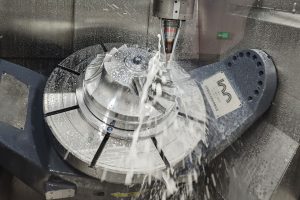
The subtractive nature of CNC milling inherently creates rounded corners, or fillets, where vertical walls of a cavity meet. The size of these fillets directly depends on the diameter of the end mill tool used for the milling operation. For example, an end mill with a 0.8 mm diameter can produce fillets with a minimum radius of 0.4 mm. Designers cannot achieve a fillet with a radius smaller than half the tool’s diameter using that specific end mill. This limitation requires careful consideration during the design phase.
Similarly, designers must account for end mill tool size when designing fillets in areas where a vertical wall meets a curved or angled wall. End mill tools come in standard lengths, usually multiples of their diameter. Experts generally recommend using an end mill with a length 3 to 5 times its diameter to optimize CNC machine tool performance. Understanding these tool limitations is crucial for creating manufacturable designs.
Stress Distribution and Part Longevity
The primary functional difference between fillets and chamfers lies in how they manage stress concentrations. Sharp corners act as stress risers, concentrating forces at a single point. This can lead to cracks, fatigue, and premature part failure. Both fillets and chamfers aim to mitigate this.
Fillets, with their smooth, continuous curve, distribute stress more uniformly over a larger area. This gradual transition prevents stress from accumulating intensely at any one point, significantly improving a part’s fatigue life and overall structural integrity. For components subjected to dynamic loads, vibrations, or repeated stress cycles, fillets are often the preferred choice due to their superior ability to reduce stress concentrations. They create a smoother flow of force through the material.
Chamfers, while also improving stress distribution compared to a sharp corner, create a more abrupt change in geometry. This results in localized stress concentrations that are higher than those found in filleted corners. However, chamfers remain effective for static loads or in applications where the cost and complexity of fillets are prohibitive. Designers often employ chamfers for aesthetic purposes, ease of assembly, or to remove burrs, even if they offer less optimal stress reduction than fillets. The choice hinges on the balance between manufacturing ease, cost, and the specific functional demands of the part.
Conclusão
Understanding the fundamental differences between fillets and chamfers is paramount for product designers aiming to create robust and manufacturable parts. Fillets, with their rounded contours, excel at reducing stress concentrations and enhancing part longevity, especially in high-stress applications.
However, their implementation, particularly for internal features, can introduce manufacturing complexities and higher costs due to the need for specialized CNC tools. Chamfers, characterized by their angled edges, offer a simpler, more cost-effective solution for easing sharp corners and improving aesthetics. While they provide less optimal stress distribution than fillets, chamfers offer greater design flexibility and ease of manufacturing. Ultimately, successful part fabrication depends not only on informed design choices but also on partnering with a proficient machining provider.
Comentários
Posts Mais Recentes
Blogs Relacionados
Senyo o blog é focado em compartilhar o nosso conhecimento extensivo de protótipo de fabricação. Através de nossos artigos, temos o objetivo de apoiar a refinar seu design de produto e navegação do complexidades de prototipagem rápida, mais eficaz.