Termoplásticos vs Plásticos Termofixos: Característica do Produto Resumo
Tabela de Conteúdo
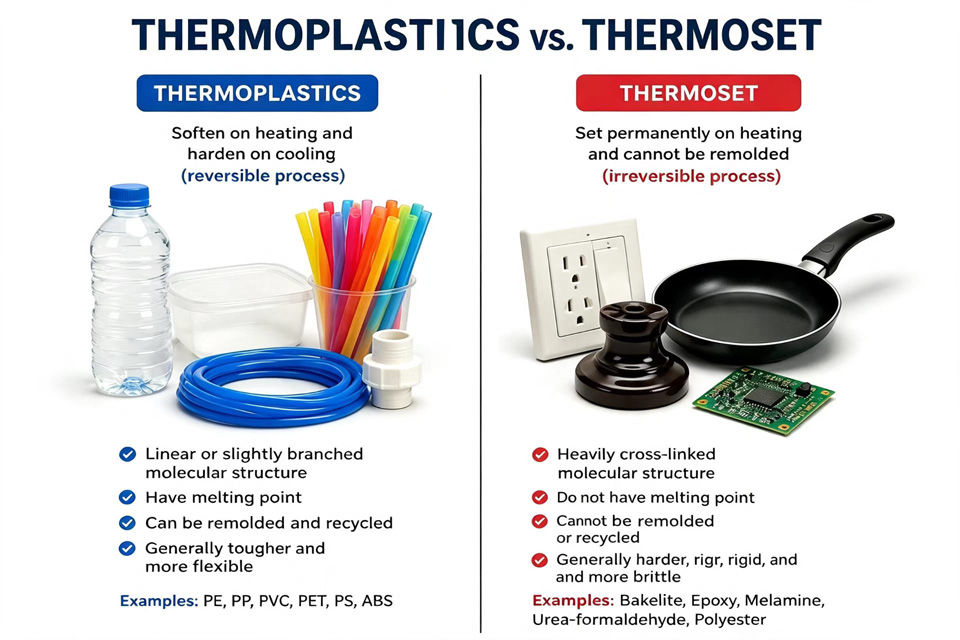
Qual É a Diferença Termoplásticos Vs Plásticos Termofixos?
Termoplásticos vs plásticos termofixos são ambos os polímeros, no entanto, comportam-se de maneira extremamente diferente quando aquecido entra em imagem.
Um termoplástico amolece quando aquecido e endurece mais uma vez quando resfriado. Esse ciclo pode ser repetido muitas vezes, embora no mundo real materiais podem enfraquecer depois de duplicados para aquecimento da casa, a contaminação, a absorção de umidade, ou UV em linha reta de exposição. Típico termoplásticos incluem o músculo abdominal, polipropileno, nylon, policarbonato, acetal, ANIMAL CÃO de ESTIMAÇÃO, PVC e polietileno.
Um plástico termofixo começa como um material, líquido, em pó, ou parcialmente curado composto. Durante a recuperação, suas cadeias de polímero de desenvolver um três-dimensional cross-linked de rede. Quando a rede é estabelecida, o reaquecimento será, certamente, não derretê-lo de volta para a direita em uma fluídos produto. Pressione o nível de temperatura muito e que o item chars, se divide, ou quebra, ao invés de. Regular termofixos consistem em epóxi, fenólicas, de melamina, silicone, poliuretano, produto de poliéster e poliamida.
Essa distinção afeta praticamente tudo o que: processo de moldagem, ferramentas, tempo de ciclo, reciclabilidade, o calor de desempenho, usinagem de hábitos, de superfície de conclusão, e de longa duração robustez.
Termoplástico vs Plásticos Termofixos: Rápida Tabela de Comparação
| Imóvel residencial ou Variável de Decisão | Termoplásticos | Plásticos Termofixos |
|---|---|---|
| Calor ações | Suavizar ou descongele quando aquecido; endurecem quando esfriou | Tratar de forma irreversível; não remelt depois de estabelecer |
| Estrutura Molecular | Em linha reta ou ramificada de cadeias de polímeros | Cross-linked rede tridimensional |
| Reutilização de | Comumente pode ser reaquecido e reciclado | Não pode ser remelted após a cura |
| Comum durabilidade | Geralmente uma maior resistência ao impacto e ductilidade | Regularmente muito mais rigorosos, mas pode ser fraco |
| Resistência ao calor | Difere comumente; restrita por Tg, ponto de fusão, e HDT | Geralmente extra eficaz em elevados níveis de temperatura |
| Resistência à fluência | Moderada reduzida a menos melhorados ou criados | Geralmente melhor, como resultado de cross-linking |
| Resistência química | Destaque em alguns graus, o fraco em outros | Normalmente forte contra solventes, ácidos, áspera e definições |
| Área da superfície | Frequentemente muito menos complicado para polonês, estrutura, cor, e tinta | Pode ser mais desafiador para acabar após a solução |
| Reutilização de potenciais | Muito melhor na teoria; sensível a preços de contar com o material, a organização e a contaminação | Rígido; geralmente o solo como enchimento ou quimicamente reutilizado na marginal circunstâncias |
| Procedimentos normais | Shot de moldagem, extrusão, greve de moldagem, termoformagem, de impressão em 3D, usinagem CNC | Moldagem por compressão, moldagem por transferência, comentários shot de moldagem, de dispersão, de produtos de moldagem por transferência de |
| O melhor ajuste da conta de produção | Versões para alto volume repetitivo de fabricação | De alto desempenho, resistente ao calor, quimicamente componentes de segurança |
Por Estrutura Molecular Matéria
A maneira mais fácil de entender o material termoplástico propriedades é a imagem cadeias de polímero que pode deslizam umas sobre as outras quando aquecido. Eles não são livres como as moléculas de água, mas eles tem bastante mobilidade acima de determinadas temperaturas e fluxo sob pressão. É por isso que uma resina termoplástica de bolinha pode tornar-se um invólucro moldado, um usinado protótipo, ou uma impressos em 3D de fixação.
Termofixos se comportam de forma diferente. Durante a cura, as cadeias de polímero formulário de ligações cruzadas. O resultado é uma rede. Essa rede é por isso termofixos propriedades do material, muitas vezes, incluem alta rigidez, estabilidade térmica, resistência à fluência e resistência química. É também por termofixos são mais difíceis de reciclar e menos indulgente se o processo de fabricação de errado.
A química não é acadêmico de trivialidades. Mostra-se em produção.
Se um termoplástico moldado por injeção, com um tiro curto, coletor de marca, ou incorretas corante, o corredor e alguns pedaços podem ser retificadas e reutilizados, dependendo do material e requisitos de qualidade. Se um termofixo parte curas incorretamente, ele não pode simplesmente ser derretido e execute novamente.
Material Termoplástico Propriedades
Termoplásticos cobrir uma substancial variedade, de suave filmes de polietileno de alto desempenho, PEEK elementos. Ainda assim, vários padrões de função em todo início de item de escolha.
Principais Vantagens de Termoplásticos
Os termoplásticos são escolhidos desde refinam com êxito. Eles correspondem repetitivo de moldagem, rápidos tempos de ciclo, geometrias complexas, magro superfície da parede áreas, snap-fits, a viver juntas, a correspondência de cores, claro componentes, e o único cosmético superfície.
Para a quantidade de fabricação, rápida de moldagem geralmente o curso prático de policarbonato componentes, pois integra a repetibilidade, item a variedade e o grau de produção de geometria sem esperar por prolongado de ferramentas horários.
Os termoplásticos, da mesma forma a tornar variação menos complexo. Um estilo que a equipe pode se modelo em ABS-como, de nylon-like, como os do PC, ou PP-como itens de exame de ajuste e recurso, após o que se movem para a direita em forma de produção com menos de choques. Eles são também comumente feito uso de Impressão 3D para o conceito de projetos, gabaritos, elementos, caixas, dutos, suportes e baixo volume de uso final de componentes.
Típico termoplásticos benefícios consistem em:
- Excelente resistência ao impacto em várias qualidades de topo
- Variedade de cores e acabamento alternativas
- O tratamento eficiente para um grande volume de peças
- Excelente resistência-peso percentual
- Muito melhor benéfico reciclagem de plásticos termorrígidos
- Forte viabilidade do snap-fits, costelas, os empregadores, clipes, e que vivem juntas
- Ampla rotina de produto, design e alto desempenho, qualidades
As Desvantagens de Termoplásticos
Termoplásticos não são excelentes. Vários amolecer sob contínua de calor. Alguns fluência sob constante grandes promoções. Outros absorver umidade, deformar ao longo do molde, do crack em solvente de exposição, ou quebrar sob UV sem ingredientes.
Normal termoplástico de riscos consistem em:
- Diminuição da resistência ao calor do que numerosos termofixos
- Fluência em contínuo mecânico de toneladas
- Empenamento e encolhendo projetado peças
- A umidade grau de sensibilidade em nylon e algumas outras qualidades
- Viável derrota em casa, depois de duplicadas reprocessamento
- Resina específicos de compatibilidade química limitações
Um policarbonato suporte, que funciona perfeitamente em temperatura ambiente pode imperfeição perto de um motor, bateria, gravador, ou ciclo de esterilização. É por isso que quente deflexão nível de temperatura, o vidro alterar o nível de temperatura, ponto de fusão, e a real temperatura da solução deve ser examinada de acordo com a aplicação.
Tipos de Termoplásticos
Os termoplásticos são comumente divididos direito em amorfos e semi-cristalinos produtos. Esta divisão é mais útil do que a memorização de uma longa lista de nomes de plástico.
Os Termoplásticos Amorfos
Os termoplásticos amorfos têm muito menos comprou molecular quadro. Eles amaciam mais de um nível de temperatura variedade em vez de mostrar um forte elemento de fusão. Ótimas ofertas de oferecer excelente estabilidade dimensional, baixa contração, e atraente cosméticos áreas de superfície.
Regular termoplásticos amorfos incluem:
- MÚSCULO ABDOMINAL
- Policarbonato
- Polímero ou PMMA
- Poliestireno
- PVC
- PEI
- PSU
Eles são normalmente escolhidos para caixas, lentes, cobre, apresenta, clínica dispositivo de peças, dispositivos eletrônicos, estética e componentes. Policarbonato, por exemplo, é valorizado por força de impacto e ópticas clareza. ABS é comumente feita quando um componente precisa durabilidade, moldabilidade, e uma excelente área de superfície, cobrindo sem detrimento dos mais estilo de fim de plásticos.
Termoplásticos Semicristalinos
Termoplásticos semicristalinos, realmente extra obtido molecular regiões. Eles normalmente oferecem muito melhor resistência química, resistência à fadiga, colocar sobre a resistência e a eficiência em elevados níveis de temperatura. Além disso, muitas vezes, tendem a diminuir muito mais durante a moldagem, assim, parte de design e ferramentas de pagamento preocupação.
Comum de termoplásticos semicristalinos, consistem em:
- Polipropileno
- Polietileno
- Nylon ou poliamida
- Acetal ou POM
- OS MEMBROS DA FAMÍLIA DO CÃO DE ESTIMAÇÃO
- PBT
- PEEK
- PPS
Estes materiais prevalecer em engrenagens, rolamentos, clipes, combustível, peças do sistema, líquido de manipulação de peças, ferramentas médicas, elementos de carros e industrial de componentes de desgaste.
Termofixos Características
Termofixos são colhidas quando a parte que necessita para se manter estável em condições que certamente fazer grandes ofertas de termoplásticos, suavizar, fluência, swell, ou perder espécie. A cura de rede fornece estes produtos de uma grande individualidade: inflexível, constante, e geralmente é extremamente imune ao calor e a produtos químicos.
Principais Vantagens dos plásticos termorrígidos
Plásticos termofixos são regularmente a excelente resposta para alta temperatura elétricos, construção, química, e de aplicativos compostos. Os sistemas epóxi bond boldy. Compostos fenólicos suportar aconchegante e chama. Silicones permanecem adaptável em toda grande temperatura de variedades. Os poliuretanos podem ser criados como espumas, elastômeros, camadas, ou rígidas atores componentes.
Típico termofixos benefícios incluem:
- Alta aconchegante resistência
- Forte dimensional de segurança
- Fantástico resistência à fluência
- Impressionante a isolação elétrica em vários sistemas de materiais
- Forte química e resistência à ferrugem
- De alta resistência e de arquitetura de segurança
- Excelente apto para reforçado com fibra de compostos
Termofixos prevalecer na placa-mãe, de alta tensão, isoladores, casa de dispositivo cuida, envasamento substâncias, adesivos, painéis compostos, barreira térmica, retentores, juntas, envolto eletrônicos, e resistentes a substâncias químicas revestimentos.
Para versões ou de baixo volume de peças que necessitam de ser moldada de poliuretano como atividades, fundição a vácuo pode criar peças com borracha, ABS, ou de limpar casas antes de comprar difícil de fabricação de ferramentas.
Desvantagens dos plásticos termorrígidos
Exatamente a mesma cross-linked estrutura que dá termofixos a sua segurança também desenvolve limitações.
Logo curado, um termofixos não podem ser remelted. O retrabalho é limitado. A sucata é mais difícil para reutilização. Usinagem pode ser mais difícil devido à verdade de que o material pode ser dura, áspera, fraco, ou repleto de vidro ou de reforço mineral. Alguns plásticos termorrígidos também chamada por exaustivamente tratada de tratamento de rotinas para ficar claro de lacunas, não há remédio, o "stress" interno, ou dimensional deriva.
Típico termofixos desvantagens conter:
- Pobres remodelando e opções de reciclagem
- Mais os tempos de cura de inúmeros procedimentos de policarbonato
- Maior fragilidade em alguns sistemas
- Mais difícil de completar e usinagem
- Maior sensibilidade para lidar com porcentagem, os graus de temperatura, umidade, e procedimento de controle de
- Ferramentas e necessidades do processo, que variam de comum de moldagem de policarbonato
Termofixos Material Famílias
Resinas Epóxi
Epóxis são entendidas para bond, resistência química, isolamento elétrico, composto e eficiência. Eles são utilizados em adesivos, fibra de carbono, peças, dispositivos eletrônicos de envasamento, ferramentas placas, camadas, elementos estruturais e composto aspectos.
Fenólicas Materiais
Compostos fenólicos são quentes imunológico, resistente à chama, e eletricamente isolante. Eles são comuns em peças elétricas, cuidar, peças para freios, peças do dispositivo, comercial e laminados.
Poliuretano Termofixos
A química de poliuretano é amplo. Ele pode produzir versátil elastômeros, espumas rígidas, de toque suave e peças, retentores, rolamentos, rodas e fundidos protótipos. Em coisa de inovação, elenco de poliuretano é geralmente utilizada para simular a fabricação de plásticos antes de ferramental é estabelecida.
Silicone
Silicone plásticos termorrígidos suportar a temperatura de nível de extremos e permanecem para ser adaptável, onde os lotes de plásticos certamente estressante ou de divisão. Eles são utilizados em vedações, gaxetas, médico componentes, teclados, isolamento, panelas e frigideiras, e dispositivos eletrônicos de defesa.
De poliéster e Plástico, Resinas Éster
Estes produtos são geralmente utilizadas em fibra de vidro reforçado compostos, componentes marinhos, tanques, painéis, infra-estrutura e construção de itens, e resistente à corrosão de estruturas.
Polyimide
Polyimide é uma alta performance de polímero membro da família utilizado quando quente, o desgaste, isolamento elétrico, e estabilidade dimensional estão pedindo. Prevalece na indústria aeroespacial, eletrônica, semicondutores e aplicações de negócios.
Processos de fabricação para Termoplásticos e Termofixos
A selecção do produto e procedimento de opção precisam ocorrer juntos. Uma resina que parece ideal em uma folha de dados pode ser caro, lento, imprevisível ou difícil de molde a geometria selecionada.
Moldagem De Termoplástico
Termoplásticos por injeção moldagem utiliza produto pelotas, quente, parafuso de stress, e um resfriado molde. É comum seleção para alto volume de peças de plástico, devido ao fato de que ela pode desenvolver a geometria complexa com o apertado repetibilidade.
Excelente candidatos consistem em:
- Item de consumo imóveis
- Clínica ferramenta de espaços
- Automotiva e clips de chaves
- Digital situações
- Ferramentas e ferramentas funcionais
- Item de componentes de embalagem
De moldagem de policarbonato apresenta melhor quando o formato de representar a espessura da parede, rascunho, costelas, portões, pias, encolhimento, linhas de separação, ejetor de marca e do fluxo de materiais.
CNC Usinagem de Elementos Plásticos
Para protótipos, componentes, substituição de componentes, e tolerância apertada partes, CNC usinagem de componentes de plástico pode ser mais rápido e muito mais preciso do que a moldagem. Usinagem da mesma forma, impede que o custo de ferramental, o que importa quando a quantidade é baixa ou o estilo ainda está se movendo.
Operações passíveis de termoplásticos consistem em ABS, acetal, nylon, COMPUTADOR, PEEK, PTFE, PEI, e o acrílico. Alguns plásticos termorrígidos e materiais compostos laminados podem da mesma forma ser usinado, ainda dispositivo de desgaste, sujeira controle, delaminação e fragilidade requerem paixão.
Impressão 3D
A impressão 3D é melhor para rápida modelo, interior intricado geometria, gabaritos, peças, estilo de reconhecimento e de baixo volume útil de componentes. Termoplásticos baseados em procedimentos de impressão prevalecer, incluindo FDM, SLS, MJF, e diferente de pó de casal ou de extrusão-based systems.
Alguns aditivo procedimentos utilizam fotopolímero resinas que atuar muito mais como termofixos após a cura. Estas peças podem ser fenomenal para o detalhe e aparência, mas ainda confortável resistência, de estabilidade UV e de resultados de desempenho necessitam de ser avaliadas com extremo cuidado.
Moldagem de termofixos e Difusão
Termofixos são tratados com métodos, tais como moldagem por compressão, moldagem por transferência, comentários shot de moldagem, materiais de moldagem por transferência, envasamento, encapsulamento, e se espalhando.
Esses métodos são comuns quando um componente de chamadas para:
- Alta resistência ao calor
- Isolamento eléctrico
- Química de segurança
- Grandes estruturas de compostos
- Grosso locais
- De elastômero de poliuretano rotinas
- Fogo ou arco resistência
Termofixos processamento depende muito do mix de percentagem, medida de temperatura, tempo de solução, mofo e bolor temperatura, ventilação e pós-cura requisitos.
Informações atualizadas: Plástico Fabricação e Reciclagem de Contexto
As opções de produtos já incluem a sustentabilidade, não apenas do desempenho e preço.
PlasticsEurope informou que internacional de plásticos, tornando tem a respeito de 414 milhões de toneladas em 2023, incluindo fósseis de base, reciclados e bio-plásticos de base. Ver PlasticsEurope Plásticos Rápido Verdades 2024.
A OCDE Internacional de Plásticos Assunção informou que global de resíduos de plástico tem a respeito de 353 milhões de toneladas em 2019, e a apenas 9% reutilizado. Ver OCDE Global de Plásticos Expectativa.
Que não indicar a cada policarbonato parte é duradouro, ou todos os termofixos parte é descuidado. Um longa-vida termofixos elétrica isolante que protege contra a falha de mais de duas décadas pode ser muito melhor ecológica opção de recicláveis componente que está aquém cedo. Contudo, as informações não expor por isso, os designers precisam levar em consideração a utilização dos materiais, produção de sucata, reparabilidade total, parte da vida, e o fim-de-vida de manipulação desde o início.
Para definições e fundamental polímero estudo clínico de pesquisa, Encyclopaedia Britannica do plástico termofixo resumo é um valioso não-comercial de referência.
Exemplos Práticos
Selecione um Termoplástico, Quando:
- O componente precisa snap-fits, clipes, dobradiças, ou a resistência de impacto.
- O item será construído em grande quantidade.
- Estética da superfície e a sombra de correspondência de preocupação.
- A possibilidade de reciclagem ou o uso de material reciclado é um formato objetivo.
- O elemento requer para ser protótipo rapidamente e aperfeiçoadas, de um modo geral.
- Solução de nível de temperatura é modesto.
Exemplo: Uma ferramenta móvel espaço feito de estômago ou PC-ABS. Ele apela para o grande efeito de resistência, um arrumados em forma de superfície, o interior patrões, as costelas e repetitivo de produção.
Escolha um Termofixo, Quando:
- O componente deve resistir contínua de calor.
- Isolamento elétrico é importante para o estilo.
- Resistência à fluência e estabilidade dimensional são muito mais vital do que o efeito de robustez.
- O componente irá definitivamente estar exposto a produtos químicos agressivos.
- Um composto de estrutura requer uma forte matriz de produtos.
- A parte será, certamente, vasos, encapsulado, elenco, ou moldada por compressão.
Exemplo: Um epóxi encapsulante todo delicado eletrônica. Ele protege os elementos de vibração, umidade, calor e produtos químicos a exposição direta.
Perguntas frequentes
1. Qual é a principal diferença entre os termoplásticos e plásticos termofixos?
A principal diferença é a forma como eles respondem ao calor. Termoplásticos amolecer ou derreter quando aquecidos e endurecem novamente quando resfriado, permitindo-lhes ser reformulado. Plásticos termofixos cura permanente cross-linked estrutura e não pode ser derretido ou reformulado após a cura.
2. São termoplásticos mais forte do que os plásticos termofixos?
Nem o material é universalmente mais forte. Termoplásticos normalmente oferecem melhor resistência ao impacto, flexibilidade e resistência, enquanto os plásticos termofixos, muitas vezes, fornecer maior rigidez, resistência ao calor, resistência química e estabilidade dimensional. A melhor opção depende da aplicação e condições de operação.
3. O que é mais resistente ao calor: termoplásticos ou termofixos plásticos?
Plásticos termofixos são geralmente mais resistentes para a manutenção de temperaturas elevadas, porque o seu cross-linked estrutura molecular não amolece da mesma forma como termoplásticos. No entanto, de alto desempenho termoplásticos, tais como observar, do PPS, e o PEI também pode resistir as exigências do calor em ambientes.
4. São termoplásticos mais reciclável do que os plásticos termofixos?
Sim, os termoplásticos são, geralmente, mais fácil de reciclar, pois eles podem ser reaquecidos, derretido, e reformulado. Plásticos termofixos não podem ser remelted após a cura, de modo que eles são mais difíceis de reciclar. Alguns termofixo de resíduos pode ser triturada para uso como enchimento ou processado através especializados, de reciclagem química métodos.
5. Devo escolher termoplásticos ou termofixos plásticos para o meu produto?
Escolha termoplásticos, quando você precisar de resistência ao impacto, flexibilidade, complexas formas moldadas, produção rápida, ou melhor potencial de reciclagem. Escolha plásticos termofixos, quando a parte requer o desempenho de alta temperatura, resistência química, elétrica, isolamento, baixa deformação, ou de longo-prazo a estabilidade dimensional. A decisão final deve considerar também o volume de produção, as tolerâncias, o custo e processo de fabricação.
Comentários
Posts Mais Recentes
Blogs Relacionados
Senyo o blog é focado em compartilhar o nosso conhecimento extensivo de protótipo de fabricação. Através de nossos artigos, temos o objetivo de apoiar a refinar seu design de produto e navegação do complexidades de prototipagem rápida, mais eficaz.
Moldagem por Injeção de Baixo Volume: Um Guia para Peças de Pequenos Lotes
15 de novembro de 2024
Ler Mais "