Design com rebaixo: O guia completo para a moldagem por injeção de plástico
Tabela de Conteúdo
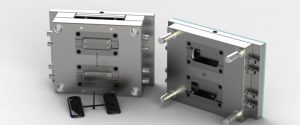
Em layout de artigos de plástico e moldagem por injeçãoO design com rebaixos é um dos pontos tecnológicos mais críticos, pois determina diretamente a estrutura do molde, a estabilidade da produção, a resistência do componente, o desempenho de montagem e o custo total. Os rebaixos descrevem atributos geométricos que impedem a ejeção direta do molde, como ganchos de ventilação, ranhuras de retenção, aberturas laterais, entalhes internos e estruturas em forma de casinha.
Um design inadequado dos rebaixos resulta frequentemente em bloqueio do molde, deformação da peça, fissuras, elevados custos de ferramental e longos ciclos de desenvolvimento. Este artigo fornece uma coleção completa de diretrizes úteis para o projeto de rebaixos, com foco em estruturas de rebaixos tipo "dog house", critérios dimensionais, ângulos de saída, requisitos de filete e coordenação de encaixe, auxiliando os projetistas na criação de componentes plásticos estáveis e produzidos em massa.
1. O que é o rebaixo na moldação por injeção de plástico?
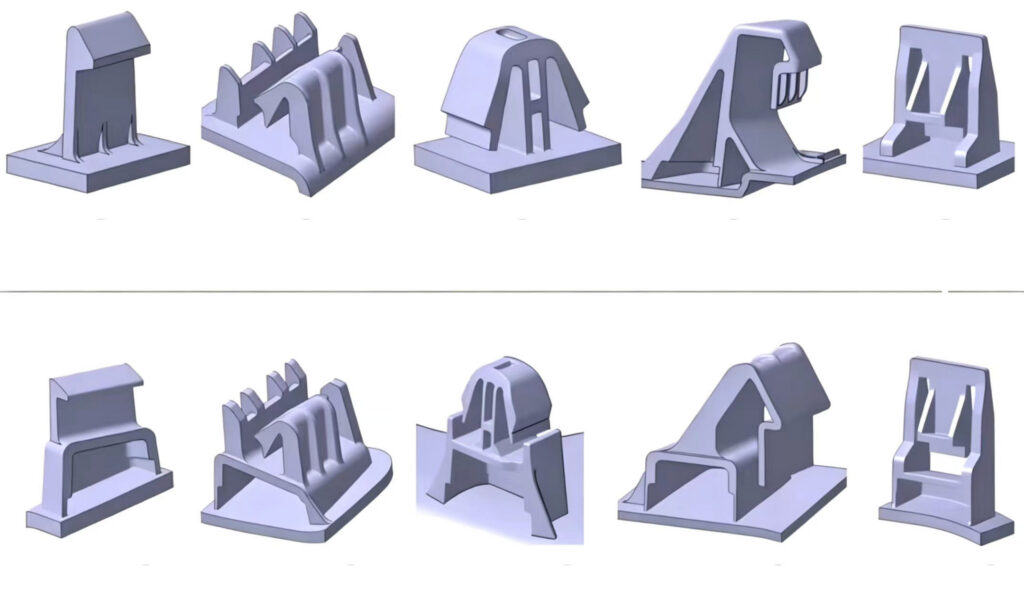
Um reduzir Uma reentrância é qualquer característica numa peça plástica que impede a desmoldagem normal em linha reta ao longo da direção da abertura principal do molde. Estas características criam interferência mecânica entre a peça e o aço do molde, impossibilitando a simples ejeção de moldes de duas placas. As características comuns de reentrância incluem:
- Recortes exteriores: Ganchos laterais, encaixes de pressão, orifícios laterais, abas salientes
- Recortes interiores: ranhuras internas, entalhes de retenção, assentos de parafusos, grampos ocultos
- Cortes undercut tipo casota: Bases reforçadas de encaixe com nervuras de suporte angulares.
Quando existe um rebaixo, o molde requer mecanismos adicionais:
- Ações laterais (deslizamentos): Para cortes exteriores.
- Tuchos (Cames Ejetoras): Para rebaixos interiores.
- Núcleos Recolhíveis: Para threads complexos.
De acordo com a análise DFM, a incorporação de rebaixamentos pode aumentar os custos de ferramental em 15% a 40%. Portanto, um bom projeto de rebaixo equilibra a funcionalidade com a simplicidade do molde.
1.1 Valor fundamental do design de rebaixo normalizado
Um design de rebaixo bem executado oferece diversas vantagens estéticas e comerciais:
- Reduz o custo do molde: Evita deslizadores, elevadores ou cilindros hidráulicos desnecessários.
- Reduz o tempo de ciclo: Simplifica a ejeção e aumenta a segurança.
- Melhora a qualidade das peças: Reduz a concentração de tensões, a deformação e os danos.
- Melhora a montagem: Garante uma força de encaixe consistente e um desempenho de fixação adequado.
- Diminui a taxa de rejeição: Reduz os danos por aderência, riscos e ejeção. Sem regras metódicas de rebaixamento, mesmo pequenos erros de geometria podem aumentar o custo das ferramentas em 15% a 30% e atrasar o início da produção em semanas.
1.2 Estruturas de encaixe de dois núcleos
O design de encaixe com recorte inferior inclui principalmente casota para cão (base de encaixe) e mosquetão de gancho, frequentemente utilizados em combinação para equilibrar a resistência e a desmoldabilidade.
2. Projeto de estrutura de casota (base de encaixe)
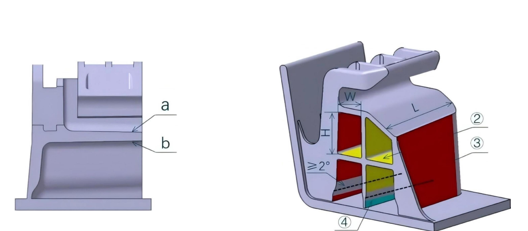
Uma "doghouse" é uma cavidade fechada ou semi-fechada que envolve a base do encaixe. As suas principais funções são reforçar a base do encaixe, evitar marcas de afundamento/deformação e otimizar os ângulos de saída — fatores críticos para a resolução de problemas de resistência interna em projetos com rebaixamentos.
2.1 Parâmetros dimensionais básicos
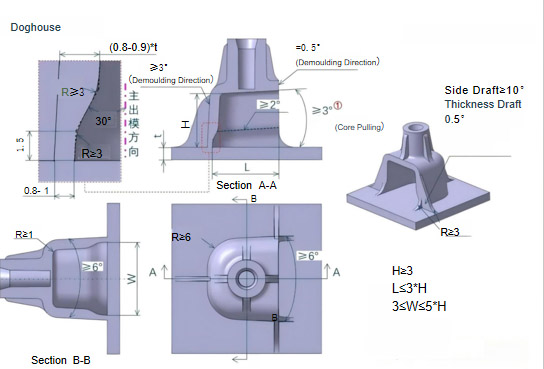
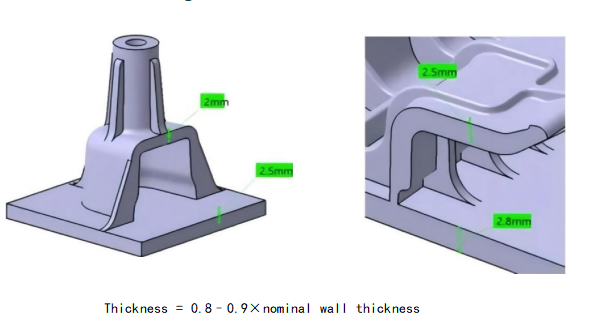
- Espessura da parede: Espessura da parede da casota = (0,8–0,9) × espessura nominal da parede da peça, mínimo ≥ 1,5 mm. Espessura espessura nominal da parede provoca marcas de afundamento na superfície.
- Proporções da cavidade: Após a divisão das costelas, cada cavidade deve satisfazer os seguintes requisitos: Altura ≥ 3 mm, Comprimento ≤ 3×Altura, 3 mm ≤ Largura ≤ 5×Altura (A = altura da cavidade, C = comprimento da cavidade, L = largura da cavidade). Evite cavidades excessivamente altas/estreitas que dificultem a desmoldagem.
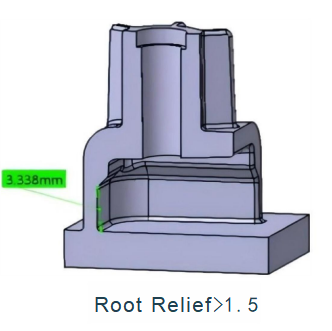
- Relevo radicular: Altura do rebaixo radicular na casota ≤ 1,5 mm (antes do ângulo de rebaixo), inclinação ≥ 2° na direção lateral do núcleo. O rebaixamento excessivo enfraquece a resistência da raiz; rebaixo insuficiente dificulta a desmoldagem.
2.2 Regras do Ângulo de Inclinação (Núcleo de Desmoldagem)
Os ângulos de inclinação são os parâmetro crítico do design com rebaixo, que determina diretamente uma desmoldagem suave e evita riscos/esbranquiçamentos:
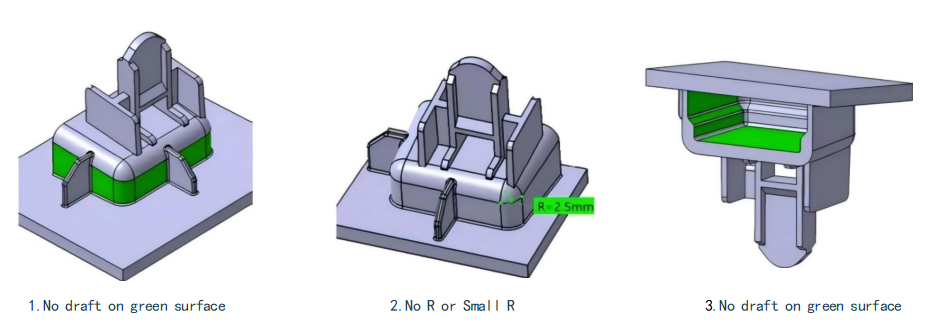
- Direção principal do molde: Superfície verde (parede exterior da casota do cão) com corrente de ar ≥ 3°. A corrente de ar insuficiente causa atrito/grudamento durante a ejeção.
- Direção do núcleo lateral:
- Inclinação da superfície amarela (parede lateral da nervura) ≥ 0,5°.
- Ângulo de saída da superfície vermelha (parede interior) ≥ 3° (tanto na direção principal de desmoldagem como na direção lateral do núcleo).
- Superfície ciano (superfície de acoplamento) com uma diferença de espessura da parede de 0,1 a 0,15 mm por extremidade para evitar riscos no molde.
- Moldagem especial do elevador: Se as superfícies A/B da casota forem formadas nos elevadores, o ângulo de inclinação deve ser ≥ 1° ou a diferença na espessura da parede ≥ 0,5 mm por extremidade para evitar o bloqueio do elevador.
2.3 Projeto de nervuras de reforço (garantia de resistência)
As nervuras de reforço são obrigatórias no interior das casotas para evitar cavidades e baixa resistência:
- Especificações das costelas: Espessura da nervura ≥ 1,6 mm, raio de concordância ≥ 0,5 mm nas intersecções para evitar fissuras por concentração de tensão.
- Requisito de descarga: As nervuras devem estar alinhadas com a face da extremidade da casota do cão; o desalinhamento provoca colapso/fissuras localizadas sob carga.
Design com filete de 2,4 mm (raio R) (anti-fissuras + fácil montagem)
- Raio da parede lateral: Raio da parede lateral exterior da casota ≥ 6 mm. Raios pequenos (por exemplo, R ≤ 2,5 mm) provocam a concentração de tensões na raiz e fissuras sob carga.
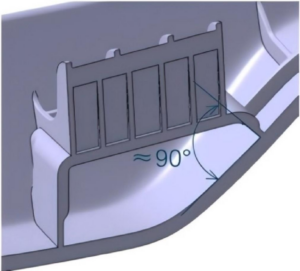
- Raio da raiz: Raio ≥ 3 mm na junção da carcaça com a superfície A da peça, ângulo o mais próximo possível de 90°. Evite o aço afiado (<0,6 mm) para prevenir lascas no molde e fissuras na peça.
3.º Projeto de engate rápido: tipos, parâmetros e regras de acoplamento
Um encaixe tipo gancho é uma característica rebaixada em forma de gancho que permite o engate direto. Classificados pela direção do núcleo lateral em ganchos de tração reta e ganchos de tração lateral, são combinados com bases tipo "doghouse" para equilibrar a força de engate, a desmoldagem e a facilidade de montagem.
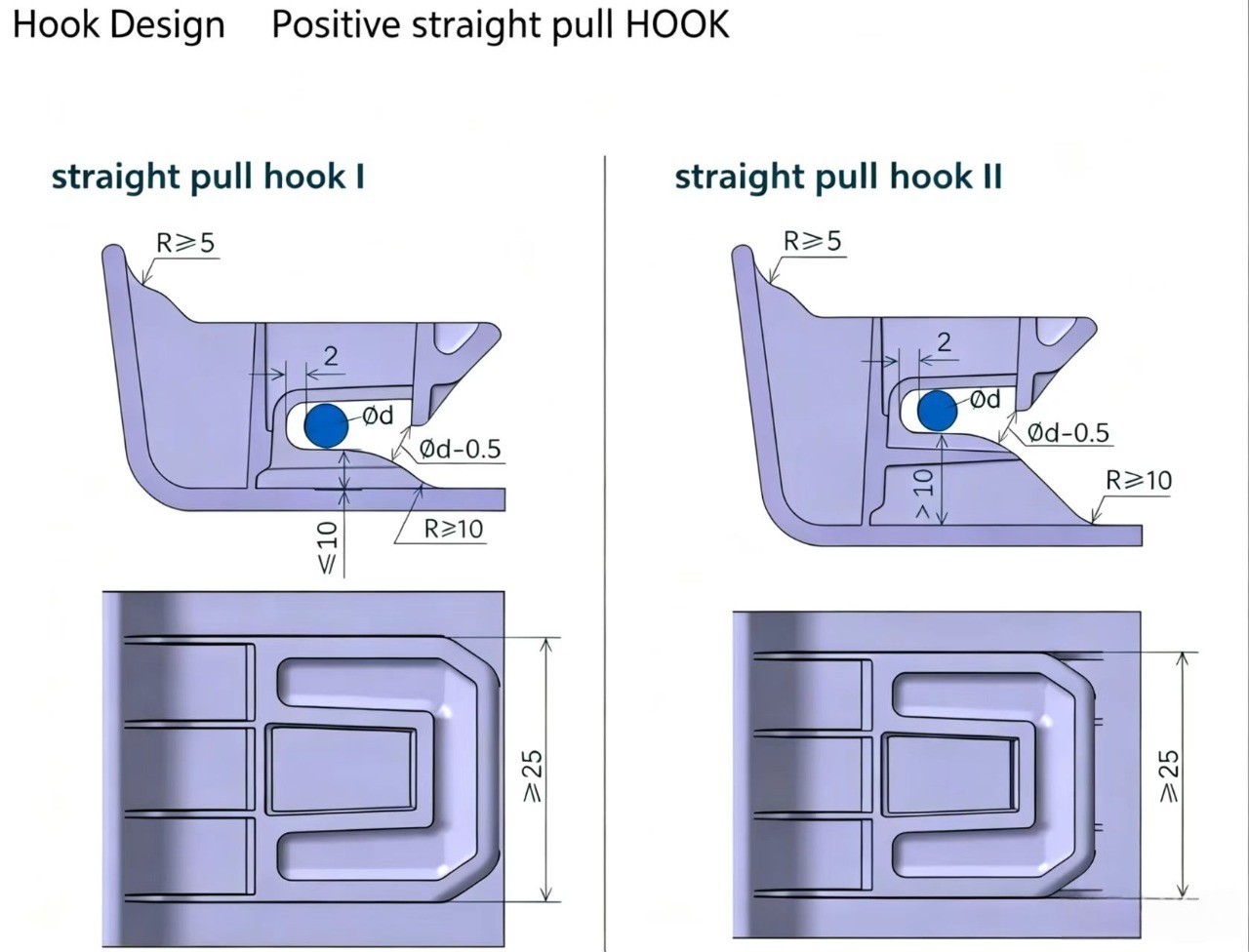
3.1 Gancho de tração reta (desmoldagem linear)
Para encaixes paralelos à direção de abertura do molde; molde simples (apenas são necessários extratores/núcleos de lados retos):
- Parâmetros principais: Espessura do gancho ≥ 2 mm, raio da extremidade do gancho R ≥ 5 mm (casos especiais R ≥ 3 mm). Bordas de suporte de carga vermelhas. não deve conter filetes para evitar a redução da força de empenhamento.
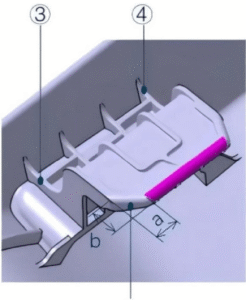
- Chanfro de montagem: Chanfro de entrada a ≥ 4 mm, b ≥ 1,5×a para guiar durante a montagem e evitar o atrito entre as peças.
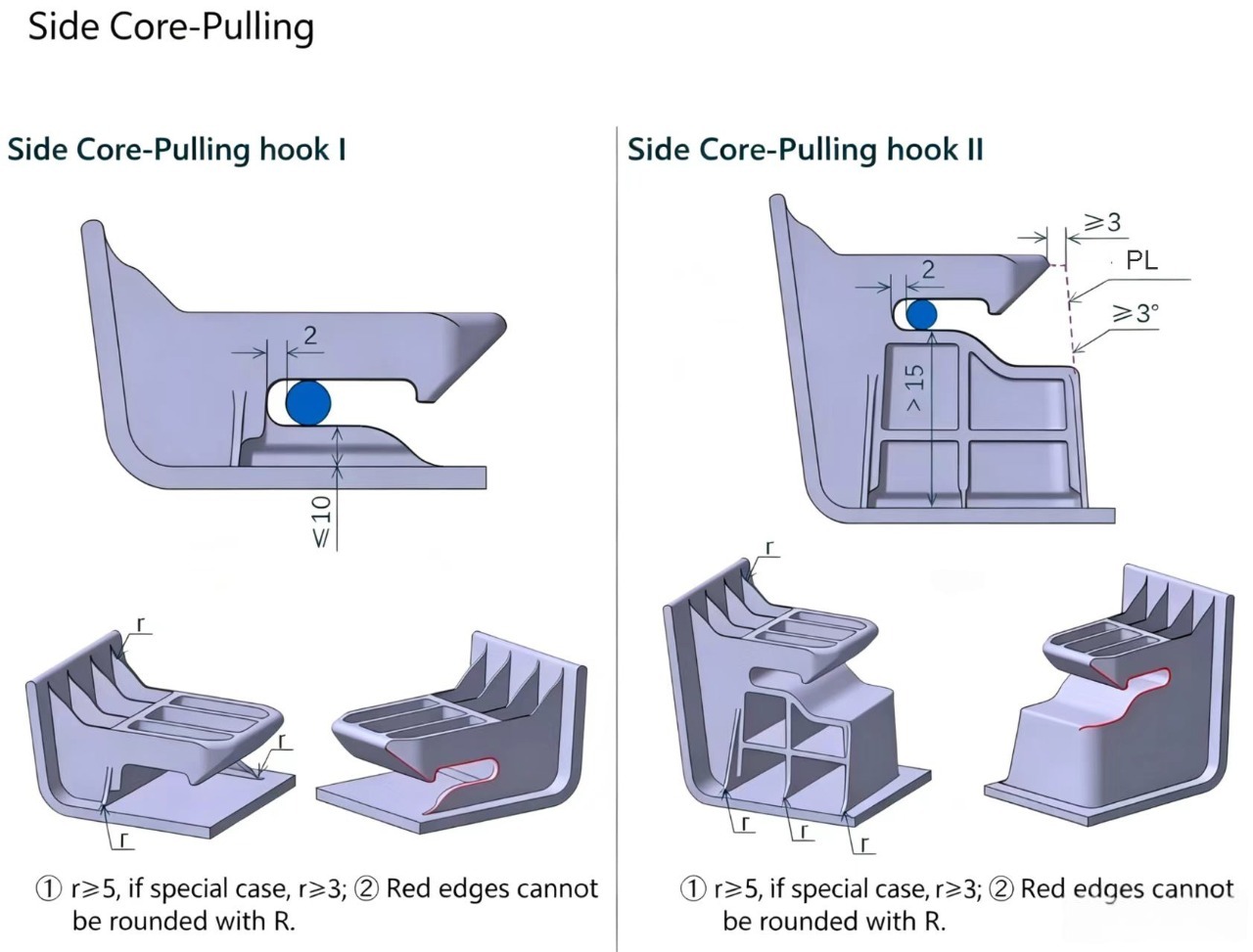
3.2 Gancho de Puxar Lateral (Desmoldagem Transversal)
Para encaixes perpendiculares à direção de abertura do molde; requer núcleos laterais deslizantes com controlos dimensionais rigorosos:
- Limite de tamanho: Projeção do gancho ≤ 10 mm, altura do gancho ≥ 3 mm, ângulo de saída ≥ 3° na linha de divisória.
- Requisito de alívio: Distância ≥ 15 mm entre o gancho e a face da extremidade da casota para evitar interferências durante o movimento lateral do núcleo.
3.3 Regras de Encaixe (Plástico/Chapa Metálica)
3.3.1 Acoplamento com peças plásticas
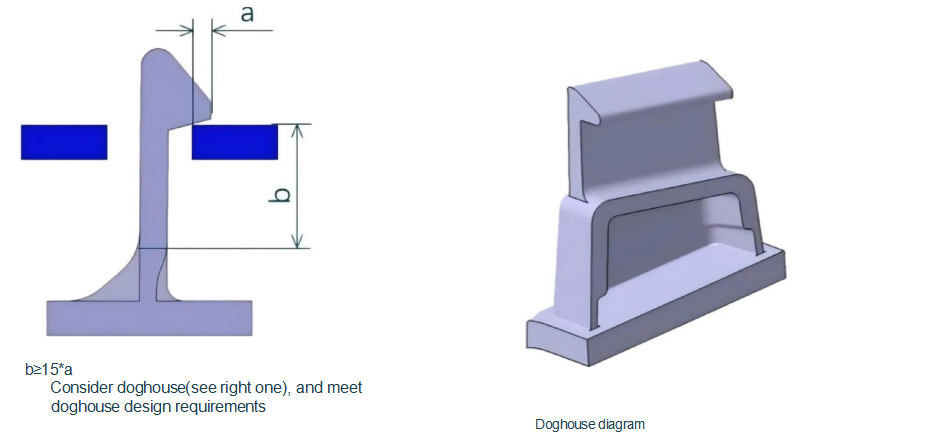
- Proporção de encaixe: Base obrigatória para casota de cão Se a altura de engate b for ≥ 15×a (a = espessura da junta); caso contrário, é provável que ocorra fissuração na raiz.
- Requisitos preliminares: Ângulo de saída lateral ≥ 0,5° na direção principal de desmoldagem, ângulo de saída traseiro ≥ 0,5°, ângulo de saída da nervura ≥ 0,5° na direção do núcleo lateral.
3.3.2 Acoplamento com chapa metálica
- Correspondência da espessura da parede: Espessura da parede plástica no ponto de encaixe: 1,2–1,5 mm; priorize a adição de uma casota. Se tal não for possível, aumente localmente a espessura nominal da parede ou adicione um relevo para as raízes.
- Controlo de lacunas: Deixe um espaço de 0,2 a 0,5 mm entre o fecho e as rebarbas da chapa metálica para evitar encravamentos ou folgas.
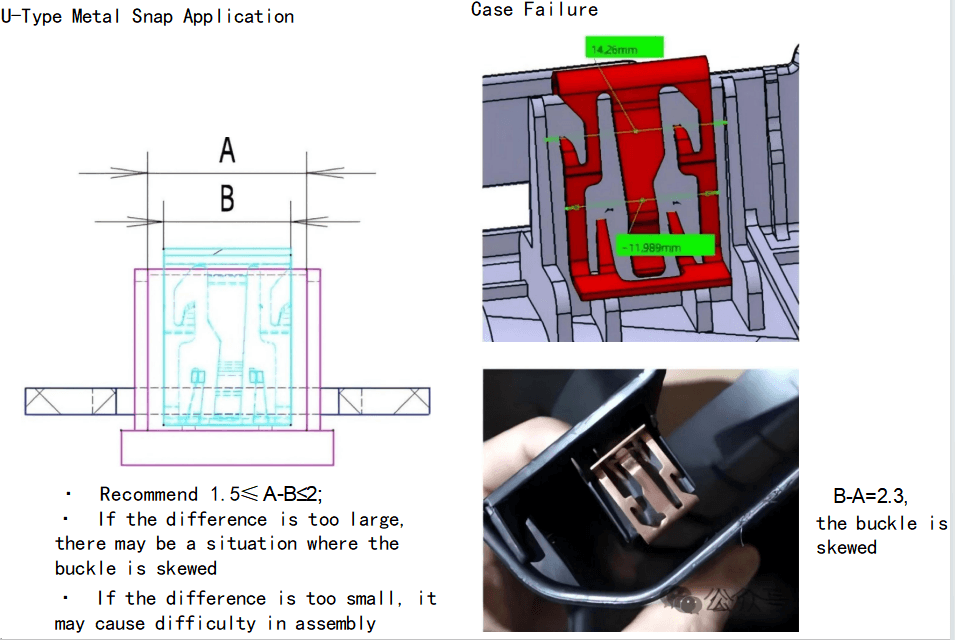
Encaixe de metal tipo U de 3,4 (recorte especial)
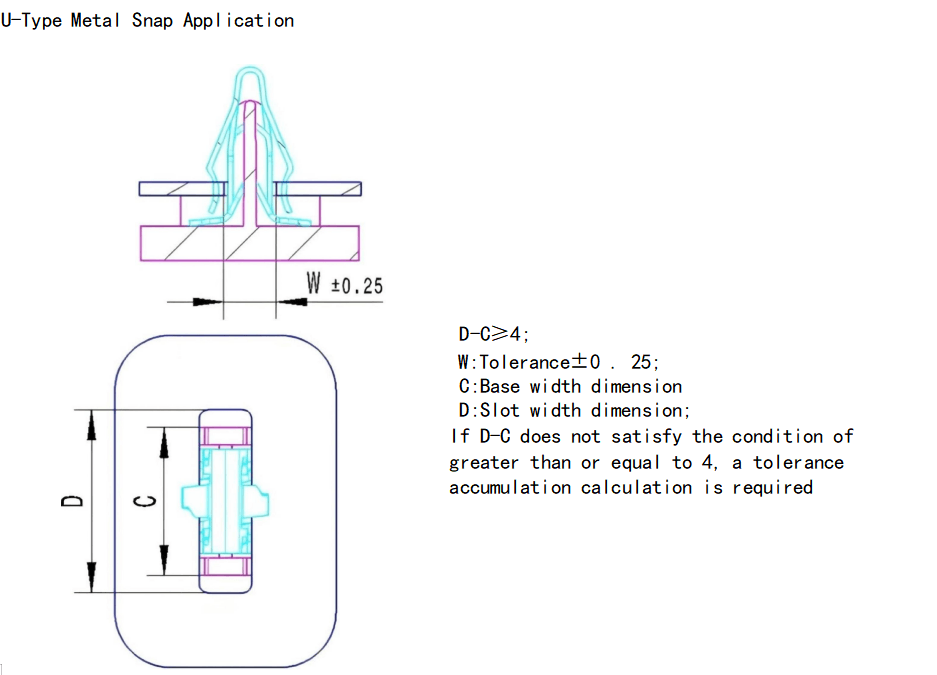
Os encaixes metálicos em forma de U complementam os recortes de plástico para uma fixação de alta resistência; o design deve ser compatível com as bases de plástico:
- Tolerância do furo: Tolerância da largura da ranhura W ±0,25 mm, largura da base C, D–C ≥ 4 mm (tolerância cumulativa necessária se não for cumprida).
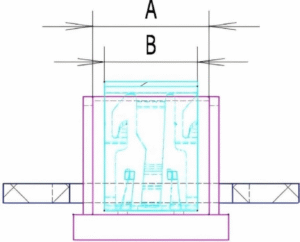
- Espaço entre bases: A–B = 1,5–2 mm; folga excessiva provoca desalinhamento, folga insuficiente dificulta a montagem.
- Suporte de espessura da parede: Para evitar a flutuação sem suporte, a espessura da costela deve ser de pelo menos 2 mm, a altura de pelo menos 3 mm e a largura unilateral de pelo menos 2 mm para além da linha média de encaixe.
4. Os 14 principais problemas comuns de design de undercut e soluções de otimização
4.1 Ângulo de inclinação ausente/insuficiente (Mais comum)
- Problema: Sem corrente de ar na superfície verde da casota (desmoldagem principal) ou no gancho (núcleo lateral), ocorre desgaste/esbranquiçamento/aderência durante a ejeção.
- Otimização: Desmoldagem principal ≥ 3°, núcleo lateral ≥ 0,5° (diferença de espessura da parede de 0,1 a 0,15 mm para superfícies de acoplamento), moldagem do extrator ≥ 1°.
4.2 Aço de raio pequeno/ponta afiada (risco de fissuras)
- Problema: Parede lateral R < 6 mm, raiz R < 3 mm, ângulos de junção agudos provocando fissuras por concentração de tensões; aço afiado < 0,6 mm apresenta risco de lascamento do molde.
- Otimização: Parede lateral R ≥ 6 mm, raiz R ≥ 3 mm, ângulo de junção próximo de 90°, remover zonas de aço afiadas.
4.3 Espessura da parede demasiado fina/grossa (Marcas de afundamento + fissuras)
- Problema: Espessura da casota espessura nominal da parede (marcas de afundamento); espessura do gancho < 2 mm (deformação).
- Otimização: Espessura = 0,8–0,9×espessura nominal da parede, mínimo ≥1,5 mm; espessura do gancho ≥2 mm.
4.4 Nervuras de reforço ausentes/não niveladas (resistência insuficiente)
- Problema: Ausência de nervuras internas, nervuras desalinhadas com a face final ou espessura da nervura < 1,6 mm, provocando colapso/fissuras sob carga.
- Otimização: Adicione nervuras com ≥1,6 mm de espessura, arredonde o raio (R) em ≥0,5 mm nas intersecções e alinhe as nervuras rente à face final.
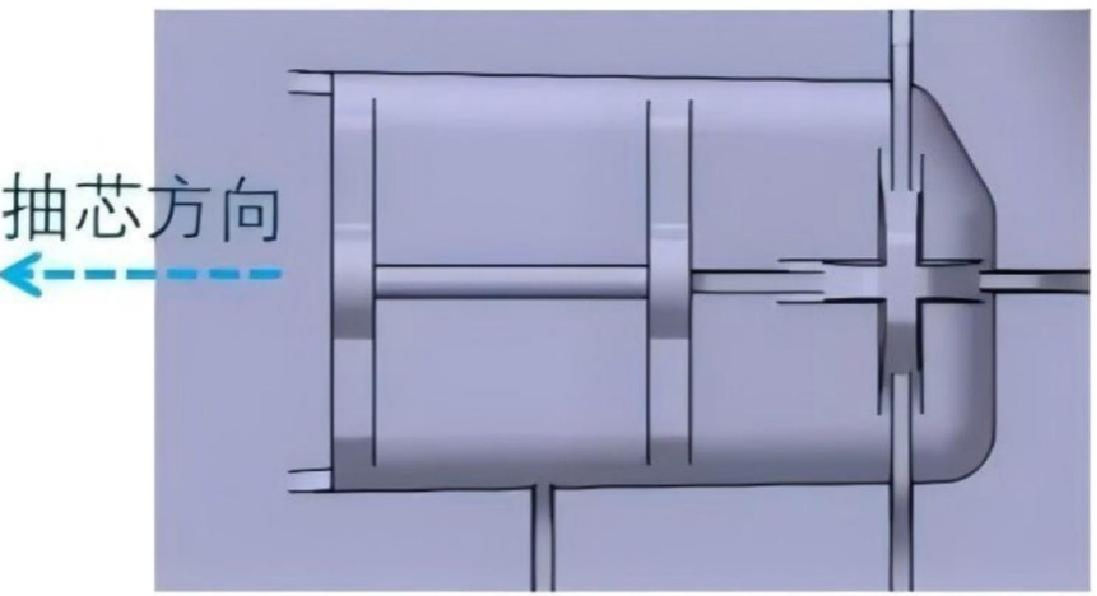
4.5 Deslocamento excessivo do núcleo lateral (molde complexo)
- Problema: Comprimento do núcleo lateral da casota L > 3×A, grande curso deslizante/elevador aumentando o custo do molde e o risco de bloqueio.
- Otimização: Controlo L ≤ 3×H, otimize a direção do núcleo lateral para evitar longos deslocamentos.
4.6 Alívio excessivo da raiz (força enfraquecida)
- Problema: Altura de alívio > 1,5 mm, adelgaçando a raiz e provocando fissuras sob carga.
- Otimização: Altura do relevo ≤1,5 mm, ângulo de inclinação ≥2° na direção do núcleo lateral.
4.7 Encaixe flutuante sem suporte (falha por deformação)
- Problema: Gancho tipo U de metal/plástico flutuante sem encaixe/nervuras de suporte, causando deformação e falha de engate sob pressão.
- Otimização: Adicione uma base para casota, com reforços de 2 mm ou mais de espessura e 3 mm ou mais de altura.
4.8 Ausência de chanfro de montagem (arranhões + montagem difícil)
- Problema: Chanfro insuficiente ou inexistente na entrada do gancho, provocando atrito nas superfícies de contacto e bloqueio durante a montagem.
- Otimização: Chanfro a ≥4 mm, b ≥1,5×a, extremidade do gancho R ≥1,5 mm.
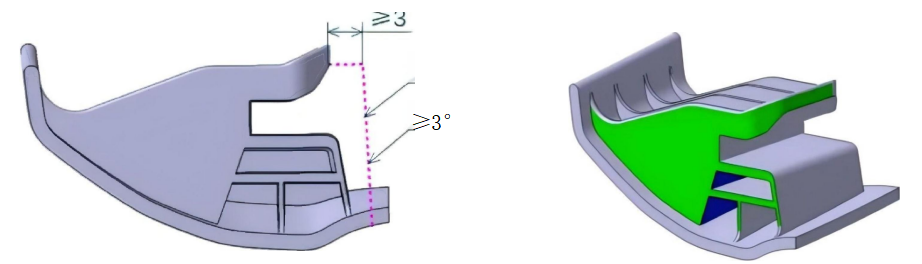
4.9 Posição inadequada da linha de partição (aço afiado sob o raio)
- Problema: A linha de junção do extrator não cobre a parede lateral da casota nem fica acima do gancho, formando pontas afiadas de aço sob o raio e lascas no molde.
- Otimização: A linha de junção cobre a parede lateral da casota, ângulo de saída da superfície verde ≥0,3° (desmoldagem principal), ângulo de saída da superfície azul ≥3° (núcleo lateral).
4.10 Proporção de estalido desequilibrada (fissuras/folga)
- Problema: Não foi adicionada nenhuma casota quando b ≥15×a, ou b <5×a causando força de engate insuficiente.
- Otimização: Casota obrigatória para b ≥15×a, a ≥0,5 mm, b ≥5×a, c ≥a+1 mm.
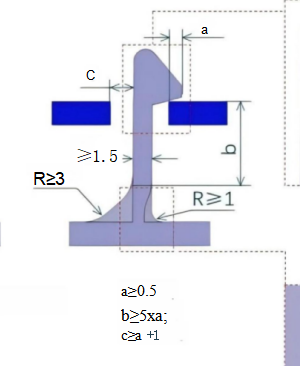
4.11 Filetes nas Bordas Vermelhas (Força de Envolvimento Insuficiente)
- Problema: A linha de junção do extrator não cobre a parede lateral da casota nem fica acima do gancho, formando pontas afiadas de aço sob o raio e lascas no molde.
- Otimização: A linha de junção cobre a parede lateral da casota, ângulo de saída da superfície verde ≥0,3° (desmoldagem principal), ângulo de saída da superfície azul ≥3° (núcleo lateral).
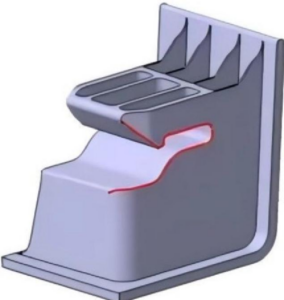
4.12 Dimensões excessivas da cavidade (dificuldade de desmoldagem)
- Problema: Cavidade da casota H 3×H, W < 3 mm, provocando o bloqueio do núcleo lateral.
- Otimização: Respeite rigorosamente as condições H ≥3 mm, L ≤3×H, 3 ≤W ≤5×H.
4.13 Junção de superfície A não a 90° (Aço afiado + Tensão)
- Problema: Ângulo agudo na junção entre a casota do cão e a superfície A, provocando concentração de tensões e aço afiado.
- Otimização: Ângulo de junção próximo de 90°, R ≥3 mm, remover áreas agudas.
4.14 Folga inadequada do encaixe metálico (desalinhamento/montagem difícil)
- Problema: Base A–B 2 mm (desalinhamento do encaixe).
- Otimização: Controlo A–B = 1,5–2 mm, furo de acoplamento D–C ≥ 4 mm.
5. Resumo do Design Undercut e Lista de Verificação Principal
O projeto de rebaixos equilibra função, resistência e viabilidade do molde, centrando-se em rebaixos racionais, parâmetros controlados, evitando pontas de aço afiadas e simplificando a desmoldagem. Tanto para bases de encaixe como para ganchos de fixação, dê prioridade a: ângulos de saída suficientes, espessura de parede proporcional, transições de raios suaves, nervuras de reforço completas e deslocamento lateral controlado do núcleo para eliminar problemas de desmoldagem, fissuras e desencaixe na origem.
Lista de verificação do projeto principal (verificação rápida)
- ✅ Espessura da casota = 0,8–0,9×espessura nominal da parede, ≥1,5 mm.
- ✅ Ângulo de desmoldagem principal ≥3°, núcleo lateral ≥0,5°, moldagem do extrator ≥1°.
- ✅ Parede lateral R ≥6 mm, raiz R ≥3 mm, sem aço afiado <0,6 mm.
- ✅ Nervuras de reforço ≥1,6 mm, intersecção R ≥0,5 mm, niveladas com a face final.
- ✅ Comprimento do núcleo lateral L ≤3×H, altura do relevo radicular ≤1,5 mm.
- ✅ Sem filetes nas bordas do anzol vermelho, chanfro de entrada ≥4 mm.
- ✅ Casota obrigatória se a altura de engate b ≥15×a.
- ✅ Base de encaixe metálica A–B = 1,5–2 mm, nervuras de suporte ≥ 2 mm.
Um design eficaz dos rebaixos aumenta a eficiência da montagem e a fiabilidade estrutural, ao mesmo tempo que reduz os custos de desenvolvimento do molde e as taxas de defeitos — uma competência essencial para os engenheiros estruturais de plásticos.
Conclusão
O design dos rebaixos é a base da moldagem por injeção de plástico em alto volume. Seguindo diretrizes rigorosas para ângulos de saída, filetes, espessura da parede, percentagens e geometria do encaixe, é possível produzir rebaixos úteis, robustos e de baixo custo.
Dominar estes padrões ajuda a evitar retrabalho nos moldes, a reduzir os prazos de entrega, a melhorar a qualidade do produto e a diminuir os custos globais. Quer se trate de projetar encaixes de pressão, bases para casotas de cães ou estruturas de proteção internas, dê sempre prioridade à moldabilidade, resistência e estabilidade de montagem. Com um design de rebaixo padrão, os seus produtos plásticos irão certamente alcançar um desempenho consistente na produção em massa.
Comentários
Posts Mais Recentes
Blogs Relacionados
Senyo o blog é focado em compartilhar o nosso conhecimento extensivo de protótipo de fabricação. Através de nossos artigos, temos o objetivo de apoiar a refinar seu design de produto e navegação do complexidades de prototipagem rápida, mais eficaz.