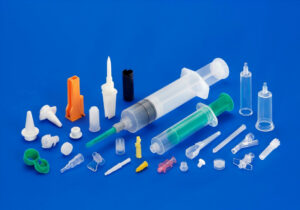
A Guide to Modern Plastics Manufacturing Processes
Table of Contents
Plastics are foundational materials in contemporary production. They develop the basis for numerous end-use products, from life-saving medical gadgets to day-to-day durable goods. The globe of plastics supplies thousands of polymer alternatives, each offering special mechanical and aesthetic homes. This flexibility, however, increases an essential inquiry for designers and engineers: what is the best means to transform a plastic material into a completed component?
A broad variety of plastics making procedures exists to fit diverse applications, part geometries, and material kinds. Understanding these options is essential for anybody involved in item growth. An educated option can drastically lower costs, shorten preparations, and boost end product quality. This comprehensive overview explores the most prevalent plastics making innovations today. We will give clear guidelines to help you select the excellent procedure for your particular application, guaranteeing your task moves from idea to truth with performance and precision.
How to Choose the Right Plastics Manufacturing Process
Choosing the optimal production process requires a calculated evaluation of your project’s specific needs. Prior to committing to a technology, an engineer should consider a number of crucial elements. We suggest you assess the adhering to aspects to make a notified choice.
- Component Geometry and Form: Does your component layout consist of complex inner functions? Does it require extremely tight resistances? The geometry of your design heavily affects your manufacturing alternatives. Some processes excel at developing detailed forms, while others are restricted to easier types. Complex layouts may also need substantial Design for Manufacturing (DFM) adjustments to be created economically.
- Production Volume and Cost: How several parts do you intend to make, both originally and annually? Particular plastics making techniques, like shot molding, have high in advance expenses for tooling yet produce parts at a really reduced per-unit cost. This makes them optimal for automation. In contrast, procedures like 3D printing have very little arrangement expenses, however the price per part stays relatively high, making them ideal for low-volume manufacturing and prototyping.
- Lead Time: How swiftly do you need the finished parts? Some processes can deliver a first prototype within 24 hours. Others, particularly those calling for facility tool manufacture, might take weeks or perhaps months before the first component is produced. Your job timeline will certainly be a definitive variable.
- Material Requirements: What functional and environmental stress and anxieties must your item sustain? The perfect material depends on a balance of factors, including toughness, flexibility, temperature level resistance, chemical resistance, and appearance. You need to evaluate the desired features against the materials offered for a provided manufacturing process.
Understanding the Two Main Types of Plastics
Plastics are broadly categorized into two main families: thermoplastics and thermosets. Their fundamental difference lies in how they respond to heat, which dictates which plastics manufacturing processes are suitable for them.
Thermoplastics
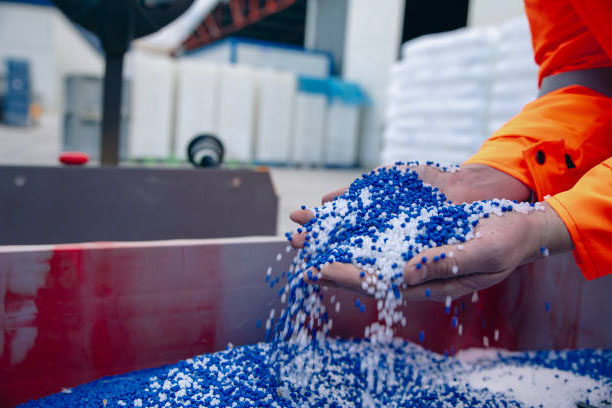
Thermoplastics are the most common type of plastic used in manufacturing. Their defining characteristic is the ability to be melted, solidified, and then melted again without significant chemical degradation. This property makes them highly recyclable and reusable. Manufacturers typically supply thermoplastics as small pellets or sheets. They heat the material to a pliable state and then form it into the desired shape. This process is entirely physical and reversible.
Common Thermoplastic Materials:
- Acrylonitrile Butadiene Styrene (ABS)
- Polycarbonate (PC)
- Polypropylene (PP)
- Polyethylene (PE)
- Polyamide (PA / Nylon)
- Polylactic Acid (PLA)
- Polyvinyl Chloride (PVC)
- Polyether Ether Ketone (PEEK)
Thermosetting Plastics
Thermosetting plastics, or thermosets, behave differently. Once cured, they remain in a permanent solid state. During the curing process—induced by heat, light, or chemical reaction—the polymers cross-link to form an irreversible chemical bond. If you reheat a thermoset plastic, it will decompose and burn rather than melt. This means you cannot re-mold or recycle thermosets in the same way as thermoplastics.
Common Thermoset Materials:
- Epoxy
- Silicone
- Polyurethane
- Polyester
- Vulcanized Rubber
- Cyanate Ester
| Feature | Thermoplastics | Thermosetting Plastics (Thermosets) |
|---|---|---|
| Response to Heat | Softens when heated, hardens when cooled. Reversible. | Cures and hardens permanently with heat. Irreversible. |
| Molecular Structure | Long-chain polymers with weak intermolecular forces. | Polymers form a rigid, cross-linked 3D network. |
| Recyclability | Highly recyclable. Can be melted and reformed. | Generally not recyclable through melting. |
| Mechanical Properties | Often more flexible and impact-resistant. | Typically more rigid, stable, and heat-resistant. |
| Common Processes | Injection Molding, 3D Printing (FDM), Extrusion. | Polymer Casting, Reaction Injection Molding. |
| Typical Applications | Consumer goods, packaging, pipes, containers. | Adhesives, coatings, electrical components, high-heat parts. |
Key Plastics Manufacturing Processes Explained
Here, we detail eight of the most significant plastics manufacturing technologies used in industry today.
1. 3D Printing (Additive Manufacturing)
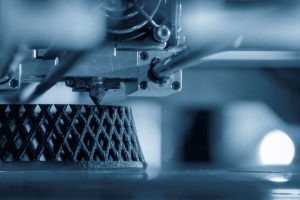
3D printers build three-dimensional parts directly from CAD files. The process works by adding material layer by layer until the final object is complete. This additive approach contrasts sharply with traditional subtractive methods.
The Process:
- Print Setup: An operator uses specialized software to orient the digital model in a virtual build space. The software then slices the model into thin horizontal layers and generates a toolpath for the printer. If needed, the software adds support structures.
- Printing: The printer executes the toolpath layer by layer. The specific technology determines how it adds material. Fused Deposition Modeling (FDM) extrudes molten plastic filament. Stereolithography (SLA) uses a laser to cure liquid photopolymer resin. Selective Laser Sintering (SLS) uses a laser to fuse powdered plastic.
- Post-Processing: After printing, the operator removes the part from the printer. Depending on the technology, the part may require cleaning, washing, and post-curing to achieve its final properties. The operator then removes any support structures.
3D printing eliminates the need for tooling, which drastically reduces setup times and costs for custom parts. However, it is generally slower and more labor-intensive per part than mass-production methods. As the technology advances, its cost-effectiveness is improving, making it viable for low-to-mid-volume production runs.
| 3D Printing | |
|---|---|
| Form Freedom | High |
| Lead Time | < 24 hours |
| Setup Cost | $ |
| Cost Per Part | $$$ |
| Ideal Volume | ~1 – 1,000 parts |
| Common Materials | Thermoplastics (Nylon, ABS, PLA), Thermoset Resins |
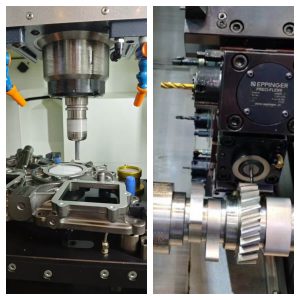
CNC (Computer Numerical Control) machining is a subtractive manufacturing process. It uses computer-controlled tools like mills, lathes, and grinders to selectively remove material from a solid block of plastic or metal, known as a workpiece.
The Process:
- Job Setup: A programmer first converts a CAD model into a CAM (Computer-Aided Manufacturing) file. This file contains toolpaths that direct the cutting tools’ movements and speeds.
- Machining: The operator sends the toolpaths to the CNC machine. For milling, a spinning tool removes material from a fixed workpiece. For turning on a lathe, the workpiece spins against a fixed cutting tool.
- Post-Processing: Once machining is complete, the operator cleans the part, deburrs sharp edges, and trims away any excess material.
CNC machining is ideal for producing low-volume plastic parts with very tight tolerances and geometries that are difficult to mold. It excels at creating prototypes and functional end-use parts like gears and fixtures. While setup costs are moderate, part complexity can significantly increase machining time and cost.
| CNC Machining | |
|---|---|
| Form Freedom | Medium |
| Lead Time | < 24 hours |
| Setup Cost | $$ |
| Cost Per Part | $$$$ |
| Ideal Volume | ~1 – 5,000 parts |
| Common Materials | Most rigid plastics (PC, POM, PEEK, Nylon, ABS) |
3. Polymer Casting
Polymer casting involves pouring a liquid reactive resin or rubber into a mold. The material then undergoes a chemical reaction and solidifies into the final part.
The Process:
- Mold Preparation: An operator applies a release agent to the mold’s interior surfaces to prevent the part from sticking. Sometimes, they preheat the mold to a specific temperature.
- Casting: The operator mixes a synthetic resin with a curing agent and pours or injects it into the mold cavity.
- Curing: The material cures inside the mold until it solidifies. Applying heat can accelerate this process for certain polymers.
- De-molding: The operator opens the mold and carefully removes the cured part.
- Trimming: Finally, the operator cuts or sands away any artifacts like flash or sprues.
Molds for polymer casting, often made from RTV silicone rubber, are inexpensive compared to the hard steel tools used in injection molding. This makes the process excellent for prototyping and short production runs. However, thermoset casting resins are often more expensive than thermoplastics, and the process is labor-intensive, resulting in a higher cost per part.
| Polymer Casting | |
|---|---|
| Form Freedom | High |
| Lead Time | 1 – 3 days |
| Setup Cost | $ |
| Cost Per Part | $$ |
| Ideal Volume | ~1 – 1,000 parts |
| Common Materials | Polyurethane, Epoxy, Silicone, Acrylic |
4. Rotational Molding
Rotational molding, or rotomolding, is a unique process for creating large, hollow plastic objects. It involves heating a hollow mold filled with powdered plastic while rotating it on two axes.
The Process:
- Charging: An operator loads a measured amount of plastic powder into the mold cavity and closes it securely.
- Heating: The mold is placed in an oven and rotated along two perpendicular axes. The heat melts the powder, which tumbles and coats the mold’s interior walls.
- Cooling: The mold continues to rotate as it cools slowly. This ensures the plastic skin solidifies evenly without sagging.
- Part Removal: Once cool, the operator opens the mold and removes the finished hollow part.
Rotomolding uses centrifugal force, not pressure, so its tooling can be made from less expensive materials like aluminum. This keeps setup costs relatively low. The process is perfect for producing items like tanks, kayaks, and large containers. Its main limitations are long cycle times and looser tolerances compared to other molding methods.
| Rotational Molding | |
|---|---|
| Form Freedom | Medium (ideal for large hollow parts) |
| Lead Time | Days to weeks |
| Setup Cost | $$$ |
| Cost Per Part | $$ |
| Ideal Volume | ~200 – 5,000 parts |
| Common Materials | Polyethylene (PE), Polypropylene (PP), PVC, Nylon |
Vacuum forming is a type of thermoforming where a sheet of heated plastic is draped over a mold and a vacuum pulls it into shape.
The Process:
- Clamping: A machine clamps a sheet of plastic into a frame.
- Heating: Heating elements warm the sheet until it becomes soft and pliable.
- Vacuum: The frame lowers the softened sheet over a mold. A vacuum pump then activates, sucking out the air between the sheet and the mold, forcing the plastic to conform to the mold’s shape.
- Cooling and Release: The formed part cools and solidifies. Fans or a fine water mist can speed up this stage.
- Trimming: The operator removes the part from the mold and trims away excess material.
Tooling for vacuum forming is very cost-effective since the process involves low pressures. This makes it suitable for everything from one-off prototypes to mass production. However, it is limited to creating parts with relatively simple geometries and thin walls, such as packaging, trays, and automotive liners.
| Vacuum Forming | |
|---|---|
| Form Freedom | Limited (simple, thin-walled parts) |
| Lead Time | Hours to weeks |
| Setup Cost | $-$$$$ |
| Cost Per Part | $-$$$ |
| Ideal Volume | Any volume |
| Common Materials | ABS, PETG, Polystyrene (PS), PC, PP, PVC |
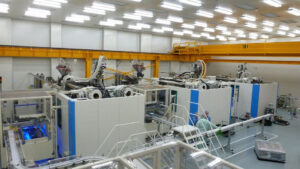
Injection molding is the dominant process for mass-producing plastic parts. It works by injecting molten thermoplastic material at high pressure into a precisely machined mold.
The Process:
- Mold Setup: The two halves of a steel mold are closed by a powerful hydraulic press.
- Injection: A large screw melts plastic pellets and forces the molten material forward. The machine then injects this material into the mold cavity at high pressure.
- Cooling and Release: The plastic cools and solidifies inside the mold. Once it is solid, the mold opens, and ejector pins push the part out.
- Post-Processing: The system often automatically removes sprues and runners (channels that guide the plastic) as the mold opens.
Injection molding can produce highly complex parts with excellent repeatability. However, the molds themselves are extremely expensive and can take months to create. This high initial investment is only justified by very high production volumes, where the per-part cost becomes incredibly low.
| Injection Molding | |
|---|---|
| Form Freedom | High |
| Lead Time | 2 – 4 months (for tooling) |
| Setup Cost | $$$$$ |
| Cost Per Part | $ |
| Ideal Volume | 5,000+ parts |
| Common Materials | Almost any thermoplastic (ABS, PP, PC, PA, etc.) |
7. Extrusion
Extrusion creates objects with a fixed cross-sectional profile. The process works by pushing molten plastic through a shaped die.
The Process:
- Plasticating: A screw melts and conveys plastic pellets through a heated barrel.
- Molding: The screw forces the molten plastic through a die. The shape of the die opening determines the profile of the final part.
- Cooling: The extruded plastic profile emerges from the die and is cooled, often in a water bath.
- Cutting: The continuous shape is then cut into desired lengths or coiled onto a spool.
Extrusion is a highly efficient, continuous process with relatively low tooling costs compared to injection molding. It is limited to producing linear, two-dimensional shapes. Common applications include pipes, tubing, window frames, and weather stripping.
| Extrusion | |
|---|---|
| Form Freedom | Limited (continuous linear profiles) |
| Lead Time | Weeks |
| Setup Cost | $$$ |
| Cost Per Part | $ |
| Ideal Volume | 1,000+ parts |
| Common Materials | PVC, PP, PE, ABS, Polystyrene |
8. Blow Molding
Blow molding is a technique for creating hollow plastic parts, most notably bottles and containers. It works by inflating a heated plastic tube inside a mold cavity.
The Process:
- Parison Creation: A machine melts plastic pellets and extrudes them into a hollow tube called a parison.
- Molding: A mold closes around the parison, pinching one end shut. Pressurized air is then blown into the parison, inflating it like a balloon until it presses against the cold mold walls.
- Cooling and Release: The part cools and solidifies. The mold then opens and ejects the finished product.
Blow molding uses lower pressures than injection molding, which helps keep tooling costs moderate. As a continuous, automated process, it can achieve very high production rates and an extremely low cost per unit. It is the go-to method for manufacturing bottles, fuel tanks, and other hollow items at scale.
| Blow Molding | |
|---|---|
| Form Freedom | Limited (hollow, thin-walled parts) |
| Lead Time | Weeks |
| Setup Cost | $$$$ |
| Cost Per Part | $ |
| Ideal Volume | 5,000+ parts |
| Common Materials | Polyethylene Terephthalate (PET), PP, PVC, PE |
Critical Quality Control Considerations
Achieving success in plastics producing depends not only on selecting the best procedure however likewise on applying strenuous quality assurance. Regardless of the method, you have to verify that the ended up parts satisfy the required requirements. Secret locations of emphasis include dimensional accuracy, product properties, and aesthetic coating. Makers make use of precision devices like electronic calipers, micrometers, and Coordinate Measuring Machines (CMMs) to validate that part dimensions are within the specified tolerances.
Additionally, it is frequently needed to perform functional examinations. Product screening can validate properties like tensile stamina, solidity, and impact resistance to make sure the part will certainly do correctly under tension. Aesthetic inspection is additionally important, especially for consumer-facing products. This includes monitoring for surface flaws like sink marks or flash, verifying color uniformity versus a criterion, and ensuring the surface coating satisfies the layout needs. A durable quality control strategy makes certain consistency and integrity from the initial component to the last.
Conclusion
The field of plastics manufacturing is dynamic and diverse, offering a solution for nearly any design challenge. Each process, from the rapid versatility of 3D printing to the high-volume efficiency of injection molding, has a unique profile of strengths and weaknesses. The best choice always depends on a careful analysis of your project’s specific requirements for geometry, volume, speed, and material performance.
By understanding the fundamental principles of these core technologies, designers and engineers can make smarter decisions early in the development cycle. This knowledge empowers you to optimize your designs for manufacturing, reduce costs, and accelerate your time to market. As technology continues to evolve, the boundaries between these processes will shift, opening up new possibilities for innovation in how we create the plastic parts that shape our world.
For Reference
- Society of Plastics Engineers (SPE):
https://www.4spe.org/– A leading technical society for plastics professionals, providing valuable resources and industry information. - Plastics Industry Association (PLASTICS):
https://www.plasticsindustry.org/– An organization that supports the entire plastics supply chain, offering market data and advocacy. - UL Prospector (formerly IDES):
https://www.ulprospector.com/en/na/plastic– A comprehensive database for searching and comparing technical data sheets for thousands of plastic materials. - Autodesk’s Design for Manufacturing (DFM) Guide:
https://www.autodesk.com/products/fusion-360/blog/what-is-design-for-manufacturing-dfm/– An excellent resource for understanding DFM principles, which are critical for processes like injection molding.
Comments
Latest Posts
Related Blogs
Senyo’s blog is focused on sharing our extensive knowledge of prototype manufacturing. Through our articles, we aim to support you in refining your product design and navigating the complexities of rapid prototyping more effectively.