
Comprehensive Guides to Anodizing Aluminum
Table of Contents
What is Anodizing Aluminum?
Anodizing aluminum is a surface treatment process widely used in industrial and consumer products. Through electrochemical processes, anodizing can significantly improve the corrosion resistance, hardness, and aesthetics of aluminum alloys. This article will provide a detailed introduction to the principle, application, process flow, chemical reaction process, film thickness information, characteristics, structural shape and size of anodized film, development status and industrial distribution of anodizing aluminum technology in China.

The Principle of Anodizing Aluminum
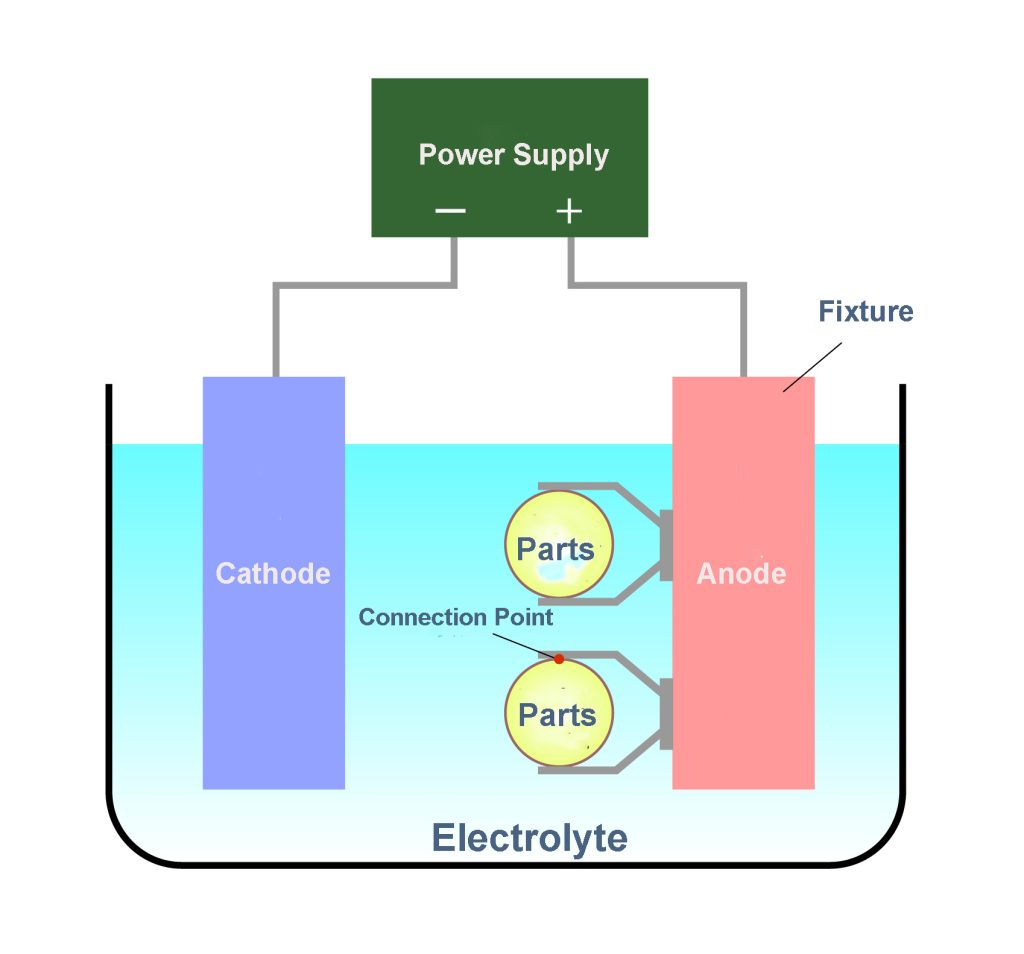
Anodizing aluminum is the process of generating an oxide film on the surface of aluminum alloy using the principle of electrolysis. Specifically, aluminum alloy is placed as an anode in the electrolyte, and through the action of current, a dense aluminum oxide film is formed on its surface. This film not only protects the underlying metal from environmental corrosion, but also provides insulation and decorative effects.
The Application of Anodizing Aluminum
1. Aerospace: Used for surface treatment of aircraft and spacecraft components to enhance their corrosion resistance and wear resistance.
2. Architectural decoration: used for building curtain walls, doors and windows, and decorative panels to provide beautiful metal surfaces.
3. Electronic appliances: used for the casing of electronic products such as mobile phones and laptops to improve their wear resistance and aesthetics.
4. Automotive industry: used for automotive components such as wheels, frames, etc., to enhance their service life and appearance.
5. Daily necessities: Used for aluminum pots, tableware and other daily necessities, providing wear-resistant and corrosion-resistant surfaces.
The Process of Anodizing Aluminum
1. Pretreatment
Cleaning: Remove oil stains, dust, and impurities from the surface.
Etching: Use alkaline or acidic solutions to remove surface oxide layers, increase roughness, and improve adhesion.
Neutralization: Use neutral solution to remove residual acidic and alkaline substances, avoiding affecting subsequent processes.
2. Anodizing Aluminum
Electrolyte selection: Common electrolytes include sulfuric acid, oxalic acid, and chromic acid.
Current control: Adjust the current density and voltage according to the required film thickness and properties.
Temperature control: Strictly control the temperature of the electrolyte, usually between 15-25 degrees Celsius.
Time control: Control the anodizing time according to the required film thickness, usually 15-60 minutes.
3. Post Processing
Sealing: By treating with hot water, steam, or inorganic salt solution, the micropores of the oxide film are sealed to improve corrosion resistance and staining properties.
Dyeing: Obtaining various colored oxide films through chemical or electrolytic dyeing to enhance decorative effects
Chemical Reaction Process of Anodizing Aluminum
In the process of anodizing aluminum, aluminum alloy acts as the anode, electrolyte acts as the electrolyte, and a series of chemical reactions occur through the action of electric current. The reaction equation is as follows:
Al → Al 3+3e H2O → O2-+2H+2Al 3+3O2- → Al 2 O 3
Thickness information of anodic oxide film
The thickness of the anodic oxide film is an important factor affecting its performance, and different applications require different film thicknesses. The common range of film thickness is as follows:
1. Ordinary anodizing aluminum: The film thickness is generally 5-20 microns, suitable for general decorative and anti-corrosion requirements.
2. Hard anodizing aluminum: The film thickness is generally 25-150 microns, suitable for industrial applications that require high wear resistance and hardness, such as mechanical parts, aerospace components, etc.
3. Micro arc oxidation: The film thickness can reach tens to hundreds of microns, with extremely high hardness and wear resistance, commonly used in special industrial applications.
The control of film thickness is mainly achieved by adjusting parameters such as current density, anodizing time, and electrolyte composition.
Characteristics of Anodized Film
The anodic oxide film has the following main characteristics:
1. Corrosion resistance: The oxide film can effectively protect the aluminum alloy substrate from contact with corrosive media in the external environment.
2. High hardness: The hardness of the oxide film is significantly increased, reaching HV300-500.
3. Electrical insulation: The oxide film has good electrical insulation properties.
4. Decorative: The oxide film has good dyeing performance and can obtain multiple colors through dyeing, enhancing the appearance of the product.
5. Heat resistance: The oxide film has a certain degree of heat resistance and can maintain stable physical and chemical properties in high temperature environments.
Structure, shape, and size of anodic oxide film
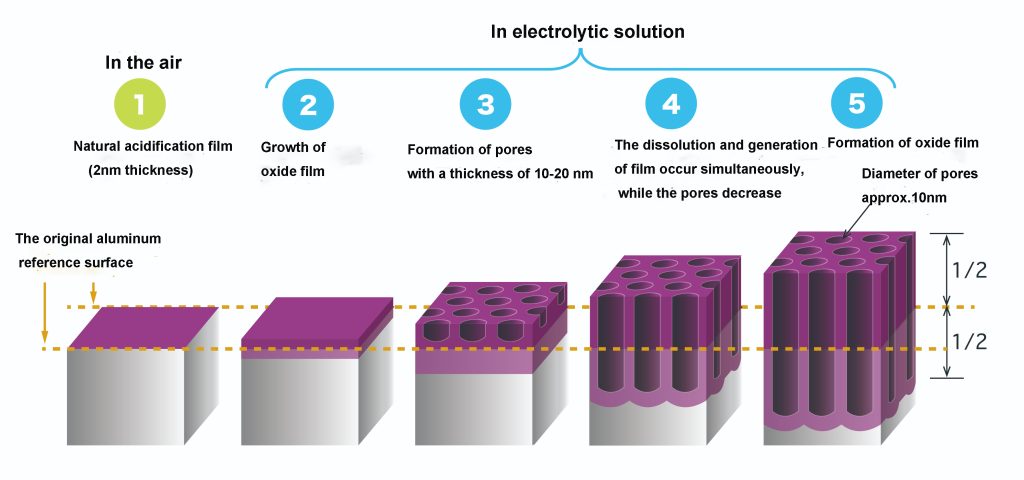
The structure, shape, and size of the anodic oxide film to some extent determine its performance. A typical anodic oxide film structure consists of two layers:
1. Outer layer (porous layer):
The porous layer is composed of many small pores, typically with diameters between 10-100 nanometers. The length and arrangement of the pores can be controlled by adjusting the anodizing conditions. This layer is mainly used for dyeing and improving adhesion.
2. Inner layer (dense layer):
The dense layer is located between the porous layer and the matrix, and its thickness is usually 1/3 to 1/2 of the porous layer. The dense layer has very high corrosion resistance and insulation properties, playing a role in protecting the substrate.
The control of membrane thickness and pore size can be achieved by adjusting the composition, temperature, current density, and anodizing aluminum time of the electrolyte to meet different application requirements.
Advantages of Anodizing Aluminum
1. Corrosion resistance: The oxide film has excellent corrosion resistance and can effectively protect the aluminum substrate.
2. High hardness: The hardness of the oxide film is significantly increased, enhancing the wear resistance of the surface.
3. Good insulation: The oxide film has good electrical insulation properties and is suitable for the electrical and electronic fields.
4. Aesthetics: Through the dyeing process, a rich and colorful surface effect can be obtained, enhancing the appearance value of the product.
5. Environmental friendliness: The anodizing aluminum process is relatively environmentally friendly and does not produce harmful gases or heavy metal pollution.
Development and Industrial Distribution of Anodizing Aluminum Process in China
1. Development Situation
In recent years, China has made significant progress in anodizing aluminum technology. Driven by technological innovation and process improvement, China’s anodizing aluminum process has significantly improved in efficiency, quality, and environmental protection. The following are several important aspects of the development of anodizing aluminum technology in China:
Technological innovation: With the increase of scientific research investment, many universities and research institutions have made important breakthroughs in the field of anodizing aluminum technology, such as efficient anodizing power supplies, new electrolyte formulations, and advanced sealing technologies.
Environmental improvement: The increasingly strict environmental regulations have prompted companies to adopt more environmentally friendly electrolytes and processes, reduce the emission of harmful substances, and improve resource utilization efficiency.
Automation and Intelligence: Many enterprises have introduced automated production lines and intelligent control systems, which have improved production efficiency and product quality stability, reduced labor costs and production risks.
2. Industrial Distribution
The anodizing aluminum industry in China is mainly concentrated in the following regions:
- Pearl River Delta region: As an important manufacturing base in China, the Pearl River Delta region has numerous anodizing enterprises, mainly serving the electronics, automotive, and construction decoration industries.
- Yangtze River Delta region: This region is home to a large number of high-end manufacturing enterprises with high demand for anodizingaluminumtechnology, mainly applied in fields such as aerospace, precision machinery, and electronic appliances.
- Bohai Rim region: Anodizing enterprises in this region mainly serve the automotive manufacturing and construction decoration industries, and are also important manufacturing centers in northern China.
Southwest region: In recent years, with the promotion of the national policy of developing the western region, the anodizing aluminum industry in Southwest China has also been rapidly developing, mainly applied in infrastructure construction and light industry.
Overall, China’s aluminum alloy anodizing process is at the forefront of the world in terms of technological level and industrial scale, and is expected to achieve wider applications in more fields in the future.
Conclusion
Anodizing Aluminum is an important surface treatment technology widely used in various industries. By selecting and controlling process parameters reasonably, high-performance oxide films can be obtained, enhancing the value of aluminum alloy products. As an important production base for global anodizing aluminum, China has abundant industrial resources and advanced technological equipment. I hope this article can help you better understand anodizing aluminum and provide reference for selecting suitable surface treatment processes for your products.
If you have any questions or need further information on anodizing aluminum, please feel free to contact us at any time. We will wholeheartedly provide you with professional technical support and high-quality services.
Comments
Latest Posts
Tags
Related Blogs
Senyo’s blog is focused on sharing our extensive knowledge of prototype manufacturing. Through our articles, we aim to support you in refining your product design and navigating the complexities of rapid prototyping more effectively.
cnc cutting laser
August 28, 2024