Praktický průvodce grafem povrchové úpravy
Obsah
In precision engineering and industrial manufacturing, surface finish is a critical parameter. It is far more than an aesthetic quality. The texture of a component’s surface can directly dictate its functionality, durability, and overall performance. Specific levels of roughness can improve fluid sealing, reduce friction, or enhance paint adhesion. For these reasons, engineers and designers must never leave surface requirements open to interpretation. If the surface texture is integral to your product’s success, a clear and precise specification is mandatory.
This comprehensive guide provides the technical knowledge needed to master surface finish specifications. We will dissect the fundamental meaning of surface finish and explore its critical role in modern engineering. We will detail the scientific methods used to measure surface roughness accurately. You will find a detailed surface finish chart, complete with standard symbols and values, designed to help you communicate your requirements effectively on technical drawings. Whether you are a design engineer, a quality control inspector, or a procurement specialist, this guide will make the surface finish chart an accessible and practical tool in your daily work. At Senyorapid, we believe that a deep understanding of these principles is the first step toward superior manufacturing outcomes.
Defining Surface Finish: A Technical Breakdown
Before we analyze the surface finish chart, we must establish a clear definition of its core concepts. In manufacturing, surface finish refers to the process of altering a part’s surface. This can involve material removal, material addition, or reshaping. The result of this process is the surface texture. This texture is not a single property but a composite of three distinct characteristics: roughness, waviness, and lay.
Surface Roughness: This is the most frequently discussed component. Roughness consists of the fine, closely spaced irregularities on a surface. These are the microscopic peaks and valleys created by the machining tool or manufacturing process. When machinists refer to “surface finish,” they are most often talking about surface roughness, typically quantified by the parameter Ra.
Waviness: This refers to the more widely spaced variations on a surface. Waviness is a longer-wavelength deviation, often caused by machine tool deflection, vibration, or heat treatment. It is the “wavy” aspect of a surface, upon which the finer roughness is superimposed.
Lay: This describes the predominant direction of the surface pattern. The lay is determined by the manufacturing method used. For example, a turning operation creates a circular or helical lay, while a milling operation produces a more linear pattern. The direction of the lay can significantly impact friction and wear in moving parts.
Understanding these three components is essential for correctly interpreting a surface finish chart and specifying the exact surface characteristics a product requires.

The Critical Role of Surface Finish in Engineering
The specified surface finish on a component has profound implications for its performance, lifespan, and reliability. It is a fundamental design parameter that engineers must control to achieve consistent and high-quality products. Proper surface finish control is also a vital tool for maintaining process control in manufacturing, ensuring that each part produced meets the same high standards.
Here are the primary ways in which surface finish impacts product functionality:
Enhances Corrosion and Chemical Resistance: A smoother surface has fewer microscopic peaks and valleys where corrosive agents can accumulate and initiate pitting or degradation. This makes a fine surface finish crucial for parts used in harsh chemical or environmental conditions.
Provides Specific Visual Appeal: For consumer products or visible components, the surface finish is a key part of the aesthetic. Finishes like brushing, polishing, or bead blasting are chosen specifically for their visual effect.
Improves Adhesion for Coatings and Paints: A surface cannot be too smooth or too rough for optimal adhesion. A controlled level of roughness creates an ideal “profile” for paints, powder coatings, and other finishes to mechanically bond to, ensuring a durable and long-lasting coating.
Eliminates Surface Defects: Processes like grinding, lapping, and polishing are used to remove microscopic cracks, scratches, and other defects left by primary machining operations. This process can significantly improve a part’s resistance to fatigue failure.
Optimizes Electrical and Thermal Conductivity: Surface roughness can affect how electrical current flows or how heat is transferred across a surface. For electrical contacts or heat sinks, a smooth, uniform finish is often required to ensure efficient performance.
Reduces Friction and Increases Wear Resistance: This is one of the most critical functions. In dynamic assemblies with moving parts, such as bearings, seals, and gears, a smooth surface finish minimizes friction, reduces heat generation, and dramatically extends the component’s operational life.
The Impact of Manufacturing Processes on Surface Finish
The manufacturing method chosen is the single most significant factor in determining the final surface finish of a part. Each process leaves a unique topographical signature on the material’s surface. Engineers must select a process capable of achieving their desired finish, as attempting to achieve a very fine finish with an inherently rough process can be inefficient and costly. Senyorapid leverages a wide array of advanced manufacturing techniques, including CNC přesné obrábění a 3D tisk, to deliver the exact surface specifications required.
| Výrobní proces | Typical Ra Range (µm) | Typical Ra Range (µin) | Notes |
|---|---|---|---|
| Sand Casting | 12.5 – 25 | 500 – 1000 | Very rough, grainy texture. Suitable for non-critical surfaces. |
| Řezání laserem | 3.2 – 12.5 | 125 – 500 | Finish varies greatly on the cut edge depending on material and settings. |
| Deep Draw Stamping | 1.6 – 6.3 | 63 – 250 | Generally smooth but can have die marks or scratches. |
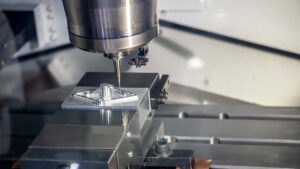
| CNC Frézování | 0.8 – 6.3 | 32 – 250 | Highly versatile; finish depends on tool, speed, feed, and toolpath. |
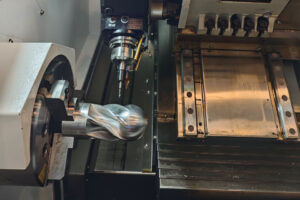
| CNC Soustružení | 0.4 – 3.2 | 16 – 125 | Capable of very fine finishes, especially with specific tooling. |
| Broušení | 0.2 – 1.6 | 8 – 63 | Produces a very smooth, precise surface by removing small amounts of material. |
| Lapping / Honing | 0.05 – 0.4 | 2 – 16 | Secondary processes used for ultra-precision finishes on flat or cylindrical parts. |
| Leštění | 0.025 – 0.2 | 1 – 8 | Creates a mirror-like finish by removing microscopic imperfections. |
This table illustrates why a designer’s choice of manufacturing process is directly linked to the achievable surface finish. It’s impractical to specify a 0.4 µm Ra finish on a part that will only be sand-cast.
Scientific Methods for Measuring Surface Roughness
Accurately quantifying surface roughness requires specialized equipment. The measurement methods can be categorized into three main types: direct (contact), non-contact, and comparison methods.
Direct Measurement (Contact Profilometry): This is the most common method. It uses an instrument called a profilometer, which has a very sensitive stylus (similar to a record player needle). The stylus is dragged across the surface at a constant speed. As it moves over the microscopic peaks and valleys, its vertical movement is recorded electronically. This data generates a 2D profile of the surface, from which roughness parameters like Ra are calculated.
Non-Contact Measurement (Optical Methods): These advanced methods use light or sound to measure the surface without touching it. Techniques like confocal microscopy, white light interferometry, and focus variation build a 3D map of the surface. These methods are extremely precise, fast, and non-destructive, making them ideal for delicate or highly polished surfaces. They can measure a defined area rather than just a single line.
Comparison Methods: This is a more practical, qualitative technique used on the shop floor. It involves using a set of surface roughness comparators—small blocks of material with calibrated, pre-defined surface finishes. A machinist can use their sight and touch to compare the workpiece to the standard blocks to get a quick and reasonable assessment of the finish.

Specifying Surface Finish on Technical Drawings
Clear communication is vital in manufacturing. A universal system of symbols is used on engineering drawings to specify all aspects of the desired surface texture. The core of this system is a checkmark-style symbol.
The basic symbol indicates that a surface should be machined, but with no specific parameters. When numbers and other symbols are added, it becomes a precise instruction. For example, the number above the checkmark specifies the maximum Ra roughness value. Other symbols around the main checkmark can define the manufacturing process required, the sampling length, the direction of the lay, and the waviness height. Mastering these symbols ensures that the part produced by the manufacturer, such as a specialist in automobilový prototyping nebo zdravotnické zařízení prototyping, will precisely match the designer’s intent.
Decoding the Surface Finish Chart: Key Parameters
A surface finish chart typically lists several parameters. While there are many, a few are used in the vast majority of applications. Understanding these is key to interpreting technical drawings correctly.
Ra (Roughness Average): This is the most widely used surface roughness parameter globally. It represents the arithmetic average of the absolute values of the profile’s deviations from the mean line. Because it is an average, it provides a good general description of the surface texture. However, it can be insensitive to occasional high peaks or deep valleys, which could be detrimental to a part’s function.
Rz (Average Maximum Height of the Profile): To overcome the limitations of Ra, engineers often use Rz. Rz is calculated by measuring the vertical distance from the highest peak to the lowest valley within five separate sampling lengths, and then averaging these five values. This makes Rz much more sensitive to scratches, burrs, and other outliers that Ra might miss. It is often specified for sealing surfaces or high-stress components.
RMS (Root Mean Square): An older parameter, RMS is still found on some drawings. It is calculated as the square root of the mean of the squares of the profile’s deviations from the mean line. RMS values are typically about 11% higher than Ra values for the same surface, a key fact to remember when using a surface finish conversion chart.
The Comprehensive Surface Finish Chart
The following charts serve as essential reference tools for engineers and manufacturers. They provide a clear way to convert between different units and standards and to understand the typical applications for various roughness values.
Surface Finish Conversion Chart
This table acts as a surface roughness comparison chart, allowing for easy conversion between Ra (in micrometers and microinches), RMS, and the ISO Grade Number (N).
| Ra (µm) | Ra (µin) | RMS (µin) | ISO Grade (N) | Cut-off Length (in) |
|---|---|---|---|---|
| 50.0 | 2000 | 2200 | N12 | 0.3 |
| 25.0 | 1000 | 1100 | N11 | 0.3 |
| 12.5 | 500 | 550 | N10 | 0.1 |
| 6.3 | 250 | 275 | N9 | 0.1 |
| 3.2 | 125 | 137.5 | N8 | 0.1 |
| 1.6 | 63 | 69 | N7 | 0.03 |
| 0.8 | 32 | 35 | N6 | 0.03 |
| 0.4 | 16 | 18 | N5 | 0.01 |
| 0.2 | 8 | 9 | N4 | 0.01 |
| 0.1 | 4 | 4.4 | N3 | 0.01 |
| 0.05 | 2 | 2.2 | N2 | 0.01 |
| 0.025 | 1 | 1.1 | N1 | 0.003 |
Surface Roughness Application Guide (Cheat Sheet)
This practical surface finish chart links Ra values to their typical finish descriptions and common real-world applications.
| Ra (µm) | Ra (µin) | Surface Description & Common Processes | Typické aplikace |
|---|---|---|---|
| 25.0 | 1000 | Extremely rough surface. Saw cutting, flame cutting, rough forging. | Clearance surfaces that will not be machined and have no load or contact. |
| 12.5 | 500 | Very rough machined surface. Heavy cuts from milling or turning. | As-cast surfaces, non-critical parts, basic prototypes. |
| 6.3 | 250 | Rough machined surface. Disc grinding, coarse milling, drilling. | Clearance surfaces where stress is not a major factor. |
| 3.2 | 125 | Standard rough machining. Common finish for many general-purpose parts. | Parts subject to moderate stress or vibration; non-mating surfaces on housings. |
| 1.6 | 63 | Good, typical machine finish. Fine feeds and controlled speeds. | Most common finish for non-critical mating surfaces; brackets and casings. |
| 0.8 | 32 | High-grade machine finish. Grinding or very fine turning/milling. | Precision components with moderate loads and motion, such as shafts and seals. |
| 0.4 | 16 | Fine ground or coarse honed finish. High-quality surface. | Bearings, gears, and other components where smoothness is critical for low friction. |
| 0.2 | 8 | Very fine finish. Honing, lapping, or buffing. | High-performance hydraulic cylinders, precision sealing surfaces. |
| 0.1 | 4 | Mirror-like finish. Fine lapping or buffing. | Used only where required by design; precision gauges and instrument work. |
| 0.05 | 2 | Superfine mirror finish. Superfinishing or fine buffing. | High-precision gauge blocks, medical implants, optical components. |
| 0.025 | 1 | Ultra mirror finish. The highest level of refinement. | Optical lenses, aerospace-grade seals, scientific instrumentation. |
Závěr
Achieving a precise surface finish is a complex but essential aspect of modern manufacturing. It is a balancing act between performance requirements, manufacturing capabilities, and cost. A thorough understanding of surface texture, measurement techniques, and standard symbology is non-negotiable for producing reliable and functional parts. The surface finish chart is the primary tool that bridges the gap between design intent and manufacturing execution.
Na adrese Senyorapid, we specialize in transforming complex designs into tangible, high-quality components. Our team of experts understands the nuances of surface finish standards and employs state-of-the-art processes, from rychlé vstřikování to precision grinding, to meet the most exacting specifications. We provide full dimensional and surface inspection reports to guarantee that the parts you receive conform perfectly to your drawings. Partnering with an expert manufacturer ensures that your products not only look right but perform flawlessly.
Komentáře
Nejnovější Příspěvky
Související Blogy
Senyo ' s blog je zaměřen na sdílení naše rozsáhlé znalosti z prototypové výroby. Prostřednictvím našich článků, naším cílem je podporovat vás ve rafinace produktu design a navigaci složitosti rapid prototyping efektivněji.