Mastering Polymer Injection Molding: Your Guide to Precision and Efficiency
Table of Contents
Conclusion
In the world of manufacturing, polymer injection molding stands out as a versatile and efficient process for creating high-quality parts and components. This comprehensive guide delves into the intricacies of polymer injection moulding, providing injection molding solutions providers with the essential knowledge to optimize their processes, select the right materials, and achieve superior results. As polymer injection molding Manufacturing plants for products, we aim to empower you with the expertise needed to excel in this dynamic field. This is your go to for understanding the many advantages of using polymer materials.
- Polymer injection molding is a versatile, efficient, and cost-effective manufacturing process for producing high-quality plastic parts in large volumes.
- Injection mold design is a critical aspect of the process, directly impacting part quality, production efficiency, and cost.
- A wide range of polymer materials can be used in injection molding, each with its own unique properties and applications.
- Different types of injection molding processes (overmolding, insert molding, gas-assisted, etc.) cater to specific part geometries and material requirements.
- Design for Manufacturability (DFM) principles are essential for optimizing plastic part designs for efficient and cost-effective injection molding.
- Quality control measures are crucial throughout the entire injection molding process to ensure consistent part quality and minimize defects.
- Choosing the right injection molding partner with the necessary expertise, capabilities, and commitment to quality is paramount for project success.
- The injection molding industry is constantly evolving, with trends like Industry 4.0, automation, advanced materials, and sustainability shaping its future.
- Polymer injection molding offers significant advantages for a wide range of industries, enabling the production of complex, high-precision plastic parts with excellent repeatability and cost-effectiveness.
As a leading polymer injection molding manufacturer, Senyorapid is committed to providing you with the highest quality injection molded parts, exceptional service, and innovative solutions. Contact us today to discuss your injection molding project and request a quote. Let us be your trusted partner in transforming your plastic product concepts into reality. We are a manufacturing company providing injection molding expertise for all your polymer parts.
Explore our injection molding services Learn about our injection molding tools Discover the benefits of multi cavity injection molding See how overmolding and insert molding can enhance your designs. Understand rapid injection molding for faster prototyping.

What is Polymer Injection Molding and Why is it a Dominant Manufacturing Process?
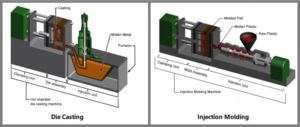
Polymer injection molding is a manufacturing process that involves injecting molten polymer, commonly referred to as plastic, into a precisely engineered mold cavity under high pressure. The molten polymer takes the shape of the cavity, cools, and solidifies, resulting in a molded part that conforms to the mold‘s design. This process is repeated with remarkable speed and accuracy, making injection molding ideal for mass production of complex and intricate plastic parts.
Why has polymer injection molding become such a dominant force in manufacturing? The reasons are multifaceted:
- Versatility: Injection molding can accommodate a vast range of polymer materials, including thermoplastics, thermosets, elastomers, and even polymer composites, each offering unique properties to suit diverse application needs.
- Design Flexibility: The process allows for the creation of highly complex shapes and intricate features, including thin walls, sharp corners, undercuts, and detailed textures, offering designers unparalleled freedom.
- High Precision and Repeatability: Injection molding delivers exceptional dimensional accuracy and consistency, producing parts with tight tolerances and minimal variation from one cycle to the next. This is crucial for applications demanding precision and reliability.
- Efficiency and Speed: Once the injection mold is created, the injection molding process itself is remarkably fast. Cycle times can range from a few seconds to a few minutes, depending on the part size and complexity, enabling high-volume production with impressive efficiency.
- Cost-Effectiveness: While the initial investment in an injection mold can be significant, the cost per part becomes extremely low at high production volumes, making polymer injection molding a highly cost-effective manufacturing solution for mass-produced plastic parts.
- Material Efficiency: Injection molding minimizes material waste, as only the required amount of polymer is used to fill the mold cavity. Excess material in runners (channels that deliver the molten plastic to the cavity) can often be recycled and reused.
- Automation: The injection molding process is highly automated, with injection moulding machines capable of running continuously with minimal human intervention. This automation enhances efficiency, reduces labor costs, and improves consistency.
These advantages combine to make polymer injection molding the preferred manufacturing process for a vast array of plastic parts and components across countless industries, from automotive and aerospace to medical devices and consumer products.
What are the Key Steps in the Polymer Injection Molding Process?
The polymer injection molding process, despite its speed and efficiency, involves a carefully orchestrated sequence of steps, each critical to the final quality and consistency of the molded part. Understanding this process is essential for optimizing production and troubleshooting any potential issues.
Here’s a breakdown of the key steps in the polymer injection moulding process:
- Clamping: The injection molding machine consists of two main parts: the injection unit and the clamping unit. The clamping unit holds the two halves of the injection mold (mold halves) securely together under high pressure. This clamping force counteracts the injection pressure of the molten plastic, preventing the mold from opening during injection.
- Injection: Polymer pellets or polymer granules, are fed into the injection molding machine‘s barrel, where they are heated and melted into a viscous molten polymer. A reciprocating screw within the barrel then forces the molten plastic forward under high pressure, injecting it through a nozzle, into the runner system, and finally into the mold cavity (or mold cavities in a multi-cavity mold). The speed at which the molten polymer is forced under high pressure is known as the injection velocity.
- Dwelling (Holding): Once the mold cavity is filled, a holding pressure is maintained to compensate for material shrinkage as the polymer cools and solidifies. This dwelling phase helps to ensure that the molded part accurately replicates the shape of the mold and minimizes defects like sink marks.
- Cooling: The mold incorporates cooling channels through which a coolant (usually water) circulates to control the mold temperature and accelerate the solidification of the molten polymer. The cooling time is a significant portion of the overall molding cycle.
- Mold Opening: Once the plastic has sufficiently cooled and solidified, the clamping unit releases the pressure, and the mold opens, separating the two mold halves.
- Ejection: The molded part is then ejected from the mold using ejector pins, sleeves, or other ejection mechanisms built into the mold. The mold is now ready for the next injection cycle.
- Part Removal/Handling: After ejection, the molded part may be removed manually by an operator or automatically by a robot. Any runners or gates (the channels that connected the injection unit to the cavity) are typically trimmed from the part.
This entire injection molding process is precisely controlled by the injection moulding machine‘s computer, which monitors and adjusts parameters such as injection pressure, injection speed, temperature, cooling time, and clamping force. Process parameters are extremely important. Optimizing these process parameters is crucial for achieving consistent part quality and maximizing production efficiency. A skilled injection molding specialist plays a vital role in setting up and monitoring the process.
What Materials are Commonly Used in Polymer Injection Molding?
One of the great advantages of polymer injection molding is its versatility in terms of material selection. A wide range of polymer materials, each with its own unique properties and characteristics, can be processed using injection molding, allowing manufacturers to tailor the material choice to the specific requirements of the molded part.
Here are some of the materials most commonly used to process in polymer injection molding:
Thermoplastic Polymers:
- Acrylonitrile Butadiene Styrene (ABS): A versatile, general-purpose thermoplastic known for its toughness, impact resistance, and good dimensional stability. It’s widely used for housings, enclosures, automotive parts, and consumer products.
- Polycarbonate (PC): A strong, heat-resistant, and transparent thermoplastic with excellent impact strength. It’s used for applications requiring high clarity and durability, such as lenses, safety glasses, and medical devices.
- Polypropylene (PP): A flexible, chemical-resistant, and cost-effective thermoplastic widely used for packaging, containers, automotive parts, and living hinges.
- Polyethylene (PE): A flexible, lightweight, and chemical-resistant thermoplastic with various densities (LDPE, HDPE). It’s used for films, bags, containers, and toys.
- Polyamide (PA/Nylon): A strong, wear-resistant, and heat-resistant thermoplastic often used for gears, bearings, automotive components, and electrical connectors.
- Polyoxymethylene (POM/Acetal): A strong, stiff, and low-friction thermoplastic with excellent dimensional stability and wear resistance. It’s used for precision parts, gears, bearings, and automotive components.
- Polybutylene Terephthalate (PBT): A strong, stiff, and dimensionally stable thermoplastic with good chemical resistance and electrical properties. It’s often used for electrical connectors, automotive parts, and housings.
- Polyethylene Terephthalate (PET): A strong, clear, and recyclable thermoplastic commonly used for beverage bottles, food containers, and fibers.
- Acrylic (PMMA): A transparent thermoplastic with good optical clarity, often used as a substitute for glass in applications like lenses, light guides, and displays.
- Thermoplastic Elastomers (TPE/TPU): Rubber-like materials that combine the flexibility of rubber with the processability of thermoplastics. They are used for seals, gaskets, soft-grip handles, and overmolding applications.
Thermosetting Polymers:
While less common than thermoplastics in injection molding, some thermosetting polymers can also be processed using specialized injection molding techniques (like Reaction Injection Molding – RIM):
- Polyurethane (PU): Used in RIM for producing large, complex parts with good impact resistance and durability.
- Phenolic Resins: Known for their high heat resistance and electrical insulation properties.
- Epoxy Resins: Used in some specialized injection molding applications requiring high strength and chemical resistance.
Polymer Composites:
Injection molding can also be used to process polymer composites, which are materials that combine a polymer matrix with reinforcing fibers (like glass fibers or carbon fibers) or fillers. These composites offer enhanced strength, stiffness, and other properties compared to the base polymer.
The choice of material for injection molding depends on a multitude of factors, including:
- The molded part‘s functional requirements (strength, stiffness, flexibility, impact resistance, etc.)
- The operating environment (temperature, chemical exposure, UV exposure, etc.)
- Aesthetic requirements (color, surface finish, transparency)
- Cost considerations
- Injection molding process compatibility
- Regulatory requirements (e.g., food contact, medical device regulations)
Working with an experienced injection molding manufacturer or injection molding specialist is crucial for selecting the optimal polymer material for your specific application. Their expertise in material properties and injection molding process parameters will ensure the successful production of high-quality injection molded parts.
What are the Different Types of Injection Molding Processes?
While the fundamental principle of injection molding remains the same – injecting molten polymer into a mold cavity – several variations of the process have been developed to address specific part geometries, material properties, and production requirements. Understanding these different injection molding processes is essential for choosing the most appropriate method for your project.
Here’s a look at some common types of polymer injection molding:
- Conventional Injection Molding: This is the standard, most widely used injection molding process. Polymer pellets are melted in the injection unit of an injection moulding machine and then injected into the mold cavity under high pressure. The plastic cools and solidifies, taking the shape of the mold. This process is often used with a wide range of thermoplastic polymers.
- Overmolding: This process involves molding one plastic material over another material, which can be a different plastic, metal, or other substrate. It’s commonly used to create soft-grip handles on tools, combine different colors or textures in a single part, or encapsulate electronic components.
- Insert Molding: Similar to overmolding, insert molding involves placing a pre-formed insert (often metal, but can be other materials) into the mold cavity prior to injection. The molten plastic flows around and encapsulates the insert, creating a single, integrated part. This is often used to create plastic parts with threaded metal inserts or electrical contacts.
- Two-Shot (or Multi-Shot) Injection Molding: This advanced process uses a single injection moulding machine and a specialized mold with multiple mold cavities to inject two or more different plastic materials or colors in a single cycle. It’s ideal for creating complex parts with integrated features, different colors, or varying material properties.
- Gas-Assisted Injection Molding: In this process, an inert gas (usually nitrogen) is injected into the mold cavity along with the molten polymer. The gas pressure helps to push the plastic against the mold walls, creating hollow sections within the molded part. This reduces material usage, weight, and cycle times, and it’s particularly useful for parts with thick sections.
- Liquid Silicone Rubber (LSR) Injection Molding: LSR is a thermosetting elastomer with excellent heat resistance, flexibility, and biocompatibility. LSR injection molding requires specialized equipment and molds designed to handle the unique properties of this material.
- Thin-Wall Injection Molding: This specialized process is used to produce plastic parts with very thin walls (typically less than 1 mm). It requires high injection pressures, fast injection speeds, and precisely designed molds to ensure complete filling of the cavity and prevent defects.
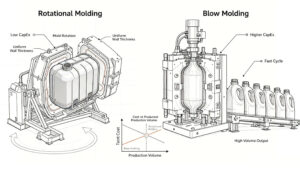
- Blow Molding: This process is used to produce hollow objects, by inflating molten plastic.
- Powder Injection Molding: Powder injection is used with ceramic or metal.
- Stack Injection Molding: Stack injection uses multiple parting planes.
The choice of material greatly affects the final product. The most suitable for injection depends on the situation.
The specific injection molding process chosen will depend on factors such as:
- Part Design: Complexity, wall thickness, presence of undercuts, and required features.
- Material Properties: The type of polymer being used and its flow characteristics.
- Production Volume: Whether it’s a prototype, low-volume, or high-volume production run.
- Cost Considerations: Balancing the cost of tooling, materials, and processing.
- Desired Part Properties: Strength, flexibility, surface finish, and other performance requirements.
Consulting with an experienced injection molding specialist is crucial for determining the most appropriate injection molding process for your specific project, ensuring optimal results in terms of part quality, production efficiency, and cost-effectiveness.
What are the Advantages and Disadvantages of Polymer Injection Molding?
Polymer injection molding, like any manufacturing process, has its own set of advantages and disadvantages. Understanding these pros and cons is essential for making informed decisions about whether injection molding is the right choice for your specific plastic part production needs.
Advantages of Polymer Injection Molding:
- High Production Rates: Injection molding is capable of producing parts in large volumes very quickly, making it ideal for mass production. Once the injection mold is created, the cycle time for producing each part can be very short, often just seconds.
- Design Complexity: Injection molding allows for the creation of highly complex shapes and intricate features, including thin walls, sharp corners, undercuts, and detailed textures. This design flexibility is unmatched by many other manufacturing processes.
- Material Versatility: A wide range of polymer materials can be processed using injection molding, including thermoplastics, thermosets, elastomers, and polymer composites, each offering different properties to suit various application needs.
- Precision and Repeatability: Injection molding delivers exceptional dimensional accuracy and consistency, producing injection molded parts with tight tolerances and minimal variation from part to part. This is crucial for applications requiring high precision and reliability.
- Low Labor Costs: The injection molding process is highly automated, requiring minimal human intervention once the injection molding machine is set up and running. This automation reduces labor costs and improves efficiency.
- Material Efficiency: Injection molding minimizes material waste, as only the required amount of polymer is used to fill the mold cavity. Excess material in runners can often be recycled and reused.
- Strength and Durability: Injection molded parts can be very strong and durable, especially when using high-performance polymer materials or incorporating reinforcing fibers.
- Surface Finish and Aesthetics: Injection molding can produce parts with excellent surface finish and a wide range of colors and textures, making it suitable for applications where aesthetics are important.
- Cost-Effectiveness (at High Volumes): While the initial investment in an injection mold can be significant, the cost per part becomes very low at high production volumes, making injection molding a highly cost-effective solution for mass-produced plastic parts.
Disadvantages of Polymer Injection Molding:
- High Initial Tooling Costs: The injection mold itself is a significant upfront investment, especially for complex or multi-cavity molds. This can be a barrier to entry for low-volume production or prototype projects.
- Long Lead Times for Tooling: Designing and manufacturing an injection mold can take several weeks or even months, depending on its complexity. This lead time needs to be factored into project timelines.
- Design Restrictions: While injection molding offers considerable design flexibility, there are still some design limitations. Certain features, like very thick sections or large undercuts, can be challenging or impossible to mold without specialized tooling or design modifications.
- Material Limitations: While a wide range of polymers can be used, not all materials are suitable for injection molding. Some materials may have poor flow characteristics, high shrinkage rates, or require specialized processing conditions.
- Potential for Defects: If the injection molding process is not carefully controlled, defects like sink marks, warping, weld lines, and short shots can occur.
- Not Ideal for Low-Volume Production: The high tooling costs make injection molding less cost-effective for very low-volume production runs or one-off parts. Other manufacturing processes, like 3D printing or CNC machining, may be more suitable for these applications.
Despite these potential drawbacks, the advantages of polymer injection molding often outweigh the disadvantages, particularly for high-volume production of complex and high-quality plastic parts. Careful planning, design for manufacturing (DFM) principles, and working with an experienced injection molding manufacturer can help to mitigate the risks and maximize the benefits of this versatile manufacturing process.
How Does Design for Manufacturability (DFM) Apply to Polymer Injection Molding?
Design for Manufacturability (DFM) is a critical engineering practice that focuses on designing products – in this case, polymer parts and injection moulds – to be easy, efficient, and cost-effective to manufacture. Applying DFM principles to polymer injection molding is essential for optimizing the part design, streamlining the molding process, minimizing defects, and reducing overall production costs.
Here’s how DFM principles apply specifically to polymer injection molding:
Wall Thickness:
- Uniform Wall Thickness: Aim for consistent wall thickness throughout the plastic part to promote even plastic flow, consistent cooling, and minimize warping, sink marks, and internal stresses.
- Appropriate Wall Thickness: Choose a wall thickness that is appropriate for the chosen polymer material and the part’s functional requirements. Thin walls can be challenging to fill, while thick walls can lead to extended cycle times and defects.
- Gradual Transitions: Avoid abrupt changes in wall thickness. Use gradual transitions, fillets, and radii to smooth out differences in thickness and prevent stress concentrations.
Draft Angles:
- Sufficient Draft: Apply draft angles (slight tapers) to the vertical walls of the plastic part to facilitate easy ejection from the mold. Insufficient draft can cause the part to stick in the mold or become damaged during ejection.
- Consistent Draft: Maintain consistent draft angles throughout the part to simplify mold design and manufacturing.
Radii and Fillets:
- Generous Radii: Use generous radii (rounded corners) and fillets (rounded edges) instead of sharp corners. Sharp corners create stress concentrations and can hinder plastic flow.
- Improved Flow and Strength: Radii and fillets promote smoother plastic flow, reduce stress, and improve the overall strength of the molded part.
Ribs and Bosses:
- Proper Rib Design: Ribs can add strength and stiffness to a plastic part without significantly increasing wall thickness. However, ribs should be designed with appropriate draft angles, rounded edges, and a base thickness that is less than the adjacent wall thickness to prevent sink marks.
- Boss Design: Bosses (protrusions used for mounting or fastening) should also be designed with draft angles, rounded edges, and a base thickness that avoids creating overly thick sections.
Undercuts:
- Minimize Undercuts: Undercuts are features that prevent direct ejection of the plastic part from a simple two-part mold. While sometimes unavoidable, undercuts add complexity and cost to the mold (often requiring side actions or lifters) and should be minimized whenever possible.
- Design for Side Actions: If undercuts are necessary, design them in a way that allows for the use of simple and reliable side actions (moving mold components) to release the part.
Parting Line:
- Strategic Placement: Carefully consider the location of the parting line (where the two halves of the mold meet) to minimize its visibility on aesthetically important surfaces and to facilitate part ejection.
- Simple Parting Line: Aim for a simple, planar parting line whenever possible to simplify mold construction and reduce costs.
Gate Location and Type:
- Optimal Gate Placement: The gate (where the molten plastic enters the mold) should be located to promote even filling of the cavity, minimize weld lines and air traps, and allow for easy removal after molding.
- Appropriate Gate Type: Select the appropriate gate type (e.g., edge gate, sub gate, pin gate, fan gate) based on the part design, plastic material, and aesthetic requirements.
Material Selection:
- Process Compatibility: Choose a plastic material that is well-suited for injection molding and has good flow characteristics.
- Shrinkage Considerations: Account for the plastic material‘s shrinkage rate during cooling when designing the part and the mold cavity.
- Material Properties: Ensure the chosen plastic material meets the functional and performance requirements of the molded part.
Tolerances:
- Realistic Tolerances: Specify realistic tolerances for the plastic part. Unnecessarily tight tolerances can significantly increase mold making costs and difficulty.
- Process Capability: Consider the inherent tolerance capabilities of the injection molding process when specifying tolerances.
By applying these DFM principles during the part design phase, you can significantly improve the manufacturability of your plastic parts, reduce the risk of defects, optimize the injection molding process, and lower overall production costs. Collaborating with an experienced injection molding engineer or mold maker early in the design process is highly recommended to ensure that DFM principles are effectively implemented.
What Software is Used for Polymer Injection Mold Design?
Polymer injection mold design is a complex and precise engineering discipline that relies heavily on specialized software tools. These tools enable mold designers to create detailed 3D models of the injection mould, simulate the injection molding process, and generate the necessary data for mold manufacturing.
Here’s a breakdown of the key software types and specific programs commonly used in polymer injection mold design:
3D CAD (Computer-Aided Design) Software: This is the foundation of injection mold design. CAD software allows designers to create a virtual 3D model of the plastic part and the entire injection mould, including all its components (cavity, core, cooling channels, ejection system, gating system, etc.). Popular 3D CAD software used in the industry includes:
- SolidWorks: A widely used and versatile CAD software with strong capabilities for part design, assembly design, and mold design. It offers a user-friendly interface and a wide range of features.
- Autodesk Inventor: Another popular CAD software with comprehensive tools for mechanical design, simulation, and mold design. It’s known for its powerful parametric modeling capabilities.
- PTC Creo (formerly Pro/ENGINEER): A high-end CAD software often used for complex injection molds and advanced design tasks. It offers robust parametric modeling, surfacing, and simulation capabilities.
- CATIA: A CAD software commonly used in the automotive and aerospace industries, known for its advanced surfacing and mold design capabilities.
- Siemens NX: A comprehensive CAD/CAM/CAE software suite with strong capabilities for mold design and manufacturing. It offers a seamless integration between design, simulation, and manufacturing.
- Fusion 360 (Autodesk): A cloud-based CAD/CAM software that is gaining popularity for its accessibility, collaboration features, and integrated design and manufacturing tools. It’s a more affordable option compared to some of the high-end CAD packages.
Mold Flow Analysis (CAE – Computer-Aided Engineering) Software: Mold flow analysis software is used to simulate the injection molding process. It predicts how the molten polymer will flow into the mold cavity, helping designers to identify potential problems like weld lines, air traps, sink marks, and warping before the mold is built. This allows for design optimization and reduces the risk of costly rework. Popular mold flow analysis software includes:
- Autodesk Moldflow: One of the leading mold flow analysis software packages, offering a wide range of simulation capabilities, from basic filling analysis to advanced warpage and cooling simulations.
- Moldex3D: Another popular mold flow analysis software with strong capabilities for simulating complex injection molding processes, including two-shot molding, gas-assisted injection molding, and insert molding.
- SIGMASOFT: A mold flow analysis software known for its accuracy and ability to simulate complex phenomena like fiber orientation, warpage, and residual stresses.
CAM (Computer-Aided Manufacturing) Software: CAM software is used to generate the toolpaths (instructions) for CNC machines that will manufacture the injection mold components. CAM software takes the 3D mold design from the CAD software and translates it into machine-readable code (G-code). Popular CAM software used in injection mold making includes:
- Mastercam: A widely used CAM software with strong capabilities for CNC machining of mold components, offering a range of toolpath strategies and machining options.
- PowerMill (Autodesk): A high-performance CAM software often used for complex mold machining, particularly for 5-axis machining.
- NX CAM (Siemens): A comprehensive CAM software integrated with Siemens NX CAD software, providing a seamless CAD/CAM workflow.
- SolidCAM: A CAM software integrated with SolidWorks, offering a user-friendly interface and powerful toolpath generation capabilities.
- Fusion 360: Also provides integrated CAM features, allowing users to go from design to manufacturing within a single platform.
These software tools are essential for modern injection mold design and manufacturing. They enable designers and tool makers to create highly optimized molds, simulate the injection molding process, predict and prevent potential defects, and generate the precise instructions needed to manufacture high-quality injection moulds. The use of these tools significantly improves the efficiency, accuracy, and quality of the entire injection mold design and mold building process.
Choosing Senyorapid for Your Polymer Injection Molding Needs
As polymer injection molding Manufacturing plants for products, Senyorapid offers a comprehensive suite of services and expertise to meet your most demanding injection molding requirements. We are committed to delivering high-quality, precision-engineered injection molded parts and providing exceptional customer service.
Here’s why you should choose Senyorapid for your polymer injection molding needs:
- Extensive Experience and Expertise: With decades of experience in the plastic injection molding industry, we have a deep understanding of mold design, material selection, injection moulding process optimization, and quality control. Our team of skilled engineers and technicians is dedicated to delivering superior results.
- Advanced Technology and Equipment: We invest in state-of-the-art injection molding equipment, including high-speed injection molding machines, precision CNC machining centers, and advanced quality control inspection tools. This ensures that we can produce complex parts with tight tolerances and consistent quality.
- Comprehensive Services: We offer a full range of injection molding services, from initial product design and prototype development to mold making, plastic injection moulding, and value-added services like assembly and packaging. We are your one-stop shop for custom plastic injection molding.
- Design for Manufacturability (DFM) Support: Our engineering team provides expert DFM feedback and guidance, helping you optimize your plastic part design for efficient and cost-effective injection molding. We work collaboratively with you to ensure your design is manufacturable and meets your performance requirements.
- Wide Range of Polymer Materials: We have experience working with a vast array of polymer materials, including thermoplastics, thermosets, elastomers, and polymer composites. We can help you select the optimal material for your specific application.
- Rigorous Quality Control: We implement a stringent quality management system throughout the entire manufacturing process, from incoming material inspection to final part inspection. We are committed to delivering injection molded parts that meet or exceed your expectations.
- Competitive Pricing and On-Time Delivery: We offer competitive pricing and strive to provide the best value for your investment. We understand the importance of on-time delivery and work diligently to meet your project deadlines.
- Customer-Focused Approach: We are dedicated to building long-term partnerships with our customers. We prioritize clear communication, responsiveness, and a collaborative approach to ensure your complete satisfaction.
- Scientific Molding Approach: Our engineers use scientific molding principles to ensure the robust production of your part.
Choosing Senyorapid means partnering with a trusted and experienced injection molding manufacturer committed to delivering exceptional quality, service, and value. Let us help you bring your polymer product vision to life. We are dedicated to producing plastic parts of the highest quality.
FAQs
What is the difference between thermoplastics and thermosets in injection molding?
Thermoplastics can be repeatedly melted and solidified, allowing for recyclability and remolding. Thermosets undergo a chemical change during the molding process and cannot be remelted. Thermoplastic polymers are more commonly used in injection molding.
What is a hot runner system, and what are its advantages?
A hot runner system is a heated manifold that keeps the plastic in the runner system (the channels that deliver molten plastic to the mold cavities) in a molten state. This eliminates runner scrap, reduces cycle times, and can improve part quality.
What is insert molding, and what are its benefits?
Insert molding involves placing a pre-formed insert (often metal) into the mold cavity before injection. The molten plastic flows around and encapsulates the insert, creating a single, integrated part. This is often used for creating plastic parts with threaded metal inserts or electrical contacts.
What is the typical cycle time for injection molding?
Cycle times vary widely depending on the size and complexity of the plastic part, the plastic material used, the mold design, and the injection molding machine‘s capabilities. Cycle times can range from a few seconds for small, simple parts to several minutes for large, complex parts.
What is mold flow analysis, and why is it important?
Mold flow analysis is a simulation software used to predict how molten plastic will flow into the mold cavity during the injection molding process. It helps identify potential problems like weld lines, air traps, sink marks, and warping, allowing mold designers to optimize the mold design and process parameters before the mold is built.
Comments
Latest Posts
Related Blogs
Senyo’s blog is focused on sharing our extensive knowledge of prototype manufacturing. Through our articles, we aim to support you in refining your product design and navigating the complexities of rapid prototyping more effectively.