Brushed Metal Finishes: Process, Types, and Fabrication Guide
Table of Contents
Innovations in manufacturing are no longer only about strength and durability. It’s also about the look. Brushed metal finishes have become the perfect example of a product meeting both the utility and the fashion needs of the metal fabrication world. The metal treatment, brushed metal, changes the metal parts to the classy and long, lasting items that you see everywhere, from luxury kitchen appliances to aerospace elements.
The brushed metal surface features an individual pattern of very thin, closely spaced lines. These lines scatter light in various directions, which reduces the amount of light reflection while giving the surface a soft, satin, like touch. In comparison to glossy finishes that show up every fingerprint and scratch, a brushed surface is a clever way to hide the flaws without compromising on the look. In this article, we will delve into the fundamental engineering concepts, materials that can be used, and the practical methods for turning a metal surface into a flawless brushed one.
Understanding the Brushed Metal Mechanism
Brushed metal is basically a surface abrasion process at the heart of it. It goes hand in hand with the mechanical changing of a metal surface topography. Fabricators employ abrasive belts, wire brushes, or non, woven abrasive pads to get a consistent pattern of micro, scratches. These scratches need to be the same in depth and direction to give a homogeneous look.
The work fulfills two main functions:
- Aesthetic Enhancement: It brings out a refined, matte sheen that is quite a departure visually from the sharp glare of polished chrome or the dreariness of raw mill finishes.
- Functional Durability: With a textured surface brushed metal finishes become a kind of disguise. The visual impression of the grain is refreshed when the wear and tear (minor scratches) get blended with the appearance of the existing grain, thus the part looks new longer.
Classification of Brushed Finishing Techniques
Not all brushed metal surfaces look the same. The technique chosen depends on the desired visual effect and the functional requirements of the component
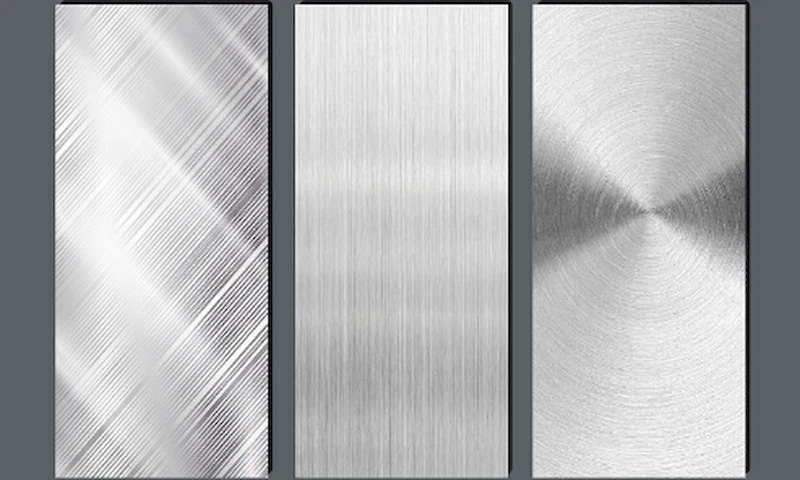
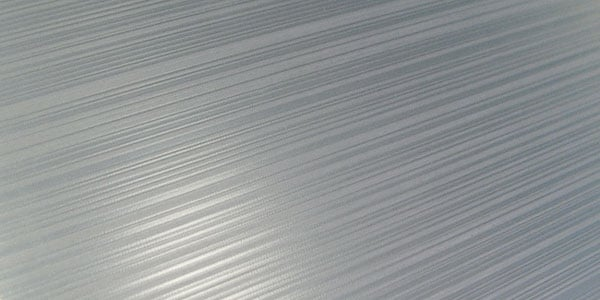
Linear Brushed Pattern
A brushed metal in a linear finish is probably the most familiar type. It has long, uninterrupted strokes that go along the length of the metal sheet. The makers of this a piece of metal come in a conveyorized abrasive belt sander at the same way as the metal, i.e., normal to its grain.
This simple grain of the metal not only suggests purity and neatness but also elevates it to be a perfect standard for architectural panels, elevator doors, stainless steel refrigerators.
Circular and Radial Patterns
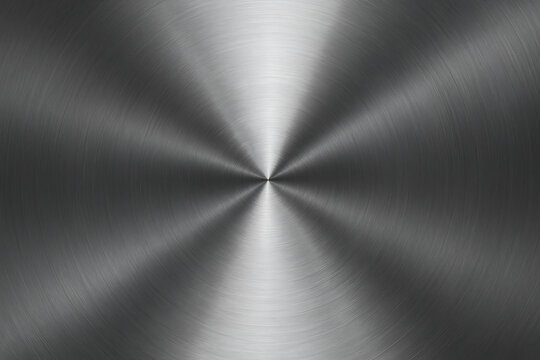
Circular brushing results in concentric circles being formed on the metal surface.
The metal is usually rotated around a central axis or the abrasive tool is rotated around that axis to achieve this effect. Radial brushing, which is a type of this, has lines spreading out from the center.
The finishes are frequently found on round parts such as watch dials, tank ends, and decorative control knobs where the shape of the part goes well with the direction of the finish.
Cross-Hatched Texture
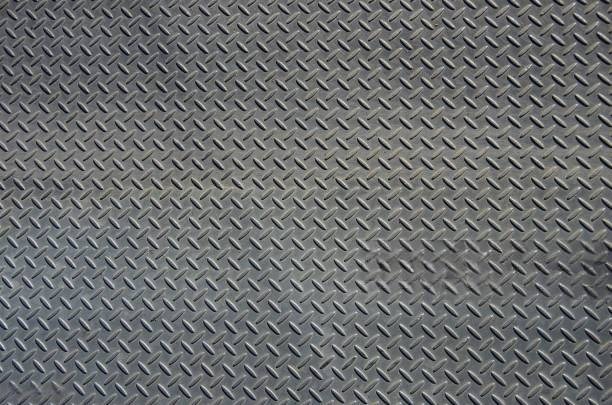
The cross, brushed finish adds another element of complexity. It is about changing the direction of the abrasive media to two perpendicular ones. By doing this, a textile, like pattern is formed on the metal. The meeting lines scatter light in several directions, thus, the surface gets a three, dimensional effect which is generally the case with customized architecture features and deluxe automotive trims.
Operational Guide: The Fabrication Process
Attaining a professional brushed metal finish necessitates a well, planned method. The entire process can be broken down into three vital phases: preparation, abrasion, and protection.
Stage 1: Surface Preparation
It is necessary to have a flawless surface before any abrasive is used on the metal. If the metal is covered with oil, grease, oxidation, welding slag, etc., the abrasive media will get clogged, and an uneven finish will be produced. Hence, fabricators clean the substrate using industrial degreasers and solvents. Scratches or gouges that are too deep and caused by previous machining operations should be first evened with a coarse grit abrasive before the final brushing pass.
Stage 2: The Brushing Operation
This is the decisive stage where the brushed metal texture is introduced to the material. The hand selects a suitable abrasive grit, mix usually ranging from 120 to 320 grit depending on the roughness of the grain.
- Belt sanding:For very extensive and flat metal panels, wide, belt sanders produce the most consistent linear grain along the sheet.
- Wire brushing:Brushes made of wire that are rotary help in shaping odd architectural elements or producing deeper and more accentuated grains.
- Non-woven pads:Some synthetic abrasive pads such as Scotch, Brite are great for surface finishing and edge blending without the material removal.
Consistency is key. The pressure, feeding speed, and moving directions should be kept at the same level all the time. Any change will result in a ‘shadow’ or an uneven area in the final product.
Phase 3: Sealing and Protection
A brushed metal, compared to a smooth one, has a significantly higher surface area that can hold moisture and contaminants. Therefore, it is a little more prone to corrosion. To prevent this, manufacturers usually put a clear sealing or lacquer film.
For stainless steel, they may also perform passivation to bring back the chromium oxide layer.Sometimes, a clear powder coat is put on to preserve the look while giving a non, oxidizable barrier.
Material Compatibility for Brushing
Although many metals can be rubbed, the brushed metal treatment works especially well with some metals.
Stainless Steel
Among metals, stainless steel is the best material for brushed metal finishing. The most commonly used varieties are 304 and 316. The metal’s toughness enables it to keep a very precise grain line without bending. The industry standard for brushed stainless steel is the “No. 4 Finish”, which is described as having short, parallel polishing lines.
Aluminum Alloys
Aluminum is a great candidate for a brushed finish. The color of the metal post, brushing is regularly a bright, silver, white that is often called “satin aluminum.” Since aluminum is a softer material than steel, the fabricators need to choose finer grit particles in order to prevent the surface from being scored. Brushed aluminum is usually anodized after the finish has been applied. The anodizing not only seals the surface to protect it, but can also add color to it, while keeping the brushed look under it.
Non Ferrous Metals (Brass, Copper, Nickel)
When you brush brass or copper you get a look that is either very old or very industrial. Since these two metals go green and red via tarnishing very fast, a clear lacquer is usually applied immediately after brushing so that the golden or reddish color is retained. Nickel, especially when it’s used as a plating, is often brushed to form “satin nickel, ” which is a very common finish for door hardware and bathroom fixtures, because of its warm and subdued color.
Comparative Analysis: Brushed vs. Other Finishes
The table below illustrates how brushed metal compares to other common industrial finishes in terms of reflectivity, maintenance, and durability.
| Feature | Brushed Metal Finish | Polished / Mirror Finish | Bead Blasted / Matte | Satin Finish |
|---|---|---|---|---|
| Reflectivity | Low / Diffused | High / Specular | Very Low / Dull | Low / Soft Glow |
| Texture | Directional Lines (Grain) | Smooth / Glass-like | Non-directional / Pitted | Smooth / No Grain |
| Scratch Hiding | Excellent | Poor (Highlights defects) | Good | Moderate |
| Maintenance | Low | High (Shows fingerprints) | High (Traps oil) | Low |
| Primary Use | Appliances, Architectural | Hygiene, Decorative | Firearms, Castings | Hardware, Fixtures |
Applications in CNC Fabrication
Subtitle: Integrating texture into precision manufacturing
Within the scope of CNC machining and sheet metal fabrication, a brushed metal finish is not simply a decorative feature but is used for various engineering purposes.
Controlled Roughness for Adhesion
When a metal surface is completely smooth it becomes a low adhesion substrate for paints, glues, and coatings. A brushed metal is a process that increases the surface energy as well as the roughness (Ra) of the part. Thus, the bonding strength of the succeeding powder coat or adhesive layer is greatly improved as there is a mechanical locking effect.
Repair of defects
During CNC milling and turning, the tools often abruptly mark the workpiece. A brushed finish can be used to remove the machining lines, the surface is then blended into a uniform texture. This means that there is no need to spend money on additional polishing operations to remove the tool marks.
Deburring and Edge Blending
The brushing motion inherently eliminates the sharp burrs left by the cutting tools. By adding brushing to the finishing process, fabricators that workflow will simultaneously deburr the edges and finish the surface. Thus, this two, fold process not only saves time but it also makes the handling of the final component more secure.
Durability and Maintenance Considerations
Although excellent in many ways, the brushed metal surface cannot be completely closed to damage. The deep lines that characterize the texture can hold dust and moisture.
Corrosion Resistance Trade off: It should be understood that brushing stainless steel slightly lowers its corrosion resistance as compared to a mirror polish. The small cracks can become a shelter for corrosive substances. Hence, for the marine environment, electropolishing is usually the first choice. Nevertheless, for indoor and normal outdoor applications, the visually appealing brushed metal usually greatly surpasses this small compromise in chemical resistance.
Cleaning Protocols: Cleaning a brushed metal surface calls for a special method. One should always wipe along the grain, never against it. Wiping against the grain will not only push the dirt further into the grooves but can also cause micro, scratches that will spoil the even look. The use of specialized cleaning agents that leave a thin, protective oil film is advised to avoid fingerprints and water stains.
The Senyorapid Capability in Surface Finishing
In order to achieve a uniform brushed metal finish on a large number of parts, one must have heavy, duty equipment and a high level of knowledge. At Senyorapid, we make use of automated wide, belt sanding machines along with robotic brushing arms to guarantee that each part is visually perfect. No matter if the work involves a rough architectural grain or a smooth satin finish for the consumer electronics, our plant is able to master every detail, from the choice of grit to the strength of the feed, to yield impeccable results.
Conclusion
The brushed metal finish is one of the staple elements of contemporary industrial design. It provides a great balance of strength, usefulness, and beauty. The manufacturers, by deliberately scratching the surface, make a material that is less prone to wear and at the same time, visually elegant. Brushed metal, no matter if it is used on the case of a high, performance computer or the exterior of a skyscraper, indicates a high quality.
Knowing the details of this process, a step that includes choosing the right material and deciding on the grain direction, can help engineers and designers to significantly raise the perceived value of their products.
FAQs
What is one sentence that describes a brushed metal finish?
A brushed metal finish is when a metal surface is mechanically scoured with a gritty material and the resulting surface has a pattern of very fine parallel lines. These very fine lines give the metal a matte, non, lustrous finish that scatters reflected light and therefore it is less likely to show stains and faults beneath the surface.
Does brushing a metal surface decrease or increase the possibility of it rusting?
Slightly, yes. Since brushed metal consists of microscopic grooves, it is prone to catching water/moisture more readily than a smooth, polished surface. Nevertheless, the risk can be almost eliminated by either the use of a clear coat or regular upkeep.
Is there any metal that cannot be brushed?
Actually, almost any metal can be brushed, however, the process is mostly suitable for stainless steel, aluminium, brass, and nickel. In the case of softer metals, it may be necessary to use finer abrasives to avoid deep scratches.
How can a metal that has been brushed be cleaned?
It is recommended to clean a brushed metal surface by always wiping along the grain of the metal. Le. Use of a microfiber cloth together with a metal cleaner specially formulated for this purpose will prevent streaks and will also keep from dirt being trapped in the texture grooves.
Can you explain the difference between satin and brushed metal?
They are alike the satin finish is smoother, and there are no grain lines visible, thus it gives a soft glow. A brushed metal finish features a pronounced, clearly visible texture with lines that are directional.
Suggested Links
- Stainless Steel Industry of North America (SSINA): https://www.ssina.com (Information on stainless steel finishes).
- The Aluminum Association: https://www.aluminum.org (Standards for aluminum surface treatments).
- National Association of Architectural Metal Manufacturers (NAAMM): https://www.naamm.org (Guidelines for architectural metal finishes).
- ASM International: https://www.asminternational.org (Data on tribology and surface engineering).
Comments
Latest Posts
Related Blogs
Senyo’s blog is focused on sharing our extensive knowledge of prototype manufacturing. Through our articles, we aim to support you in refining your product design and navigating the complexities of rapid prototyping more effectively.