The Art and Science of Custom Silicone Molding
Table of Contents
Silicone is one of the few substances in the manufacturing world which is very adaptable, durable, and very “human, friendly”. Almost everything around us, that is made of silicone, is flexible spatulas in our kitchen or life, saving valves in medical devices. But what is the way from a raw chemical element to a high, precision, custom, molded part?
Custom silicone molding is what enables the designer’s idea to take the form of a real product. It is a combination of historical roots and modern material science technology. If you are an engineer designing medical device prototyping or a designer working on consumer product prototyping for the next big hit, knowing the silicone molding intricacies is very important.
We will unwrap custom silicone molding history, materials, procedures, and next chapter in the guide, and why it is still the foundation of the modern industry.
A Brief History: From Aviation to the Surgeon’s Table
Starting early in the 20th century, the silicone molding saga does not begin in a modern lab. Originally inspired by natural rubber, silicone showed something remarkable: it remained solid at temperatures that would cause natural rubber to melt or crack.
The aviation industry in the 1940s was first to really embrace silicon. During World War II, when high-altitude travel presented subfreezing conditions and aircraft engines’ extreme heat, engineers had to locate appropriate materials. Making complex engine gaskets and seals that would not fail under pressure, silicone rubber molds turned into the stealth weapon.
Material science developed significantly as we neared the 1960s and 70s. Silicone developed from a particular industrial material into a versatile tool for chefs, physicians, and artists. 3D printing has changed the industry once again right now. Thanks to rapid prototyping , we can now produce elaborate molds in a few days—or even hours—instead of waiting weeks for a hand-carved master mold.
The Materials: HCR vs. LSR
Silicones are not all the same. At the outset of custom silicone molding, you will use two types of raw materials HCR and LSR. Deciding between them is the first big decision in the manufacturing process.
1. High Consistency Rubber (HCR)
Think of HCR as a dense, clay-like clay-like dough. It’s solid, long-lasting and has phenomenal ”tear strength.” This is the material used for tough work.
Ideal for: Automotive prototyping such as engine seals and gaskets, and heavy duty bushings.
Procedure: Typically treated through compression molding, in which “the dough” is forced into a mold cavity heated.
2. Liquid Silicone Rubber (LSR)
If HCR is dough, LSR would be honey. It’s a two-part liquid that’s filled into a mold. Because it’s liquid, it can penetrate into extremely small and complex cavities, which HCR is impossible to.
Best for: Medical device prototyping (such as catheters or respiratory masks) and high-precision electronics.
Procedure: Processed through injection molding. It’s quick, accurate, and great for large runs.
Senyorapid, executive summary: Navigating this you may need to choose between polyurethane and silicone material properties for your industrial prototyping projects.
How It’s Made: The Silicone Production Process
Silicone is a kind of “miracle” material, mainly because it is made from a surprisingly common element found in everyday materials: silicon (which you can find in a lot of sand). The process from sand to silicone starts with silicon metal reacting with methyl chloride. This makes a chemical chain known as a polymer.
And it’s this polymer that gives silicone its unique “superpowers”:
- Biocompatibility: It isn’t reactive with human tissue (required in healthcare).
- Thermal Stability: It can be used from -60°C to beyond 200°C.
- Resistant to Chemicals: It is not substantially sensitive to oils and chemicals.
Silicone is even mixed with other substances in some specialised cases. For instance, in overmolding and insert molding, silicone can be bonded directly to metal or plastic components, adding a soft-touch grip to a rigid tool or a waterproof membrane to a piece of robot prototyping.
The Steps of Custom Silicone Molding
Manufacturing a quality silicone part is a precise business. So here’s the step-by-step “human” version of how a design goes from concept to finished product.
1. The Blueprint and Mold Making
It starts all with a CAD drawing. After the design has been approved, we proceed with making “tooling” – the mold itself. For large runs, these same molds can be ground on notch stones or diamond plated. If the design is still experimental, we may take advantage of vacuum casting service to produce a master mold more cost effectively.
2. Material Preparation
The two components (silicone base and catalyst), if we use LSR, are mixed together in certain proportion. Imagine it “two-part epoxy; once they meet, the clock starts ticking toward the ‘curing’ phase.
3. Filling the Mold
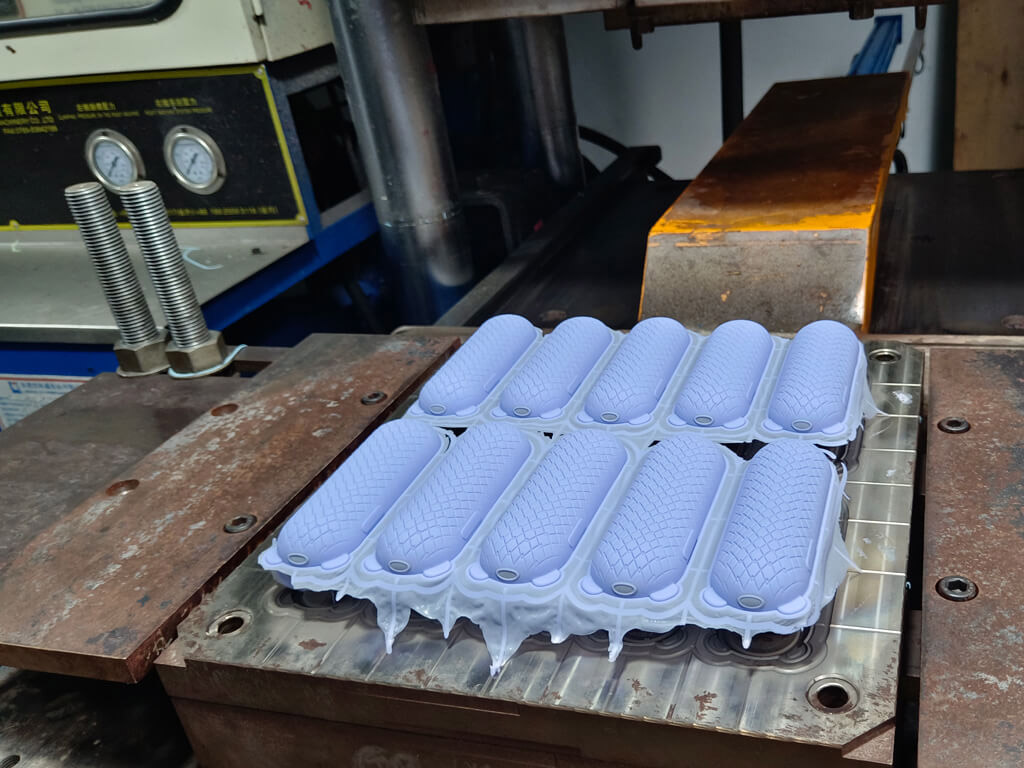
The blend is inserted (HCR) into a mold cavity or injected (LSR) into one or more mold cavities. With multi cavity injection molding, dozens of cavities can be filled with a single injection which is productivity boosting for mass production.
4. The Curing (The Magic Moment)
A mold is in the curing oven. Heat induces the polymerization reaction which turns the liquid (or dough) into a solid, rubbery polymer. This isn’t merely drying; it’s a molecular transformation.
5. Demolding and Finishing
When finished, the parts come out of the mold. There is usually some excess called “flash” at the seams. Expert technicians trim this off, frequently utilizing precision tools or laser cutting to achieve a flawless finish.
Applications: Where Silicone Saves the Day
Custom silicone molding, because of its versatility, is the backbone for several major industries:
- Medical applications: Silicone is the gold standard when it comes to medical device prototyping. Since it can be sterilized multiple times and does not irritate the skin, its use ranges from prosthetic limbs to heart valves.
- Automotive: Modern cars are full of silicone. It’s used in spark plug boots, hose connectors, and vibration-dampening seals. For those working on automotive prototyping, silicone’s heat resistance is a lifesaver, quite literally.
- Robotics: Silicone is also used in robot prototyping for “soft robotics”-grippers able to pick up an egg without breaking it, or flexible “skins” for humanoid robots.
- Consumer Products: From wearables like fitness trackers to baby bottle nipples, the soft feel and safety of silicone make it a preferred choice for consumer product prototyping.
Comparing Techniques: Which Molding is Right for You?
When you’re looking to manufacture a part, you’ll hear several different terms. Let’s break them down:
- Injection Molding: Best for high-volume, complex parts. It’s fast and produces very little waste.
- Compression Molding: A simpler process that is great for larger, thicker parts like sheet metal fabrication gaskets or heavy-duty pads.
- Rapid Injection Molding: A specialized version of molding aimed at getting prototypes in the customer’s hands as fast as possible, often using aluminum tools instead of steel.
- Transfer Molding: A hybrid of the two that is often used for parts requiring metal inserts, like electrical connectors.
The Sustainability Factor: Is Silicone "Green"?
The environmental cost of manufacturing is something we can’t afford to overlook in our current world. One common myth is that silicone is a form of plastic. It’s not.
Silicone Established as the superior alternative to plastic – which can leach dangerous phthalates and various chemicals – silicone is made with silica – derived from sand. When silicone does degrade — eventually — it doesn’t become microplastics; rather it converts slowly back into its mineral form, primarily silica, and then ultimately exits the body as carbon dioxide and water vapor.
And since silicone is so strong, items made with it are very often much more durable than plastic versions of the same products. This minimises the ‘disposable’ mindset and encourages sustainability. Keeping rapid injection molding and other minimal-waste processes a priority at Senyorapid in production of your custom parts.
The Pros and Cons of Custom Silicone Molding
Silicone molding, just like anything in manufacturing, involves trade-offs.
The Advantages:
Finest Detail: Allows you to reproduce tiny details that are not possible with other materials.
Materials Integrity: It won’t crack when it’s cold or melt in the heat.
Scalability: After you have the injection molding tools, you can make thousands of parts at an extremely low per-unit price.
The Disadvantages:
First Tooling Cost: A steel mold costs some money. If you only need five parts, the vacuum casting service or 3D printing could be more cost effective.
☛ Cost of Material: Raw silicone is generally more costly than base plastics such as polyethylene.
Cycle Times: Certain silicone compositions need to cure longer than conventional plastics.
Future Trends: What’s Next for Silicone?
The future of personalized silicone molding is looking more automated and environmentally friendly.
- Advanced Automation: More and more, we are experiencing “lights-out” manufacturing complete with robots doing the full injection approach as well as demolding the part — minimizing human error and cutting costs.
- 2. Smart Silicones: There’re plenty of studies going on to develop “conductive” silicones that can double as sensors — Ideal for robot prototyping of tomorrow.
- 3. Bio-based Catalysts: We’re working on new methods for curing silicone, which require even less chemicals to be used in manufacture of the material.
Why the Right Partner Matters
Opting to go with silicone, however, is only half the battle. The other half is finding the right partner implement that vision. With Senyorapid, we don’t just see ourselves as a factory – WE ARE YOUR INDUSTRIAL PROTOTYPING PARTNER.
Whether your part needs metal bending for a structural frame, deep draw metal stamping to form an enclosure or high-precision custom silicone molding for medical seal, we give high-tech manufacturing human touch.
We know that somewhere in those CAD files, there is a pro or an entrepreneur seeking to solve a problem. Our intention is to make that process as seamless as it can be, from the initial cnc milling of the mold right up until disassembly and quality inspection on the completed part.
Conclusion
Custom silicone molding represents a wonderful combination of traditional strength and modern accuracy. It is a substance that takes care of the human body, can be very tough against the roughest of places, and gives the designer almost unlimited freedom.
While we think about such products as intelligent robots, medical devices that are safer, and consumer goods that are more eco, friendly, silicone is going to be the material around which everything will revolve.
Ready to bring your design to life? Explore Senyorapid’s services today and let us help you mold the future.
Comments
Latest Posts
Related Blogs
Senyo’s blog is focused on sharing our extensive knowledge of prototype manufacturing. Through our articles, we aim to support you in refining your product design and navigating the complexities of rapid prototyping more effectively.