
Density of Copper: The Ultimate Guide for Manufacturing
Table of Contents
We must understand the density of copper to master material selection. This physical property dictates weight, cost, and performance in manufacturing.
In this guide, we evaluate critical aspects regarding the density of copper. We analyze the exact values and how copper alloys differ in weight. We also explore the scientific factors that shift these numbers. You will find all the technical data you need right here.
The True Density of Copper Defined
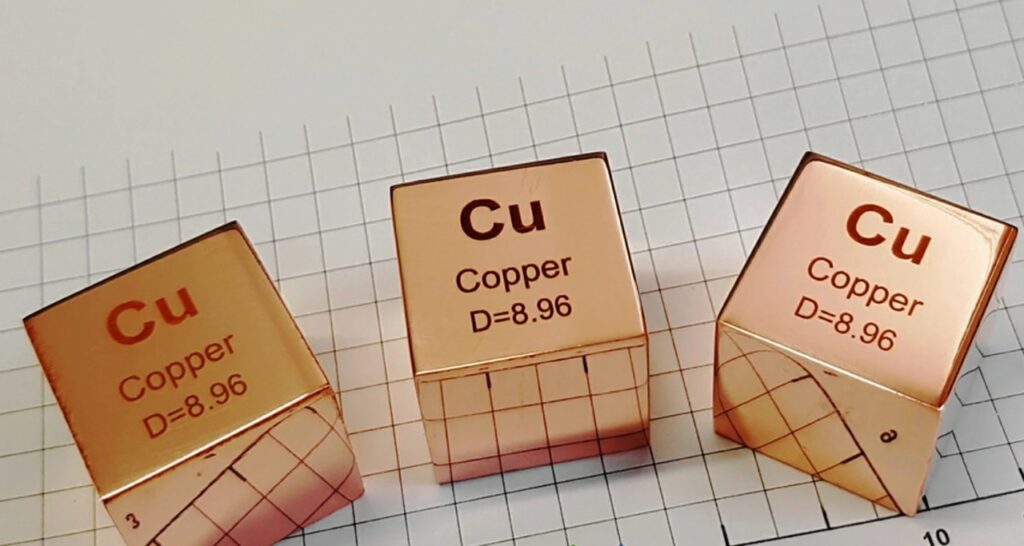
The scientific community agrees on 8.96 g/cm (grams per cubic centimeter) as the density of copper. At room temperature, it is a measure of the metal’s mass in relation to its volume.
Engineers use this number for very precise work. It is relevant to the creation of medical devices, automotive parts, and electrical components. The high density implies a closely packed atomic structure. Such a structure provides strength. It also makes the copper excellent in heat and electricity conduction.
Fabricators refer to this density number to assess the level of copper purity. Impurities in the atomic lattice cause the disruption. The disruption changes the mass. So, detailed density determinations are the means of confirming material quality prior to production.
The Science Behind the Numbers: Why is Copper Heavy?
In the periodic table, copper is the element that comes at position 29. The atomic weight of copper is 63.55 u. The metal forms a crystal lattice structure of face, centered cubic (FCC).
The FCC lattice is a very efficient packing arrangement. There is very little empty space between atoms in this arrangement. Because of this atomic efficiency, copper turns out to be a heavy metal. A small cube of copper will, therefore, surprise you with its weight.
This is due to the fact that billions of atomic nuclei are tightly packed in that small space. This feature is what makes copper different from lighter structural metals like aluminum or magnesium.
Critical Factors Influencing Density
The density of copper is not the same in all cases. Various external and internal factors cause changes in this value.
Purity Levels
The standard density of 8.96 g/cm is based on 100% pure copper. In reality, the copper used in the industry is rarely pure and contains minor impurities. Oxygen, free high, conductivity (OFHC) copper is the type of copper that has a density closest to the ideal one. On the other hand, oxygen content in electrolytic tough pitch (ETP) copper may cause a little fluctuation of density. In general, impurities reduce the density of a material. For example, if a producer puts lighter elements into a melting pot, the total mass per unit volume will go down. At the same time, extremely precise industries like that of aerospace require purity to be certified for the sake of accurate weigh in.
Alloying Elements
The most significant changes come from alloying. The question is: why would engineers use pure copper to make a structural part when it can be mixed with other metals to get stronger materials?
- Zinc: By adding zinc one gets brass. With a density of 7.14 g/cm, zinc is a relatively light metal. Thus, the resultant alloy, brass, is lighter than pure copper.
- Tin: Adding tin results in bronze. Tin’s density is roughly 7.31 g/cm. Hence, the overall density of bronze is also less than that of copper.
- Nickel: Being dense (8.90 g/cm), nickel makes a product like cupronickel have a weight very similar to that of pure copper.
Thermal Dynamics
The truth is temperature has a major hand in it too. When heated, a material’s atoms vibrate. These vibrations cause the atoms to move further apart. This phenomenon is thermal expansion.
- High Temperature: Copper continues to warm, its volume will keep on increasing. Therefore, density will go down since mass is still the same. The difference between the densities of copper in its molten and solid state is quite significant.
- Low Temperature: When cooling occurs, the material is said to contract. Its atoms are now even closer than before. Therefore, its density is increased, albeit only by a small amount.
Designers need to think about this when designing injection molds or casting tools. The material shrinks as it cools.
Density of Copper Alloys
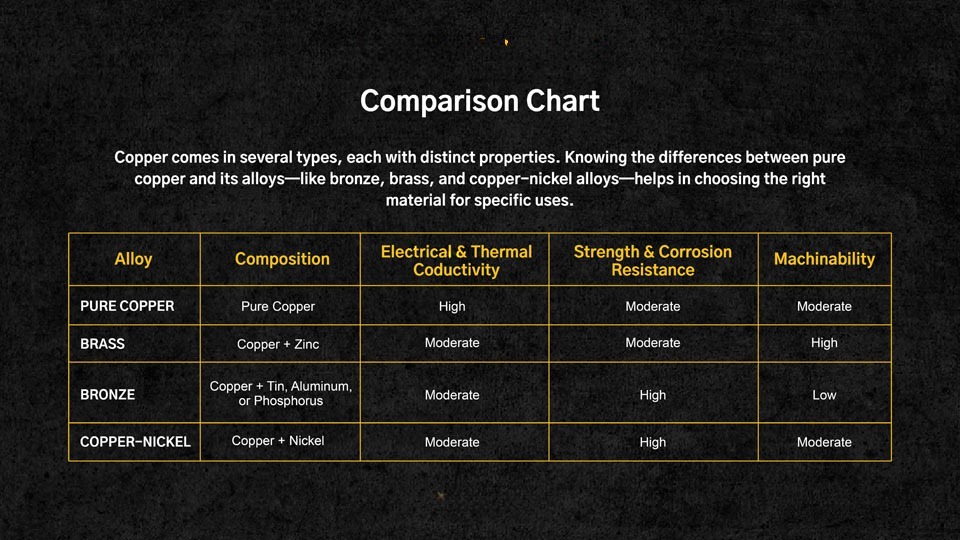
Fabricators select alloys based on the desired mechanical properties. Nevertheless, these decisions influence the overall weight of the product.
Brass (Copper, Zinc Alloy)
Brass is the most typical copper alloy. Its density generally lies between 8.4 and 8.73 g/cm. A zinc ratio determines the exact number. The high, zinc bras ses are lighter. Firms produce brass for plumbing fixtures, musical instruments, and cartridges. Besides, it has good machinability and corrosion resistance.
Bronze (Copper, Tin Alloy)
Bronze is a classic, strong alloy. Its density depends on the range 7.4 to 8.9 g/cm. The difference is wider here since bronze is an alloy of tin with other elements such as aluminum or phosphorus.
- Aluminum Bronze: lighter and more durable.
- Phosphor Bronze: heavier and fatigue, resistant.Bronze is the perfect material for bearings, bushings and marine hardware due to its high wear resistance and low friction compared to copper.
Cupronickel (Copper, Nickel Alloy)
Cupronickel has a density very similar to that of pure copper, approximately 8.94 g/cm. This alloy is almost completely resistant to seawater corrosion. Thus, shipbuilders employ it for hulls and piping. On the other hand, coin mints use it for currency. The close density between pure copper and cupronickel keeps the weight requirements the same even if these materials are interchanged to get corrosion benefits.
Comparison of Copper Alloy Densities
| Alloy Type | Common Grade | Main Composition | Density (g/cm³) | Typical Application |
|---|---|---|---|---|
| Pure Copper | C10100 (OFHC) | 99.99% Cu | 8.96 | Electronics, Busbars |
| Gilding Metal | C21000 | 95% Cu, 5% Zn | 8.86 | Coins, Bullet Jackets |
| Cartridge Brass | C26000 | 70% Cu, 30% Zn | 8.53 | Radiator Cores, Fasteners |
| Muntz Metal | C28000 | 60% Cu, 40% Zn | 8.39 | Architectural Panels |
| Phosphor Bronze | C51000 | Cu, Sn, P | 8.86 | Electrical Contacts, Springs |
| Aluminum Bronze | C95400 | Cu, Al, Fe | 7.53 | Heavy Duty Bearings |
Comparative Data: Copper vs. Industrial Metals
You must compare copper against other fabrication metals to make informed decisions. Weight is often a constraint in design.
| Metal | Density (g/cm³) | Comparison to Copper | Primary Advantage |
|---|---|---|---|
| Copper | 8.96 | Reference | Conductivity |
| Aluminum | 2.70 | ~30% of Copper | Lightweight |
| Zinc | 7.14 | ~80% of Copper | Die-casting ease |
| Steel (Carbon) | 7.85 | ~87% of Copper | Structural Strength |
| Stainless Steel | 8.00 | ~89% of Copper | Hygiene/Strength |
| Silver | 10.49 | ~117% of Copper | Max Conductivity |
| Lead | 11.34 | ~126% of Copper | Radiation Shielding |
| Gold | 19.32 | ~215% of Copper | Inertness/Value |
Analysis: Copper is heavier than steel and aluminum. If you replace an aluminum part with copper, the weight triples. This is critical for automotive and aerospace prototyping. However, copper is lighter than precious metals like gold or silver. Plating copper with gold adds significant weight.
Sheet Metal Weight Calculation
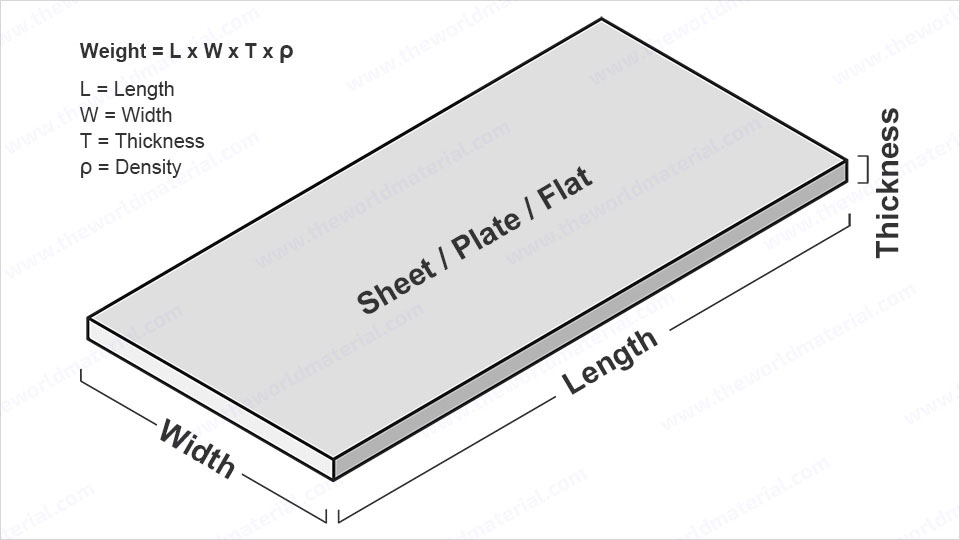
This section addresses practical fabrication needs.
In the sheet metal fabrication industry, we calculate weight before we cut a single piece of metal. This determines shipping costs and structural support requirements.
To calculate the weight of a copper sheet, use the density formula:
Weight=Length×Width×Thickness×Density
Example Calculation:
Imagine you need a copper busbar.
Length: 100 cm
Width: 10 cm
Thickness: 1 cm
Volume:
100×10×1=1000 cm3100×10×1=1000 cm3Weight:
1000 cm3×8.96 g/cm3=8960 grams1000 cm3×8.96 g/cm3=8960 grams(or 8.96 kg).
Fabricators use this math to estimate raw material costs. Copper is sold by the pound or kilogram. A slight miscalculation in density leads to significant budget errors in large production runs.
Practical Applications of Density in Prototyping
This section dives into the engineering ramifications of density.
Density is more than just a number on the scale. It is the property that ultimately determines how a prototype behaves in the real world.
1. Vibration Damping
Denser materials generally have a greater capacity to absorb vibration than lighter materials. Manufacturers deploy copper and heavy bronze alloys in their machining setups to lessen the occurrence of chatter. The added mass thus stabilizes the tool.
2. Moment of Inertia
In the case of rotational parts, mass distribution is a factor that matters. A copper flywheel, for instance, can store more kinetic energy than a steel one of the same size. It is the high density of copper that enables the creation of compact energy storage designs.
3. Quality Control through Density
Density is one of the properties that we leverage to locate the internal defects in the structure. In the case of a cast copper part, if it is found to be lighter than the theoretically calculated weight, it is most probably that the part contains porosity. The presence of air bubbles inside the part lowers its overall density. This, in turn, is the indication of a failed casting process.
Methodology: How to Measure Density
Step 1: Determine Mass Use a calibrated digital scale. Ensure the sample is clean. Oil, dirt, or oxidation adds weight without adding copper volume.
Step 2: Determine Volume
- For Geometric Shapes: Measure dimensions with calipers. Calculate volume (Length × Width × Height).
- For Irregular Shapes (Displacement Method): Fill a graduated cylinder with water. Record the initial level. Submerge the copper part completely. Record the new water level. The difference represents the volume of the copper.
Step 3: Calculate Divide the mass by the volume. The result is the density.
Density(ρ)=Volume(V)Mass(m)
If the result deviates significantly from 8.96 g/cm³, you likely have an alloy or a porous casting.
FAQs
What is the Density of Scrap Copper?
Scrap copper still holds the original density of 8. 96 g/cm. In most cases, scrap is packed in bales or is in a shredded form. The so, called “bulk density” is significantly less because of empty spaces between the pieces. Besides that, oxidation and insulated scrap also change the apparent density. Recycling plants have to melt the scrap to get the real material weight.
Does Density Correlate with Conductivity?
Yes, there is a close relationship. The pure and dense copper crystal structure is the most preferable for the flow of electrons. Impurities lower the density and separate the electrons’ path. Hence, higher density in copper normally means better electrical conductivity.
How Does Density Relate to Corrosion Resistance?
Density has influence on corrosion through an intermediate factor. A metal surface that is highly dense and non, porous will not allow water to get inside the metal. Any copper that is porous (has low density) will allow the agents to penetrate deep into the part. This will speed up the internal corrosion process.
Can I Distinguish Brass from Bronze by Density?
Yes, but the method is not straightforward. Brass (approx. 8. 5 g/cm) is in most cases lighter than Copper (8. 96 g/cm). The weight of the bronze can vary a lot but it is often heavier than the one of brass. Color is much quicker and easier to indicate: Brass is yellow; Bronze is reddish, brown. Density just reassures it.
What is the Difference Between Apparent and True Density in Copper Foam?
Copper foam is a porous material used for heat exchangers.
- True Density: The density of the solid copper struts (8.96 g/cm³).
- Apparent Density: The weight of the foam block divided by its total dimensions. This is very low (often 0.5 – 2.0 g/cm³) because it is mostly air.
Conclusion
Copper stands out as a unique material. Its density of 8.96 g/cm³ defines its character. It is heavy, robust, and reliable.
We have seen that this value is not absolute. Alloys like brass and bronze shift the scale. Temperature and purity also play their roles. For the sheet metal fabricator or the medical device prototyper, these numbers are vital. They determine the cost, the structural integrity, and the performance of the final product.
By understanding the density of copper, you gain control over your manufacturing process. You ensure that every kilogram of material serves its purpose efficiently.
Reference Links
ASTM International (ASTM B152)
- Target URL:
https://www.astm.org/b0152_b0152m-19.html - For standard specifications on copper sheet, strip, plate, and rolled bar.
- Target URL:
Copper Development Association (CDA)
- Target URL:
https://www.copper.org/resources/properties/ - For comprehensive data on copper properties and alloy standards.
- Target URL:
NIST (National Institute of Standards and Technology)
- Target URL:
https://www.nist.gov/pml/periodic-table-of-elements - For reference data on elemental physical properties.
- Target URL:
MatWeb (Material Property Data)
- Target URL:
https://www.matweb.com/search/MaterialGroupSearch.aspx?GroupID=230 - For a searchable database of specific material property data sheets.
- Target URL:
Comments
Latest Posts
Related Blogs
Senyo’s blog is focused on sharing our extensive knowledge of prototype manufacturing. Through our articles, we aim to support you in refining your product design and navigating the complexities of rapid prototyping more effectively.