Scientific Guide to Aluminium Bending Processes and Alloys
目次
結論
Aluminium bending is a significant example of precision manufacturing.
In essence, it is the process where the metal (aluminium) is plastically deformed around a single axis. The procedure changes the metal’s metal working by keeping the volume almost the same. People directly apply a mechanical force on the aluminium sheet. The force should be greater than the material’s yield strength but still lower than its ultimate tensile strength. This is what makes the metal bend permanently instead of breaking or going back to its original shape.
Designers and fabricators choose aluminium mainly because of its low weight and high strength characteristics. However, you need to have a thorough metallurgical knowledge if you want to make accurate bends. You must know how stress and strain affect the metal lattice of the crystal. The alloy composition, temper and thickness, along with other factors, determine the aluminium bending process’s outcome. This manual delves into the concepts of material science involved in the metalworking of aluminium sheets and profiles to create complex geometries.
The Physics of Formability in Aluminium
Formability is the capacity of a metal to go through a plastic deformation without a breakdown of its structure. In aluminium bending, the formability is mostly dependent on the particular alloy series. Aluminium is not the same in the way it behaves under the stress.
Pure aluminium has a face-centered cubic (FCC) crystal structure. It has many slip systems available for dislocations to move. So, pure aluminium deforms without much effort. However, alloying elements such as magnesium, silicon, or manganese distort the lattice. They increase the strength but most of the time ductility decreases.
Elongation and Tensile Limits
Elongation is the main parameter that indicates formability. It is the measure of the percentage a material can stretch before it breaks. The higher the elongation values the easier the bending operations become. Engineers must consider the difference between the yield point and the ultimate tensile strength. A bigger distance between these two points normally indicates a safer bending range. In case the elongation percentage is small, the material behaves like a brittle one. It will crack under the force of a tight radius.
Thickness and Bend Radius Ratios
The thickness of the material is the main factor that limits a bending operation. The Minimum Bend Radius (MBR) is dependent on thickness. When the plate becomes thicker, the outer fibers of the bend are stretched more. The inner fibers, on the other hand, are compressed. The neutral axis does not change. If the radius is too small for the thickness, the outer fibers will tear. You should find out the right radius in order to eliminate the risk of stress fractures. According to a standard rule, the radius should be equal to 1x thickness for soft alloys. Harder alloys may need 3x to 4x thickness.
Analyzing Aluminium Alloys for Bending
The feasibility of a project depends on whether the right chemical composition is picked. We differentiate aluminum alloys based on the elements that are primarily used for alloying. Each series differently responds to the aluminium bending process.
3003 Series: The Manganese Advantage
The 3003 alloy changes from the first is the manganese content. The addition of this element raised the strength by 20%. However, the alloy still maintains very good workability. Fabricators use heat for bending 3003 only in rare cases. 3003 has moderate strength and good resistance to corrosion. This property makes it suitable for the production of chemical equipment and the general 板金加工 industry. The alloy is not a heat treatable product. It is only strengthened by strain hardening.
5052 Series: Magnesium Reinforcement
The 5052 alloy is improved with the addition of magnesium. As a result, the element provides a number of substantial strength improvements over the 3003 series. The alloy offers the highest strength of the non-heat-treatable grades. It retains good formability despite its rigidity. The alloy is also resistant to salt-water corrosion. This attribute has made the material the standard for marine applications as well hydraulic tube fabrication. The material work-hardens very quickly. Thus, a very strict control of bend speeds is necessary.
6061 Series: Silicon and Magnesium Structural Blends
The 6061 alloy is a combination of magnesium and silicon. So, the alloy can be heat treated. During the hardening stage, it forms magnesium silicide precipitates. These precipitates are the very places in the crystal lattice where the dislocations cannot move, so the alloy becomes very strong. However, this strength is at the expense of formability. If you bend 6061 T6, you are likely to get a crack. Fabricators usually perform an annealing process to the ‘O’ temper before bending. Due to its structural integrity, it is widely used in the 自動車プロトタイピング industry.
Comparative Data: Alloy Characteristics
The following table compares the bending characteristics of common aluminium grades.
| Alloy Series | Primary Element | Workability | 耐力 | 耐食性 | 一般的なアプリケーション |
|---|---|---|---|---|---|
| 3003 | Manganese | 素晴らしい | 中程度 | 高い | Storage tanks, Roofing, Siding |
| 5052 | Magnesium | グッド | 高い | Excellent (Marine) | Chassis, Marine parts, Signage |
| 6061 | Mg + Silicon | Poor (at T6) | 非常に高い | グッド | Structural frames, Aerospace, Robotics |
| 7075 | Zinc | Very Poor | Extreme | フェア | Aerospace, High-stress gears |
Understanding The Temper Designation System
The temper of an alloy is what determines its mechanical state. The code that is used here is the one that comes after the alloy number. It is a way of telling the metal worker how the metal has been processed. A mishap with the temper can cause the 金属曲げ in extremely dangerous ways.
- O (Annealed): The metal is heated by the mill to a temperature where the grain structure can be recrystallized. This state has the lowest strength and the highest ductility of the metal. It is the best state for extreme bending.
- H (Strain Hardened): This term refers to non-heat-treatable alloys (examples are 3003 and 5052). The metal is made stronger by cold working. The number that comes after ‘H’ shows the extent of the hardness. H14 stands for half-hard; H18 is full-hard.
- T (Thermally Treated): This means the same for alloys such as 6061. The metal goes through solution heat treatment and aging processes.T6 is a frequently used, fully hardened temper. T4 is naturally aged and is a little more formable.
- F (As Fabricated): The metal bits that have neither had special thermal nor strain hardening control applied to them.
The Science of Springback and Elastic Recovery
Aluminium bending is accompanied by a critical phenomenon, that is, springback. After the machine is released from the bending force, the metal goes through a relaxation process. The elastic part of the stress-strain curve is recovered. The final angle is a little bit bigger than the tooling angle.
Aluminium has a higher springback than mild steel. The reason for this is that aluminium has a lower modulus of elasticity. The yield strength is quite high when compared to the elastic modulus. Fabricators are required to over-bend the material in order to take this recovery into account. Thus, the operator may bend the material to 92 degrees instead of 90 degrees in order to get the bend of 90 degrees. Advanced CNC machines determine this variable on their own.
They change the punch depth in order to be able to elastically recoil.
Strategies to Mitigate Cracking
Cracking is a result of the occurrence of tensile stress on the outer radius that goes beyond the cohesive strength of the material. Some scientific methods take into account this risk and try to reduce it to almost zero.
1. Grain Direction Orientation
Aluminium sheets have a grain structure resulting from the rolling process. Bending perpendicular to (across) the grain is stronger. It allows the grains to elongate. Bending parallel to the grain often leads to cracks. Fabricators should orient the part layout to bend across the grain whenever possible.
2. Radius Optimization
Do not use a sharp internal radius. A sharp corner concentrates stress. A larger radius distributes the strain over a wider area. Engineering drawings should specify a radius that respects the alloy’s limits.
3. Lubrication Application
Friction is the main cause of localized stress. Lubricants allow the material to slide over the die shoulders. This distributes the strain more evenly. It prevents “drag” which can tear the surface.
4. Thermal Assistance
Heating the workpiece lowers the yield strength temporarily. This increases ductility. It allows for tighter bends on rigid alloys like 6061-T6. But, too much heat can spoil the temper.
Detailed Bending Methodologies
The industry is full of different mechanical methods aiming to achieve certain geometrical shapes. The decision rests on the cross-section, radius, and the volume of the production.
Press Brake Forming
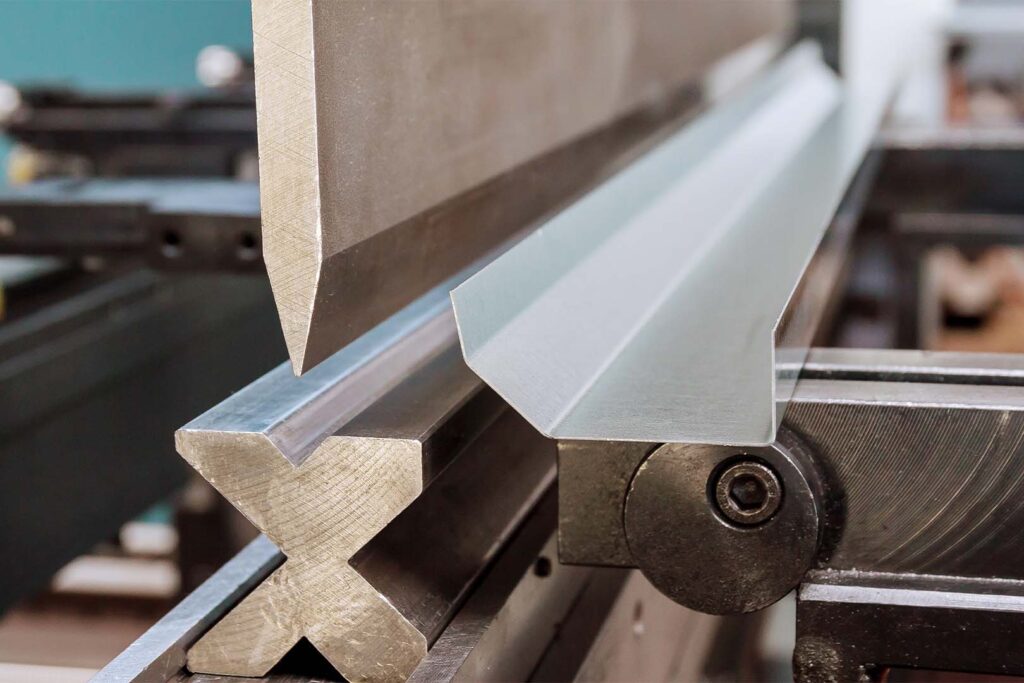
The press brake still employs the most common method of sheet metal fabrication. The process involves a punch and a die.
The Mechanics: The punch, driven by either a hydraulic or an electric ram, is inserted into the V-shaped die. The aluminium sheet is positioned in the opening of the die. The punch pushes the sheet into the die.
Process Variants:
- Air Bending: The punch presses the sheet, but the bottom is not reached. The bend angle is not determined by the die angle. The depth of the stroke is the factor that controls the angle. This enables the springback to be compensated for. A lesser tonnage is needed.
- Bottoming: The punch forces the sheet to follow the shape of the die exactly. This requires more force but offers high precision.
- Coining: The punch goes through the neutral axis of the metal. This totally gets rid of the return of the bend but it requires a very high tonnage.
Advantages and Limitations: Press brakes are extremely versatile. CNC controls make it possible to have complex, multi-stage bends. They are perfect for brackets and enclosures. Nevertheless, the cost of the tooling can be quite high. The setup time for different geometries also changes cycle times.
Roll Bending Techniques
Roll bending is used to produce large radius curves and cylinders. The process involves three or four rollers.
- The Mechanics: The operator places the aluminium profile or sheet between the rollers which are turning. The top roller exerts pressure downwards. The side rollers hold the material. As the material is fed, the offset between the rollers causes a continuous curve. This is a typical method in 工業用プロトタイピング for tanks and tunnels.
Advantages and Limitations: With this technique, one can obtain perfect circles and spirals. Long profiles can be dealt with efficiently. On the other hand, it leaves some straight pieces at the beginning and the end of the profile. These “flat spots” are often leftover pieces that need to be cut off. Also, it is not good for very tight corners.
Rotary Draw Bending
This technique is the most common when it comes to bending tubes and pipes. The material is supported from the inside to avoid collapsing.
- The Mechanics: The aluminium tube is secured to a bend die by the machine. A pressure die holds the tube against the bend die. The bend die turns, pulling the tube along with it. Usually, a mandrel is placed inside the tube.
- The Mandrel’s Purpose: The mandrel is the support for the tube’s inner walls. It stops the formation of wrinkles at the inside radius. Besides that, it also prevents the flattening of the outer radius.
Advantages and Limitations: Rotary draw bending is capable of producing clean and tight-radius bends. The method can be used for 医療機器プロトタイピング where tube precision is extremely important. The appearance of the tube is maintained. Unfortunately, the tooling is costly and dependent on the tube diameter.
Compression Bending
Compression bending holds the work-piece tightly against a fixed bend die.
- The Mechanics: A wiper shoe or roller moves around the fixed die. It presses the aluminium against the die shape.
メリット This is a simpler method compared with the rotary draw one. Certain applications can be done faster with this method. Symmetrical bends on both sides of a part can be done perfectly with this method.
Limitations: The ability to make tight bends is limited as compared to rotary draw. The outside of the bend can be flattened. Mostly it is used for simple structural shapes.
Stretch Forming
Stretch forming is a combination of tension and bending.
- The Mechanics: The machine holds the aluminium sheet or extrusion at both ends. It pulls the material to the point where it yields. Then the machine, still holding the material under tension, wraps it around a form block.
メリット By stretching the material, the problem of springback is solved. Also, the tension helps to align the internal stresses. Very accurate and complex curves can be made in this way. It is a standard method in the aerospace industry for fuselage skins.
Limitations: The process is quite slow. Large gripping allowances are needed which become scrap. The equipment is very large and costly.
Ram / Push Bending
Ram bending is basically the simplest kind of tube bending.
- The Mechanics: The tube is supported by two counter-rollers and lies across them. A hydraulic ram with a radius block is used to push down on the center of the tube.
メリット The equipment is cheap and easily movable. Ram bending is quite fast if it is for rough bending purposes.
Limitations: An internal support is not provided. The tube is reshaped in oval form. The exact control of the bend angle is quite difficult. The quality of cosmetic parts cannot be good if this method is used.
Industrial Applications and Sectors
Aluminium bending has been the major lead of the various Industries and these have been driven by the properties of the material.
Automotive Sector: Car-makers incorporate bent aluminium in the production of the frame and the outer surface of the car. It works to lessen the weight of the vehicle. Thus, a better fuel consumption is achieved. Bending helps in the fabrication of impact structures which can absorb energy.
Aerospace Engineering: Aircraft ribs, stringers, and skin are the most common parts which are produced by stretch forming and bending. The strength-to-weight ratio of 2024 and 7075 alloys is of the utmost importance. The precision is to the point of ensuring aerodynamic efficiency.
Consumer Electronics and Robotics: The use of bent aluminium is quite trendy for the production of the gadgets’ (laptops and phones) outer coverings. Robot prototyping gets bent plate materials for arms and chassis. The metal is a perfect thermal conductor and thus the best component is protected from overheating.
Construction and Architecture: Bent profiles are commonly utilized for the production of window frames, curtain walls, and roofing systems. Aluminium is a very good weather-resisting material. By bending one can make curved architectural features that are visually appealing.
結論
Aluminium bending to a master level calls for the understanding of both material science and mechanical engineering principles. Manufacturers need to be aware of the boundaries of the metal. They also need to figure out the bend allowance and K-factors very precisely. They have to choose the right tempering if they want to avoid cracking. No matter if it is a press brake for 消費者製品プロトタイピング or rotary draw bending for hydraulics, the result must be accurate.
The right use of force changes a simple flat sheet into a functional, load-bearing component. By knowing the grain structure, elongation limits, and springback, engineers can always achieve the same results.