The Reasons For The Presence Of CNC Machining Tool Marks

目次

We often encounter the phenomenon of cnc machining tool marks when using machining centers to process products. What are the reasons for this? The following is a summary of common causes and solutions for tool marks in CNC machining, combined with analysis of multiple factors such as machine tools, cutting tools, and materials:

What is CNC Machining Tool Marks?

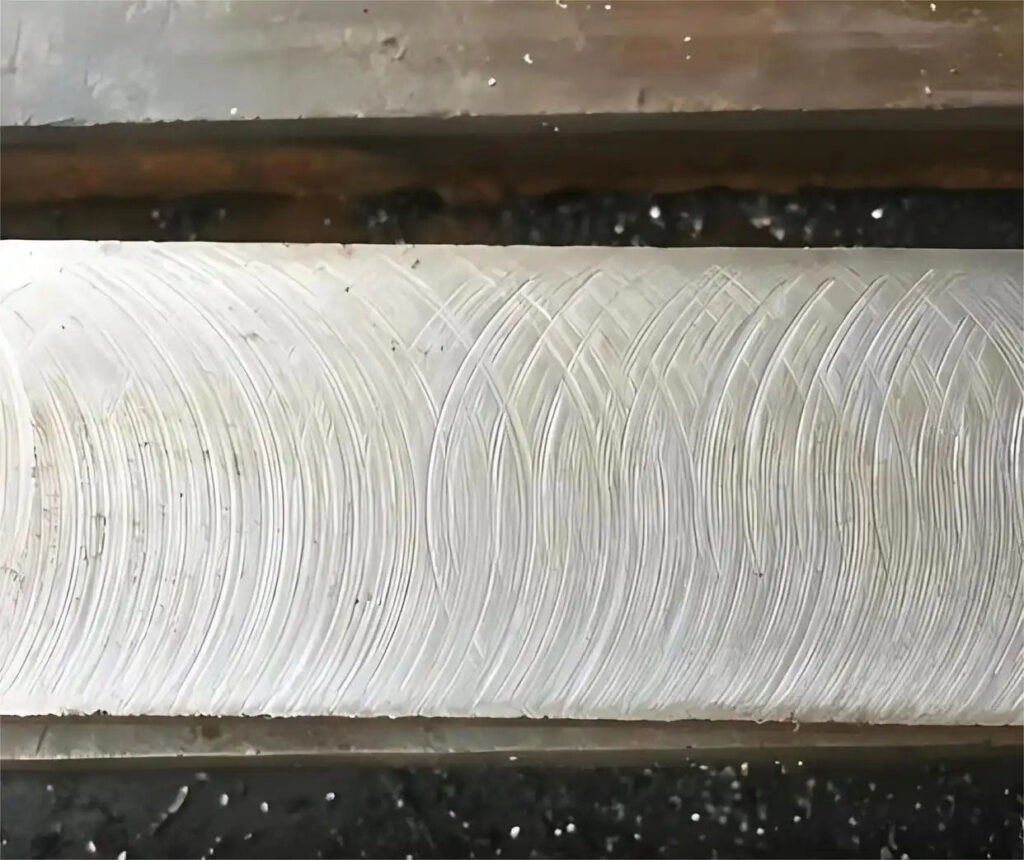
CNC machining tool marks refer to the texture on the cutting surface of the tool generated during the machining process. According to the cutting direction, tool shape, and tool material, tool patterns can be divided into longitudinal, transverse, oblique, curved, and intersecting patterns.

Tool Related Factors For CNC Machining Tool Marks

1. Tool wear
Passivation or chipping of the cutting edge can lead to an increase in cutting force, causing the surface of the workpiece to be squeezed and forming spiral or wavy cutting patterns. ·
解決策 Regularly check the wear of cutting tools and replace passivated tools in a timely manner; Choose wear-resistant coated tools (such as TiAlN coating) to improve their lifespan.


2. Improper geometric parameters of cutting tools
A front angle that is too small (15 °) can intensify cutting friction and cause surface scratches. ·
Optimization suggestion: Adjust the geometric parameters according to the material (such as the recommended front angle of 15 ° -25 ° and rear angle of 8 ° -12 ° for aluminum processing).


3. Tool installation issues
Tool eccentricity or inclination can change the actual cutting angle, for example, if the installation height of the cutting tool deviates from the center of the workpiece by 0.1mm, it can cause spiral patterns. ·
Control measures: Use a tool presetter to calibrate the tool coaxiality (error ≤ 0.005mm).

Cutting Parameters And Process Issues For CNC Machining Tool Marks

1. The feed rate does not match the rotational speed
Excessive feed rate (such as>0.15mm/tooth when milling aluminum parts) will form obvious tooth marks; Excessive rotation speed (such as aluminum parts>8000rpm) can easily cause vibration knife marks. ·
Optimization formula: Recommended line speed for aluminum parts is 200-300m/min, with a feed rate of 0.05-0.1mm/tooth.

2. Unreasonable cutting depth
Rough machining with a cutting depth exceeding 50% of the tool diameter will significantly increase cutting force and cause tool vibration. ·
Layered strategy: using small cutting depth and multiple cutting times (such as 0.2mm/layer) combined with high-speed milling.

Machine Tool and Clamping Issues For CNC Machining Tool Marks

1. Influence of material properties
Resilient materials (such as copper alloys) are prone to the formation of chip deposits, leading to surface tearing like knife marks; Uneven hardness materials (such as castings) have large fluctuations in cutting force.
Response measures: When processing copper parts, add extreme pressure cutting fluid to reduce cutting speed by 10% -20%.


2. Insufficient cooling and lubrication
Low cutting fluid concentration (<5%) or insufficient flow rate (<10L/min) will intensify friction and form high-temperature oxidation grooves. ·
Parameter suggestion: For aluminum alloy processing, it is recommended to use emulsion with a concentration of 8% -12% and a pressure of ≥ 1MPa.

Materials and Cooling Factors For CNC Machining Tool Marks

1. Machine tool vibration
Radial runout of the spindle (>0.01mm) or wear of the guide rail can cause periodic ripples. ·
Testing method: Use a micrometer to check the spindle runout. If it exceeds 0.005mm, the bearing needs to be repaired.

2. Unstable workpiece clamping
Uneven clamping force of thin-walled parts (such as a pressure difference of more than 10N between three jaw chucks) can cause deformation, and stress release after processing can result in tool lines. ·
Improvement plan: Adopt hydraulic fixtures or soft claws for uniform clamping, with clamping force controlled at 20% -30% of the material yield strength.

Comprehensive Optimization Suggestions For CNC Machining Tool Marks

1. Process parameter adjustment:

Adopting high-speed (increasing line speed by 20%) and small feed (reducing by 30%) strategies to reduce cutting force fluctuations.


2. Equipment maintenance:

Check the clearance between the spindle bearings every 500 hours, and control the straightness error of the guide rail within 0.01mm/m.


3. Tool optimization:

When machining steel parts with hard alloy tools, increasing the rake angle by 5 ° can reduce cutting force by 15% -20%.


Typical case: A 0.1mm spacing ripple appeared on the machined surface of an aluminum component, which was detected to be caused by tool eccentricity of 0.08mm. After adjusting the installation coaxiality, the surface roughness improved from Ra3.2 μ m to Ra0.8 μ m.

結論

The above are some reasons for the occurrence of tool lines during the machining process of machining centers. The specific reasons need to be systematically investigated through factors such as cutting tools, parameters, equipment, materials, etc., in order to eliminate the problem of tool lines in a targeted manner. Specific measures need to be verified through processing scenario experiments.

コメント

最新の投稿

今すぐお問い合わせを送信
Drag & Drop Files, Choose Files to Upload

Talk to us

Didn’t find what you want? Contact us and we will be in touch shortly.